
Skyvern blog
Suchintan Singh
272 posts by Suchintan Singh.
Stories and ideas from the Skyvern team.
July
 17 min read
RPA vs AI Agents: Comparing Methods and Choosing Right (July 2026)
The days of treating RPA and AI agents as two versions of the same thing are catching up with teams managing real production workflows. One replays a recorded sequence and breaks when the page changes. The other reads the current state of the page and reasons through whatever it finds. The comparison below maps out where each approach holds up, where it breaks, and how to match your actual workflow conditions to the right tool. TLDR: * RPA automates a fixed path and breaks silently when porta
Agentic Process Automation & RPA 17 min read
APA Control Plane for Agentic Automation (July 2026)
If you're running agentic process automation across more than a handful of portals, the wall where individual agents fall short is familiar. State doesn't persist across session timeouts. Exceptions have nowhere to go. There's no audit trail when something goes wrong. APA control plane agentic process automation is the infrastructure layer that solves those problems, and understanding how it works changes how you think about building automation that actually holds up in production. Skyvern is an
Agentic Process Automation & RPA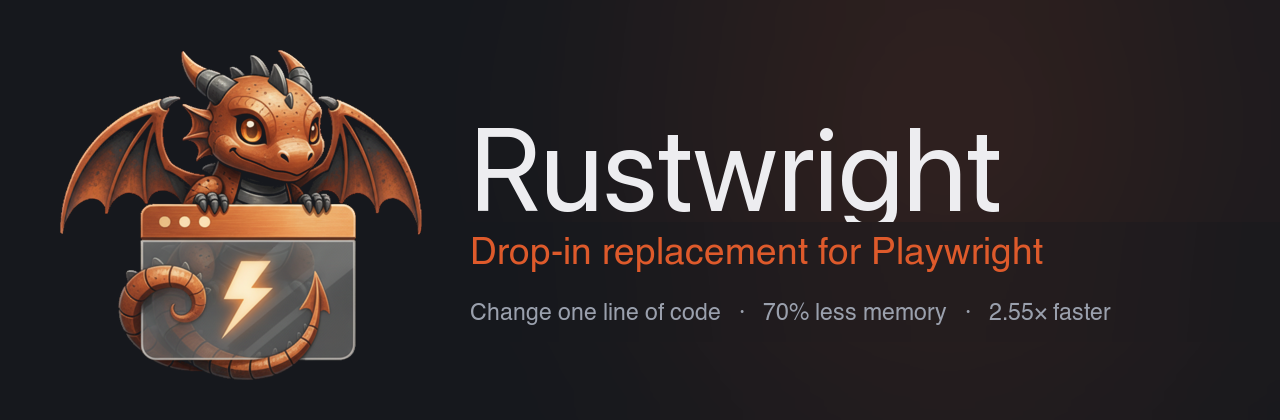 2 min read
Rustwright: Playwright rewritten in rust that occupies 70% less memory (and is 2.55x faster)
Hey everyone, Suchintan from Skyvern (YC S23). We run browser automation for AI agents at scale, and we're launching Rustwright: Playwright on an in-process Rust CDP engine. The engine consumes 70% less memory than Playwright, and is 2.55x faster to boot. We built this to improve Skyvern’s memory footprint, and thought this would be independently valuable to the broader community The whole idea fits in two lines: playwright-python: your code ──pipe──► Node driver ──CDP──► Chromium rustwrig
Engineering & Research 19 min read
Building the Agentic Process Automation Stack in 2026 (July 2026)
Long gone are the days when you could record a login path once and trust it to run clean six months later. Portal layouts change, 2FA prompts rotate, session flows shift, and the script that worked last Tuesday silently delivers nothing this Tuesday. The agentic process automation stack is the architectural response to that compounding maintenance problem, and it's made up of four distinct layers that each carry a different set of responsibilities. Getting clear on what those layers are, and wh
Agentic Process Automation & RPA 18 min read
The Case for Agentic Process Automation in 2026
The portals your team depends on most, insurance payer systems, carrier quote platforms, government permit applications, were built for people, not for automation scripts. Every time one of them changes, someone pays for it in maintenance hours or broken workflows. Agentic process automation takes a different architectural approach entirely, and the business case for making that switch is clearest when you look at where traditional automation keeps failing the same way for the same reason. This
Agentic Process Automation & RPA 21 min read
Five-Layer Framework for Agentic Process Automation (July 2026)
Your automation breaks at the same places every time: the login flow changes, a form gets restructured, a modal fires mid-session, the output lands in the wrong schema. Those aren't random failures. They map to specific layers in how any Agentic Process Automation (APA) system is built, and each one has its own failure mode, its own fix, and its own architectural requirements. Walk through all five and you'll have a cleaner way to diagnose what's actually going wrong. TLDR: * Agentic Process
Agentic Process Automation & RPA 19 min read
APA Maturity Model: Stages, Metrics & Strategy (July 2026)
If your automation program has grown past a handful of scripts, you already know the gap between 'we have automation' and 'our automation scales.' Bots break when portals change, governance is an afterthought, and new workflows take longer to ship than they should. The scripts, though, are not usually the problem. The architecture is. An Agentic Process Automation (APA) maturity model gives you a way to diagnose what is actually blocking you. It maps where your program sits across five dimensio
Agentic Process Automation & RPA 13 min read
What Is APA Automation? Complete Guide Updated for 2026
The workflows that cost teams the most time are almost never the complex ones. They're the repetitive, portal-based tasks that have no API, that someone has to log into manually, and that break every script you build around them. Agentic Process Automation (APA) was built for exactly this gap. If you're trying to figure out what it is, how it actually works under the hood, and whether it's the right fit for your team, this guide covers all of it. TLDR: * APA agents read the live page state at
Agentic Process Automation & RPA 15 min read
UiPath vs Skyvern: Full Comparison (July 2026)
Every RPA comparison of Skyvern vs UiPath tends to stack feature against feature, but the more useful question is what breaks first when a vendor updates their portal without warning. If your workflows run on stable internal systems like SAP or Oracle, that question barely matters. If they run on credential-guarded portals that change on someone else's schedule, it's the only question that matters. Here's how each tool handles the answer. That answer sits at the heart of what separates tradition
Comparisons 5 min read
Skyvern Changelog — June 2026
Everything we shipped in June 2026 — weeks of June 1, 8, 15, and 22. Workflows Are Now Agents We renamed Workflows to Agents across the product, the public API, and the docs. The API now lives under /agents (e.g. POST /v1/run/agents) and accepts an agent_id alias for workflow_id — same wpid_ value, echoed back in responses. It's fully backwards-compatible: your existing workflow_id inputs, /workflows endpoints, SDK methods, and bookmarked doc URLs all keep working. Workflow Studio (Beta) M
Changelog
June
 13 min read
Browser MCP in 2026: What It Is, How It Functions, and the Best Servers Available
Most browser automation scripts fail the moment a site changes its layout. A button moves, a class name updates, and your carefully crafted Selenium script stops working. Skyvern solves this by giving AI agents live browser access instead of hardcoded selectors. The agent sees what's actually on the screen, decides what to do next, and adapts when things change. That's the difference between brittle scripts that need constant maintenance and automation that keeps working. This guide covers what
Browser Automation 13 min read
Sola vs Skyvern: Which is Better for Browser Automation? (June 2026)
You're comparing Sola vs Skyvern because you need to automate workflows that live on portals with no API, and you're tired of scripts that break every time a vendor updates their layout. The pitch for both tools sounds similar: automate browser work without writing code. But the execution models are miles apart. Sola pauses for human input when it hits something new. Skyvern reads the page visually and works through changes autonomously. This Skyvern vs Sola breakdown covers the browser automati
Comparisons 7 min read
How We Cut Token Count by 11% and Boosted Success Rate by 3.9% Using HTML Instead of JSON in LLM Calls (Updated June 2026)
Every time Skyvern takes an action on a web page, it sends an annotated screenshot plus a structured description of every interactable element to a multimodal LLM: buttons, inputs, dropdowns, the works. That description is where a lot of tokens go. We'd been representing those elements as JSON, which is readable and explicit, but also verbose. After hearing from others in the space that HTML and markdown representations could cut token counts by 15% or more, we decided to test it ourselves. The
Engineering & Research 12 min read
Kernel vs Skyvern: Which is Better for Browser Automation? (June 2026)
You've got a workflow that runs on a portal with no API, requires credentials that rotate, and breaks automation scripts every time the vendor updates their layout. Kernel provisions clean, fast browser sessions in 300 milliseconds and ships anti-detection configuration out of the box, but you still write and maintain the automation logic yourself. Skyvern reads the live page state visually, identifies interactive elements by appearance and context, and keeps going when portals change instead of
Comparisons 12 min read
Browse AI vs Skyvern: Which is Better? (June 2026)
Every browser automation comparison eventually comes down to one question: does your workflow require more than pulling data off a page? The Skyvern vs Browse AI decision breaks along that line. Browse AI records your interactions once and replays them as long as the page layout stays consistent. Skyvern reads the live page state at runtime, which means it keeps working when portals change and can work through authentication flows that would stall a scraper. We'll cover where each tool fits, wha
Comparisons 15 min read
Axiom vs Skyvern: Which Browser Automation Tool is Better? (June 2026)
Choosing between Axiom and Skyvern for browser automation means choosing between two fundamentally different approaches to handling the fact that websites change. Axiom records a workflow once and replays it using selectors tied to the page structure at that exact moment, which works until the site updates and breaks the script. Skyvern reads the page visually every time it executes, identifying buttons and fields by what they look like and what they do instead of by a stored XPath, so redesigns
Comparisons 12 min read
Stagehand vs Skyvern: Which is Better? (June 2026)
You automate a workflow once, and three weeks later the portal moves a button and your script breaks. That's the maintenance cycle everyone who's tried browser automation has lived through. Stagehand tries to soften that cycle by letting you mix stable selectors with AI-powered fallback instructions. Skyvern avoids it by reading pages visually at runtime, so layout changes don't require code updates. This Stagehand vs Skyvern breakdown covers how each handles the self-healing problem, what the i
Comparisons 11 min read
Director vs Skyvern: Which Browser Automation Tool is Better? (June 2026)
You've narrowed it down to Director vs Skyvern for browser automation, and now you need to know which one survives contact with real workflows. Director turns plain-language prompts into executable scripts anchored to selectors, so every time a portal renames a button or restructures a form, someone has to fix it manually. Skyvern uses computer vision to read pages visually at runtime, identifying interactive elements by appearance and context instead of DOM paths. That means when a layout shift
Comparisons 11 min read
Anchorbrowser vs Skyvern: Which Browser Automation Tool is Better? (June 2026)
Anchorbrowser gives you cloud browser infrastructure you script against. Skyvern reads pages visually and acts on goals you describe in sentences. The difference shows up immediately when sites change: in the anchorbrowser vs skyvern scenario, one requires you to fix broken selectors manually while the other re-parses the page and keeps going. Teams running this browser automation comparison tend to split along a clear line: engineers who want full programmatic control over every session detail
Comparisons 12 min read
Steel vs Skyvern: Which is Better? (June 2026)
Steel and Skyvern both solve browser automation problems, but they sit in completely different parts of the stack. Steel is infrastructure: it manages Chrome sessions and gives you an API to script against, but the automation logic stays your responsibility. Skyvern is end-to-end execution: you give it a goal, and it reads the page visually, identifies what to interact with, and works through the workflow on its own. This Steel vs Skyvern breakdown covers how each tool handles authentication, wh
Comparisons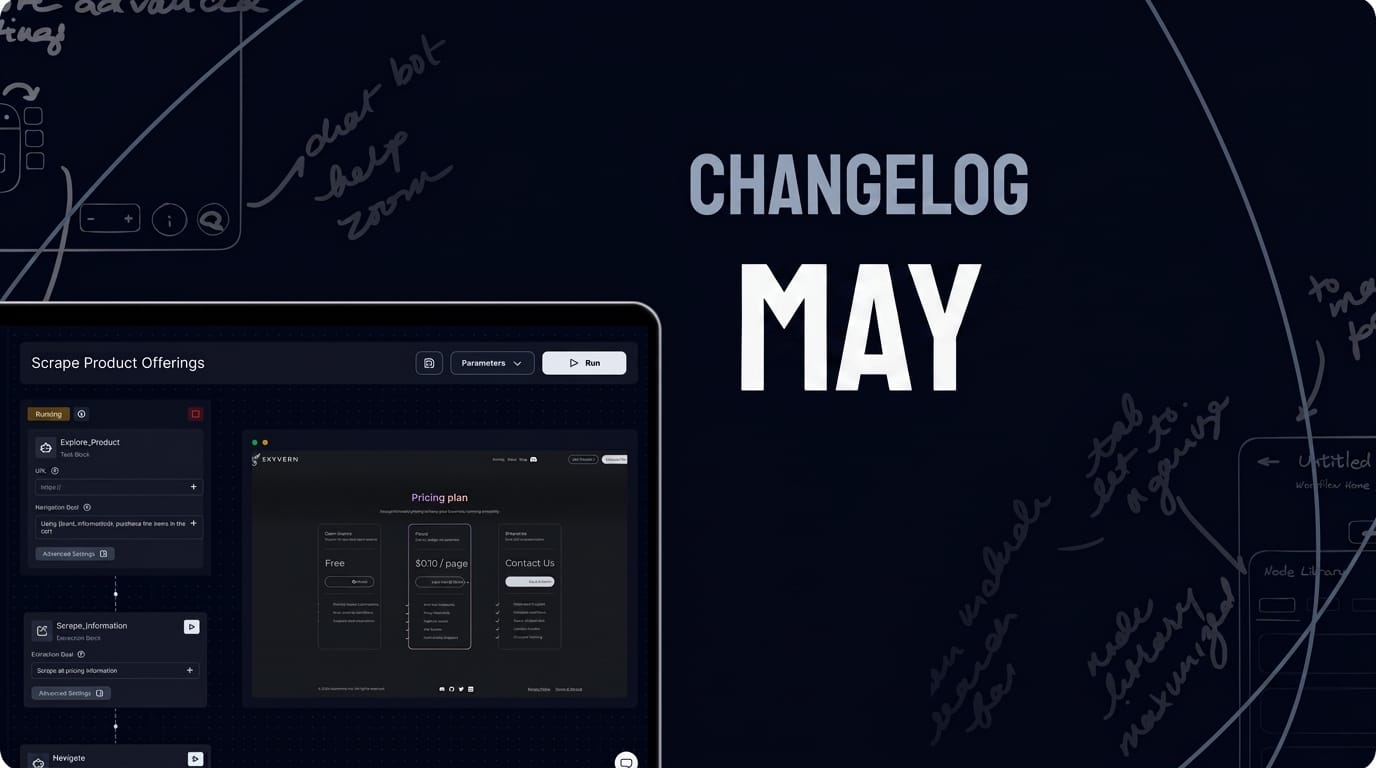 7 min read
Skyvern Changelog — April & May 2026
Two months of shipping in one email — a draggable editor, cleaner MCP OAuth, stronger run controls, and plenty more. Headliners first, the full list at the end. April 2026 Workflow Copilot v2 The workflow copilot got a lot more hands-on. Hard-cancel a run mid-flight instead of waiting it out, and follow it live as it streams status narration and surfaces block-level events (starts, completions, errors) while your workflow runs. When a test trips, it hands back the work-in-progress workflow
Changelog
May
 10 min read
Automation Anywhere vs Skyvern: Which is Better? (May 2026)
The Skyvern vs Automation Anywhere decision turns on one structural difference. Automation Anywhere builds workflows around pre-mapped selectors, so every portal redesign means someone on your team reopens the bot, finds the broken element, and redeploys. Skyvern reads pages visually at runtime, identifying buttons and fields by appearance instead of DOM position. This RPA comparison comes down to a simple question: do you want automation that needs constant fixing, or automation that adapts whe
Comparisons 11 min read
Skyvern MCP vs Hyperbrowser AI: Complete Comparison for May 2026
The Skyvern MCP vs Hyperbrowser AI question comes down to whether you need a faster way to run the automation you've already written, or a way to stop writing it in the first place. Hyperbrowser solves the infrastructure side: managed browsers, stealth capabilities, session orchestration, all accessible through an API your scripts can call. Skyvern MCP solves the logic side: it reads pages visually at runtime, figures out what to click, and keeps working when the site changes its layout. Both to
Comparisons 9 min read
Skyvern MCP vs Browser-Tools-MCP: Which One Wins for Automation in May 2026?
Your AI coding assistant needs browser access, so the choice comes down to skyvern mcp or browser-tools-mcp. One tool hands your assistant debugging data from an active Chrome session. The other hands it a worker that can log into portals, fill multi-page forms, and keep running when the site renames a button. The architecture you choose depends on whether you want to observe the browser or direct it to act. TLDR: * Browser-Tools-MCP gives your AI assistant read-only access to console logs, n
Comparisons 11 min read
Skyvern MCP vs Selenium: Head-to-Head Comparison (May 2026)
The debate around Skyvern MCP vs Selenium comes up constantly, and the answer depends on what kind of maintenance burden you can stomach. If your site never changes and your selectors stay put, Selenium still works. But cross-portal workflows, frequent UI updates, and third-party sites that redesign monthly all tilt toward Skyvern MCP, because it reads pages visually and keeps running through the change. TLDR: * Selenium uses DOM selectors that break when sites change; Skyvern MCP reads pages
Comparisons