Automation Anywhere vs Skyvern: Which is Better? (May 2026)
 Suchintan Singh10 min read
The Skyvern vs Automation Anywhere decision turns on one structural difference. Automation Anywhere builds workflows around pre-mapped selectors, so every portal redesign means someone on your team reopens the bot, finds the broken element, and redeploys. Skyvern reads pages visually at runtime, identifying buttons and fields by appearance instead of DOM position. This RPA comparison comes down to a simple question: do you want automation that needs constant fixing, or automation that adapts when sites change?
TLDR:
- Automation Anywhere uses selector-based bots built for stable internal systems, but breaks when external portals change UI or rename fields.
- Skyvern reads pages visually at runtime using computer vision and LLM reasoning, so workflows survive site redesigns without manual fixes.
- Maintenance cost separates the two: selector bots need constant upkeep when sites change, while visual automation adapts automatically.
- Automation Anywhere fits large enterprises with RPA centers and controlled internal apps; Skyvern fits teams automating external portals that change often.
- Skyvern runs workflows across dozens of sites without per-site customization and connects via Python SDK or MCP server in hours.
What is Automation Anywhere?
Automation Anywhere is one of the older names in the RPA space, founded in 2003 and built around the idea of automating repetitive business processes through recorded workflows, rule-based bots, and structured task execution.
The product has grown considerably over the years, adding a cloud-native architecture, an AI layer called AARI, and a marketplace of pre-built bot templates. It targets large enterprises with complex, high-volume back-office operations. Think finance, HR, procurement, and compliance workflows that run across legacy software and internal systems.
Where Automation Anywhere tends to work well is in structured, predictable environments. If your process follows the same steps every time and the underlying systems stay stable, its rule-based bots can handle the load reliably.
The harder problem is dynamic web environments. Automation Anywhere was built for desktop and internal application automation first. When workflows depend on third-party websites, carrier portals, or pages that change without notice, teams often find themselves spending more time maintaining bots than running them. Large enterprises typically run a mix of legacy systems and modern portals which is exactly the kind of environment where selector-based bots accumulate technical debt fast.
What is Skyvern?
Skyvern takes a different approach to browser automation. Built around computer vision and LLM reasoning, the agent reads pages visually at runtime, identifying buttons, fields, and modals by appearance and context instead of relying on pre-written selectors or XPath rules.
Self-healing follows directly from that architecture. When a portal redesigns its layout, renames a field, or shuffles its navigation, Skyvern re-reads the page and keeps working. There is no selector to break, and no developer to call at 2am to patch a script.
A single workflow also runs across dozens of different websites without per-site customization. A workflow built for one insurance carrier portal works for others unmodified, and the same holds across government tax portals, court filing systems, and wholesaler sites.
Key Features
- Visual page reading at runtime lets the agent identify interactive elements by appearance and context, so layout changes do not require workflow updates.
- Self-healing execution keeps workflows running through portal redesigns, field renames, and navigation shuffles without manual intervention.
- Cross-site generalization lets a single workflow work across multiple sites in the same category, unmodified, covering insurance carriers, government portals, and wholesaler sites alike.
- LLM reasoning handles branching logic and conditional steps that rigid rule-based tools cannot process without custom scripting.
- Skyvern exposes a Python SDK and an MCP server integration, giving engineering teams a way to call browser automation directly from agent workflows or existing code.
Limitations
- Teams coming from traditional RPA may face a learning curve adjusting to prompt-based workflow definition instead of recorded click paths.
- At high task volume, per-task inference costs can add up, so cost-at-scale planning matters more here than with fixed-license RPA.
- The ecosystem of pre-built connectors is newer than Automation Anywhere's, so some enterprise integrations will require custom setup.
- Edge cases involving highly dynamic or unusual UI patterns can still require human review before Skyvern proceeds confidently.
- Teams with simple, stable, single-site automation needs may find the AI-driven approach goes beyond what their use case requires.
Deployment and Setup
Automation Anywhere follows a traditional enterprise deployment model. Getting started typically involves procurement conversations, IT security reviews, license negotiations, and a professional services engagement before your first workflow runs. For large organizations accustomed to deploying software like SAP or Salesforce, this mirrors the same multi-stakeholder rollout process, though it still adds weeks or months before your first workflow runs.
Skyvern takes a different approach. Because it runs entirely in the cloud and reads pages visually at runtime, there is no infrastructure to provision and no selectors to configure before you can begin. Teams can connect Skyvern to an existing workflow via the Python SDK or API in hours, not quarters.
There are three ways to get started with Skyvern:
- The cloud-hosted version requires no setup beyond creating an account and passing in your first task via API or the Skyvern UI, making it accessible to teams without dedicated DevOps resources.
- The self-hosted version gives engineering teams full control over data residency and execution environment, which matters in compliance-sensitive industries where data cannot leave a private cloud.
- The Skyvern MCP server lets developers call browser automation directly from an AI agent, making Skyvern composable with LLM-based pipelines without writing custom orchestration logic.
Automation Anywhere's setup complexity, though, reflects its scope. It is built for large-scale enterprise environments with dedicated RPA centers of excellence, and that audience expects a managed onboarding process. Teams without that infrastructure may find the ramp steeper than the workflow complexity actually warrants.
Code Example: Automating a Carrier Portal with Skyvern
Once you have an API key from app.skyvern.com, connecting Skyvern to a carrier portal workflow takes a few lines of Python. The example below logs into a carrier portal, pulls the latest certificate of insurance, and posts the result to a webhook when the task finishes.
import asyncio
from skyvern import Skyvern

# Initialize with your API key
skyvern = Skyvern(api_key="YOUR_API_KEY")

async def pull_certificate_of_insurance():
    task = await skyvern.run_task(
        # Starting URL for the carrier portal
        url="https://carrier-portal.example.com/login",

        # Natural language goal — no selectors or XPath needed
        prompt=(
            "Log in to the carrier portal and download the most recent "
            "certificate of insurance. COMPLETE when the file has been downloaded."
        ),

        # Pass a stored TOTP identifier if the portal requires 2FA
        totp_identifier="carrier-portal-mfa@yourcompany.com",

        # Extract structured data alongside the file download
        data_extraction_schema={
            "type": "object",
            "properties": {
                "policy_number":  {"type": "string"},
                "effective_date": {"type": "string"},
                "expiration_date": {"type": "string"},
            }
        },

        # Receive a webhook notification when the run completes
        webhook_url="https://your-app.example.com/webhooks/skyvern",

        # Block until the task finishes so you can use task.output immediately
        wait_for_completion=True,
    )

    print(task.output)          # structured JSON from data_extraction_schema
    print(task.downloaded_files) # list of downloaded file objects

asyncio.run(pull_certificate_of_insurance())
The same workflow runs against any other carrier portal without changes to the code — Skyvern re-reads each site visually at runtime, so a layout update or field rename on one portal does not affect runs on the others.
Cost Structure and Pricing
Automation Anywhere's pricing sits behind a sales conversation, but publicly available information puts its enterprise licensing in the range of tens of thousands of dollars annually, and that's before factoring in infrastructure, bot runner licenses, and the professional services most teams need to get complex workflows running. For organizations already deep in the Microsoft or SAP ecosystem, that investment can make sense. For teams without a dedicated RPA team or implementation budget, it can be a hard number to swallow.
Skyvern's pricing is usage-based, meaning you pay for what you run. There's a free tier for getting started, and costs scale with task volume. Because Skyvern handles authentication, dynamic pages, and multi-step flows without requiring separate bot runner licenses or orchestration infrastructure, the total cost of ownership tends to be lower for teams automating browser-heavy workflows at moderate scale.
The more honest comparison, though, is maintenance cost over time. Automation Anywhere bots built on selectors require ongoing attention every time a target site updates its layout. That's engineer time, and it compounds. Skyvern's visual approach means workflows don't break on routine UI changes, which reduces the hidden labor cost that rarely shows up in an initial pricing comparison.
At the end of the day, if your team has the budget and internal resources for enterprise RPA, Automation Anywhere's pricing reflects a mature, full-featured product. If you want lower upfront cost and less ongoing maintenance overhead, Skyvern's model is worth a close look.
Maintenance and Reliability
Maintenance burden is one of the sharpest dividing lines between traditional RPA and AI browser automation, and it's worth looking at closely before committing to either.
Automation Anywhere workflows are built on selectors and DOM element mappings. When a web app updates its UI, renames a button, or shifts an element's position, those mappings break. Someone on your team then has to open the bot, find the broken selector, remap it, and redeploy. For teams running dozens of bots against portals that update frequently, this becomes a constant background tax on engineering time.
Skyvern takes a different approach. Because it reads pages visually at runtime using computer vision and LLM reasoning, it can adapt to layout changes without requiring manual fixes. If a vendor portal moves a button or renames a field, Skyvern re-reads the page and keeps going. There are no selector trees to maintain and no redeployment cycle triggered by a UI refresh.
AI-driven interpretation has its own failure modes, though.
What This Looks Like in Practice
- Automation Anywhere bots require hands-on upkeep every time a target application changes its UI, which compounds as the number of bots grows.
- Skyvern workflows tend to stay intact through routine site changes, reducing the need for reactive maintenance sprints.
- For high-change environments like insurance portals, carrier websites, or government forms, the difference in ongoing maintenance load can be considerable.
Human oversight still matters for high-stakes or regulated workflows regardless of which tool you choose.
Authentication and Security
The two tools take different approaches here, and the gap matters most when automation touches external portals with varied authentication schemes.
Automation Anywhere handles authentication primarily through its credential vault and pre-built connectors. For internal enterprise systems with predictable login flows, this works reasonably well. But external portals with MFA, CAPTCHA, or rotating session tokens tend to require custom scripting, and that script breaks whenever the portal changes its login page layout.
Skyvern reads authentication flows visually at runtime, so it can work through login screens it has never seen before. Credential storage, TOTP-based two-factor authentication, and CAPTCHA solving are built into the core workflow instead of bolted on as edge-case handling. The result is that teams automating carrier portals, insurance systems, or government sites spend less time maintaining authentication logic when those sites update.
For teams running workflows across many external sites, that architectural difference adds up considerably. Skyvern handles the authentication layer the same way it handles everything else: read the page, reason about what to do next, act.
Which Tool Fits Your Use Case
The table below summarizes how Automation Anywhere and Skyvern differ across the dimensions that matter most for production workflows.
Dimension | Automation Anywhere | Skyvern |
|---|---|---|
How it handles site changes | Uses selectors and DOM mappings that break when portals rename buttons or shift layouts, requiring manual fixes and redeployment | Reads pages visually at runtime using computer vision and LLM reasoning, adapting to layout changes without code edits |
Maintenance burden | Requires hands-on upkeep every time a target application changes its UI, with maintenance cycles compounding as bot count grows | Workflows stay intact through routine site changes because the system re-reads pages at runtime, reducing reactive maintenance overhead |
Setup timeline | Involves procurement conversations, IT security reviews, license negotiations, and professional services engagements that add weeks or months before first workflow runs | Teams can connect via Python SDK or API in hours with no infrastructure provisioning or selector configuration required |
Best fit | Organizations with dedicated automation centers of excellence, controlled internal applications, and budgets for multi-month enterprise implementations | Operations and engineering teams automating external portals at scale where maintenance burden from UI changes becomes unsustainable |
The decision comes down to where your workflows live and how much UI change you expect.
Automation Anywhere fits organizations with dedicated automation centers of excellence, controlled internal applications, and the budget for multi-month enterprise implementations. Its Control Room governance and 2026 platform enhancements are built for large IT-governed deployments with mature partner networks for implementation support. The ongoing cost, though, is selector maintenance every time a target system updates its UI.
Skyvern fits differently. If your workflows touch external portals, carrier sites, or government forms at any volume, visual automation removes the per-site maintenance cycle entirely. A single workflow runs across dozens of sites without customization, and per-step pricing means no bot runner licenses or infrastructure overhead between your team and production.
For stable internal systems with long IT cycles and a dedicated RPA center, Automation Anywhere is the institutional choice. For frequently-changing external sites, multi-site workflows where maintenance compounds fast, or teams that need production automation running in days instead of quarters, Skyvern is the more practical fit.
Final Thoughts on Automation Anywhere and Skyvern for Your Workflows
Pick based on maintenance load, not feature lists. Automation Anywhere fits organizations with RPA centers of excellence, controlled environments, and budgets for ongoing selector upkeep. Skyvern fits teams where workflows touch frequently-changing external sites and you can't afford to redeploy every time a portal moves a button. Set up a demo if you want to see how a single workflow runs across multiple carrier portals without per-site configuration.
FAQ
How should I decide between Automation Anywhere and Skyvern for my workflows?
The decision comes down to where your automation lives and how much change you expect. If you're automating stable internal applications with a dedicated RPA center of excellence and IT governance, Automation Anywhere fits that institutional model. If your workflows touch external portals that update frequently (insurance carriers, government sites, court systems) Skyvern's visual approach eliminates the per-site maintenance cycle that compounds with selector-based tools.
What's the core technical difference between how these tools handle website changes?
Automation Anywhere uses selectors and DOM mappings, so workflows break when a site renames a button or shifts layout, requiring manual fixes and redeployment. Skyvern reads pages visually at runtime using computer vision and LLM reasoning, so it adapts to layout changes automatically without requiring code edits or maintenance sprints.
Who is each tool actually built for?
Automation Anywhere targets large enterprises with dedicated automation centers of excellence, professional services budgets, and controlled internal systems where change happens slowly. Skyvern fits operations and engineering teams automating external portals at scale — insurance agencies managing 15–40 carrier sites, healthcare teams processing prior auths across payer portals, or legal teams filing across court systems, where maintenance burden from UI changes becomes unsustainable.
What should I expect during setup and onboarding?
Automation Anywhere follows a traditional enterprise deployment model with procurement, IT security reviews, license negotiations, and professional services engagements that add weeks or months before your first workflow runs. Skyvern can connect to existing workflows via Python SDK or API in hours, with no infrastructure provisioning or selector configuration required before you start.
How does ongoing maintenance compare between the two approaches?
With Automation Anywhere, every UI change on a target site triggers a maintenance cycle: open the bot, find the broken selector, remap it, redeploy. For teams running dozens of bots against portals that update frequently, this becomes continuous background work. Skyvern workflows stay intact through routine site changes because the system re-reads pages at runtime, reducing reactive maintenance overhead considerably in high-change environments.
Keep reading
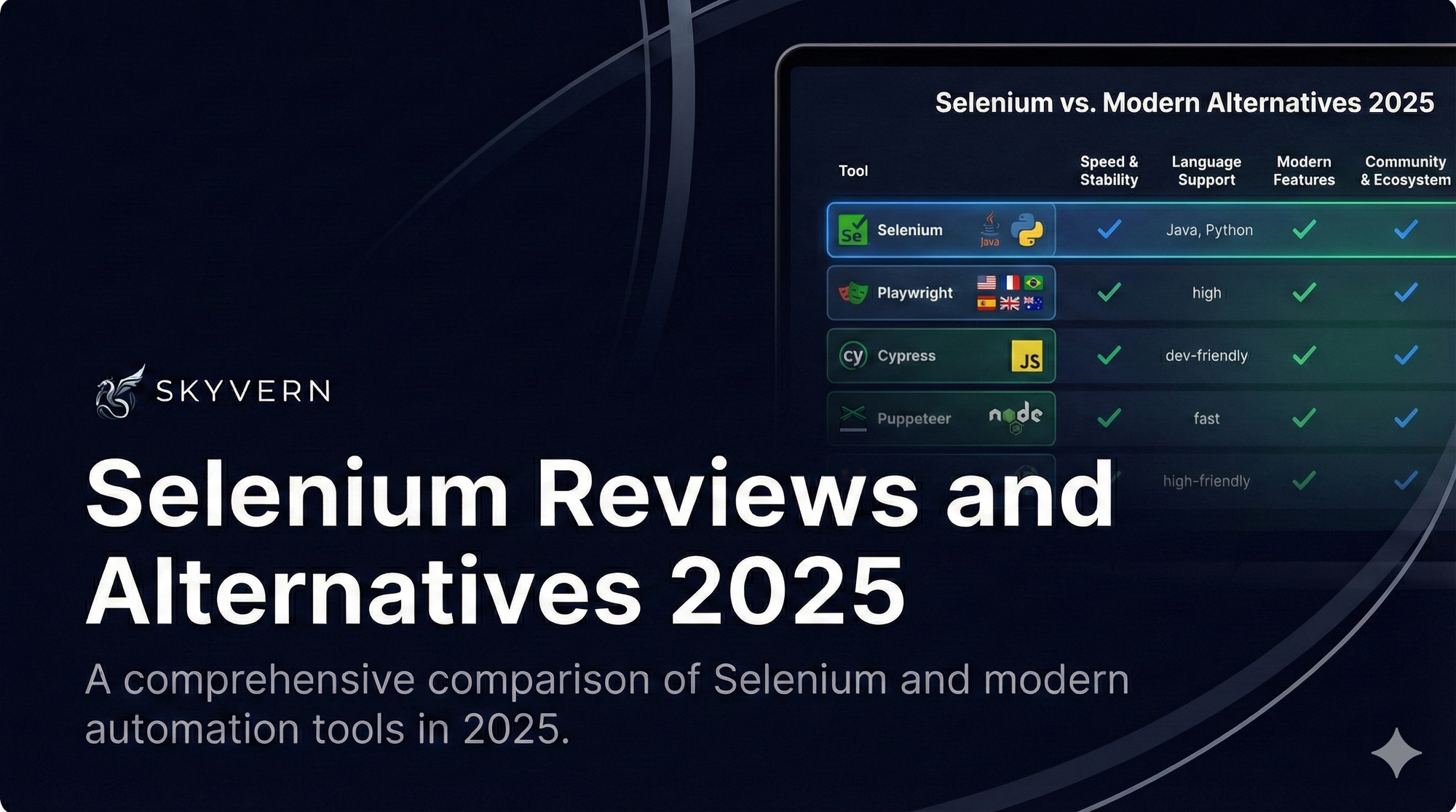
6 Selenium Alternatives for Faster Browser Automation
Here is my guess: you are tired of fixing scripts that break every time a website changes its layout and you are looking for an alternative. Selenium has been the most popular testing framework for years. It’s open source, it runs tests across every major browser, OS and language. But Selenium leans on XPath selectors and DOM parsing. It makes automations unreliable when a site changes even a little. We started Skyvern to fix exactly this problem (I am Skyvern's CEO), using LLMs and computer

7 Playwright MCP Alternatives for Better Browser Automation
Compare seven Playwright MCP alternatives that reduce context overhead, retries, and stalled agent runs. Find the right option for your workflow.
9 Prior Authorization Companies Compared (2026)
Compare nine prior authorization companies by workflow coverage, setup, human review, who each product serves, and the work each leaves to your team.
Put the browser to work
Use Skyvern for the work that lives in a browser.
Turn repetitive browser tasks into reliable workflows with Skyvern.