APA Control Plane for Agentic Automation (July 2026)
 Suchintan Singh17 min read
If you're running agentic process automation across more than a handful of portals, the wall where individual agents fall short is familiar. State doesn't persist across session timeouts. Exceptions have nowhere to go. There's no audit trail when something goes wrong. APA control plane agentic process automation is the infrastructure layer that solves those problems, and understanding how it works changes how you think about building automation that actually holds up in production. Skyvern is an Agentic Process Automation platform built around exactly this control plane function. Browser execution handles the portals; the platform layer governs the workflow above it, from task routing and credential management to exception escalation and audit trails.
TLDR:
- The APA control plane is the governance layer above agents: it owns task routing, state management, exception escalation, and audit logging.
- Without a control plane, credentials embed in scripts, governance exists only as team norms, and audit requests require manual log archaeology.
- The control plane and execution plane stay separate by design; tangling them is why most portal automation breaks when a layout changes.
- Credentials get stored centrally and injected at runtime per task, so rotating one credential updates every workflow that references it.
- Skyvern is an Agentic Process Automation platform, browser automation is the execution layer; credential management, approval gates, audit trails, and exception escalation are the platform layer that makes it production-grade across credential-guarded portals.
What the APA Control Plane Is
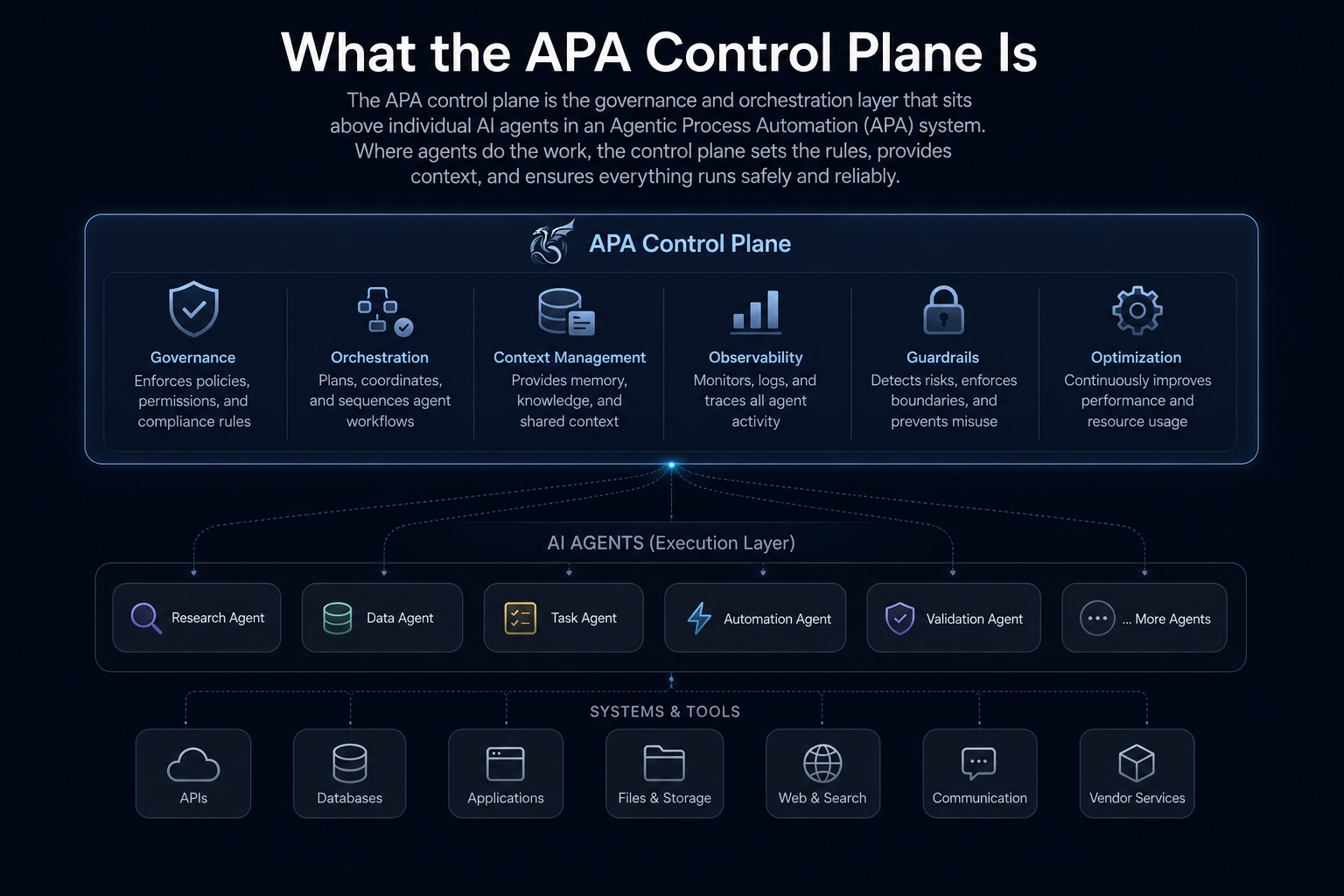
The APA control plane is the governance and orchestration layer that sits above individual AI agents in an Agentic Process Automation (APA) system. Where the agents themselves handle execution (reading pages visually, working through authentication, filling forms, extracting structured output), the control plane handles everything that makes that execution production-grade: task routing, state management, exception escalation, audit logging, and human-in-the-loop handoffs.
Think of it as the layer that answers a different set of questions than the agents do. An agent answers "how do I complete this step?" The control plane answers "which agent runs this workflow, what happens when it fails, who reviews the output, and how do we prove it ran correctly?"
Why the Control Plane Matters for Enterprise APA
Three concerns show up consistently in enterprise APA deployments that agents alone cannot resolve:
- Workflow state needs to persist across sessions, portal timeouts, and multi-step processes that may span hours or days. Without a control plane managing state, a session timeout mid-workflow means starting over.
- Exceptions that agents cannot resolve autonomously (ambiguous form fields, unusual authentication challenges, outputs that require human sign-off before downstream submission) need a defined escalation path. The control plane owns that path.
- Compliance-sensitive workflows require a traceable record: what ran, when, against which portal, with what result, and where human review occurred. Agents produce the actions; the control plane produces the audit trail.
These are not edge cases. They are the conditions that separate a working demo from a workflow you can run in production at scale.
Control Plane vs. Execution Plane in APA
Every APA system has two distinct layers, and confusing them leads to poorly designed automation that breaks under real operating conditions.
The control plane is where decisions get made: goal interpretation, task sequencing, exception routing, and human escalation logic all live here. The execution plane is where actions happen: clicking buttons, filling forms, extracting data from live pages.
Why the Separation Matters
Most brittle automation collapses because decision logic and execution logic are tangled together. When a portal changes its layout, the whole workflow fails because there is no layer capable of reasoning about the new state independently, which is the gap that intelligent process automation architectures are built to close.
In a well-architected APA system, the control plane receives a goal, breaks it into steps, monitors execution state, and reroutes when something unexpected occurs. The execution plane handles each step without needing to understand the broader goal. That separation is what makes self-healing behavior possible: when execution hits an unexpected modal or a rotated login flow, the control plane reassesses and issues a new instruction instead of crashing.
What Each Plane Owns
- The control plane owns workflow sequencing, conditional branching, retry logic, approval gates, audit logging, and escalation to human reviewers when an exception falls outside the agent's defined authority.
- The execution plane owns visual page reading, form interaction, authentication handling, structured output extraction, and session management across portals that have no API.
The table below summarizes the division of responsibility between the two planes, organized by function and what each layer is accountable for in production.
Function | Control Plane | Execution Plane |
|---|---|---|
Primary question answered | Which agent runs this? What happens when it fails? Who reviews the output? | How do I complete this step? |
Workflow sequencing | Decomposes goals into tasks, manages branching and retry logic | Executes each discrete step without awareness of the broader goal |
Authentication & sessions | Stores credentials centrally, injects at runtime, manages session state across steps | Works through login flows, 2FA prompts, and session-timeout modals as they appear |
Exception handling | Defines escalation paths: retry, reroute, or pause for human review | Signals unexpected states back to the control plane |
Audit & observability | Logs every action, page state, credential handoff, and human approval event | Produces the actions and output that get logged |
Output delivery | Enforces output schema consistency across all agent runs | Extracts structured data from live pages and forms |
Self-healing behavior | Reassesses the goal and issues new instructions when execution hits an unexpected state | Reads pages visually at runtime, with no hardcoded selectors to break |
Teams automating portal-heavy workflows across insurance, logistics, or government systems benefit most from this architecture, because the processes they are running involve both high decision complexity and high execution variability.
Why Enterprises Need a Control Plane Now
Enterprises running APA at scale face a coordination problem that individual agents cannot solve on their own. A single agent can log into a portal, extract data, and return a structured result. But real enterprise workflows span dozens of portals, involve credential rotation, require exception escalation to human reviewers, and need a documented audit trail for every run. Without a layer that coordinates those moving parts, you get isolated automations, not a production-grade process.
Three structural pressures are driving demand for control plane infrastructure right now.
- Workflow complexity has outpaced point solutions. Operations teams managing prior authorizations, carrier quotes, or permit filings across 20 or more external portals cannot treat each portal as an independent automation project, a gap the APA maturity model helps organizations diagnose and close. They need orchestration that sequences agents, passes state between steps, and recovers from failures without manual intervention.
- Compliance requirements have moved upstream. In healthcare, logistics, and financial services, audit trails and approval gates are no longer post-hoc reporting features. They are prerequisites for deploying automation at all. A control plane that captures every action, every credential handoff, and every exception is the difference between a workflow you can run in a compliance-sensitive environment and one you cannot.
- Non-technical teams now own production workflows. When the people responsible for a process cannot write or debug code, every portal change becomes a support ticket. A control plane with goal-directed agent execution means the workflow specification stays stable even when the underlying portal changes.
Analyst forecasts project rapid growth in task-specific AI agents by the end of 2026, accelerating demand for exactly this layer. The agents exist. The missing piece is the infrastructure that governs them.
Skyvern is an Agentic Process Automation platform built for exactly that infrastructure gap. Browser execution handles the credential-guarded portals, and the platform layer handles the orchestration, exception routing, and audit logging that make agentic workflows defensible at scale.
Core Components of the APA Control Plane
The APA control plane is not a single module but a layered set of coordinating systems that sit above individual task execution. Each layer handles a distinct responsibility, and the interaction between them is what separates production-grade agentic automation from a collection of individual scripts running in sequence.
Four components define how a control plane governs APA workflows at scale.
Orchestration and Task Routing
The orchestration layer receives a workflow goal and decomposes it into discrete tasks, then routes each task to the appropriate agent or execution thread. In portal-heavy operations (insurance eligibility checks, carrier quote retrieval, government permit submissions), a single business goal may span a dozen sequential steps across multiple credentialed systems. The orchestrator maintains state across those steps, tracks completion, and handles branching logic when a step returns an unexpected result.
Credential and Session Management
Agents working through authenticated portals need access to credentials without those credentials being exposed in workflow definitions. The control plane stores credentials separately, injects them at runtime, and manages session state across multi-step flows. When a portal rotates its 2FA prompt mid-session, a well-built control plane handles that as a state event, not a fatal exception. That is part of how Skyvern handles authentication across credentialed portals.
Exception Handling and Human-in-the-Loop Gates
Not every edge case can be resolved autonomously. The control plane defines escalation paths: which failures trigger a retry, which trigger an alternate route, and which pause execution and route to a human reviewer. For compliance-sensitive workflows, those approval gates are not optional features. They are the mechanism that keeps automated output trustworthy.
Audit Trail and Observability
Every action the agent takes, every page state it reads, every structured output it returns gets logged. That trace is more than a debugging tool. It is the record that compliance teams, operations managers, and audit processes depend on to verify that the workflow ran correctly and that exceptions were handled according to defined policy.
How the Control Plane Handles Agent Identity and Access
In agentic systems, knowing what an agent can do matters less than controlling who it is and what it's allowed to touch. The control plane handles both.
Each agent operating inside an APA system carries a defined identity: a set of credentials, a permission scope, and a role that determines which workflows it can run, which data it can read, and which actions require a human to approve before execution continues. This is not optional governance layered on afterward. It is part of the execution architecture from the start.
Credential Management and Scope Boundaries
Credentials in a well-designed control plane are never embedded in workflow definitions. They are stored separately, referenced by identifier, and injected at runtime only for the duration of the task that requires them. An agent running an insurance eligibility check against a payer portal receives the credential it needs for that portal, for that run, and nothing more. A different agent handling payroll tax registration gets a different credential set, scoped to a different system.
This separation matters for two reasons:
- Credential sprawl across workflow scripts creates maintenance and security problems that compound as the number of portals grows. When credentials rotate, updating a centralized store updates every workflow that references it, without touching the workflow definition itself.
- Scope boundaries limit blast radius. If an agent encounters an unexpected condition or is pointed at the wrong endpoint, its permission set determines how far the error can propagate before the system stops it.
Approval Gates and Human Handoff
Some actions should not run autonomously regardless of how confident the agent is. The control plane defines those thresholds. Approval gates are checkpoints where the agent pauses, surfaces its current state and proposed next action, and waits for a human to confirm before continuing.
In compliance-sensitive workflows, this is where human judgment still matters. An agent can work through a complex multi-step government filing, populate every field, and validate the output schema, but the final submission step may be gated behind a reviewer who confirms the data before it leaves the system.
Process Definitions as the Foundation of Control
An agent that improvises its own execution path is a prototype, not a production system. Mature Agentic Process Automation (APA) architecture treats process definitions as infrastructure: every workflow is declared in advance as a structured sequence of tasks, decision nodes, branching conditions, escalation paths, and approval gates.
Why the Definition Comes First
The declaration is also what you version. When a compliance requirement changes or an escalation threshold shifts, the change goes to the declared process first, then propagates to every agent running that workflow.
Without that sequencing, governance becomes retrospective at best: learning what actually ran after the fact instead of controlling what was authorized to run from the start.
Audit Trails and Observability Inside the Control Plane
Every APA control plane run produces a complete trace: the page states the agent saw, every action it took, the authentication steps it worked through, any exceptions that fired, and the structured output it returned. That record is not an archive; it is a diagnostic instrument.
When the same step fails across consecutive runs against the same portal, that is a signal the portal has changed its layout or rotated its session behavior, not a reason to add a retry. Failures that cluster at a specific time of day point to a maintenance window. Failures that appear only after a credential rotation point to a session-establishment gap.
Why This Matters for Governed Workflows
For compliance-sensitive workflows, the trace serves a second function: it is the audit trail that regulators and internal reviewers ask for, the kind of transparency that explainable AI automation tools for compliance teams are built to provide. Approval gates and human-in-the-loop checkpoints are logged alongside agent actions, so every handoff between the agent and a human reviewer has a timestamp and a documented state.
The observability layer covers four things worth planning around before building production workflows:
- Every page state is captured at the moment the agent reads it, so you can reconstruct exactly what the agent saw when it made a given decision, not a post-hoc approximation.
- Exception events are logged with full context, including which step failed, what the agent attempted, and whether a retry or escalation followed.
- Authentication steps, including 2FA prompts and session-timeout modals, appear in the trace as discrete events, making it possible to identify session-rotation patterns before they compound across a workflow.
- Structured output delivery is recorded alongside the input state that produced it, so downstream discrepancies can be traced back to a specific run and a specific portal condition.
Read the trace as a diagnostic instrument before the next scheduled run, not as a post-mortem after the fourth failure.
Human-in-the-Loop Controls as a Control Plane Function
Full autonomous operation is rarely the right architecture for high-stakes workflows. When an agent is processing prior authorizations across 40 payer portals, filing documents with a court system, or submitting payroll tax registrations across states, the cost of an undetected error compounds fast. Human-in-the-loop controls are not a fallback for when AI fails, they are a designed component of how APA control planes manage risk.
The control plane governs when agents pause and route a decision to a human reviewer. That might be triggered by confidence thresholds (the agent encounters an ambiguous field it cannot resolve with sufficient certainty), exception conditions (a portal returns an unexpected state), or compliance rules (any submission above a dollar threshold requires sign-off). Human review still matters here, not as a patch over unreliable automation, but as a deliberate gate in a governed workflow.
What This Looks Like in Practice
A well-designed APA control plane treats human handoffs as first-class workflow events, not error states. Three patterns show up consistently across production deployments:
- Approval gates at defined checkpoints, where the agent pauses before a consequential action (a form submission, a payment initiation, a document filing) and surfaces the prepared output to a reviewer before proceeding.
- Exception escalation, where the agent flags ambiguous or out-of-scope conditions to a human queue instead of guessing, then resumes once the human resolves the decision.
- Audit trail generation on every run, so reviewers have full context (page state, action sequence, extracted output) when they review what the agent prepared.
Together, these controls let organizations run high volumes of automated workflows without sacrificing the oversight that compliance-sensitive contexts require.
What Happens Without a Control Plane
Without a control plane, the failure modes are structural, not incidental. Credentials end up embedded in individual workflow scripts or shared informally across teams. When one credential rotates, some workflows get updated and others quietly fail for days before anyone traces the cause, a structural limitation that AI RPA browser automation resolves through centralized credential management. Governance rules (which actions require sign-off, which portals require restricted access) exist as team norms instead of enforced policy, which means they degrade the moment the team changes.
The audit problem is worse. When a regulator asks what an agent did on a specific date against a specific portal, the answer requires manually piecing together log files across separate systems. That is not audit-readiness; it is archaeology.
The clearest sign of an Agentic Process Automation (APA) deployment without a control plane is agents taking live, consequential actions, submitting documents, initiating payments, updating records, with no documented chain of authorization. Shadow automation is the outcome: real work happening in production systems with none of the oversight that makes it defensible.
How the Control Plane Scales with Agent Volume
As agent volume grows, the control plane's job shifts from coordination to capacity management. A single agent running a workflow is straightforward. Fifty agents running simultaneously across insurance carrier portal workflows, payer systems, and government filing sites introduce a different class of problems: credential contention, session conflicts, rate limiting at the target site, and downstream systems that can't absorb results fast enough.
The control plane handles this through a few interconnected mechanisms.
Concurrency and Queue Management
Agents don't all fire at once without coordination. The control plane manages a work queue that dispatches tasks based on available capacity, site-specific rate limits, and priority signals. If a target portal starts returning errors consistent with rate limiting, the control plane can back off that destination while continuing to process other queued tasks. This prevents one overloaded portal from blocking unrelated workflows.
Credential and Session Isolation
At scale, credential sprawl becomes a real production risk. The control plane maintains isolated credential contexts per agent session, so a session timeout on one workflow doesn't corrupt another. This matters most in multi-portal environments where dozens of agents may be authenticating against different systems simultaneously.
Structured Output Consistency
When fifty agents return results at different times, downstream systems need consistent schema regardless of which portal layout each agent encountered during its run. The control plane enforces output schema at the point of delivery, so the receiving system sees uniform JSON whether the agent worked through three authentication steps or one.
Teams processing high volumes of portal-heavy workflows, where concurrency and credential isolation determine whether the system holds up or collapses under load, get the most from this layer.
The APA Control Plane in Practice: Skyvern
Skyvern is an Agentic Process Automation (APA) platform built for exactly the workflows the APA control plane was designed to govern: credential-guarded portals, multi-step processes that span authentication flows and structured data extraction, and end-to-end sequences where a broken script means a missed deadline.
The control plane function in Skyvern covers four interconnected layers: goal-directed task planning, visual runtime page reading, exception escalation with approval gates, and structured output delivery. Each layer feeds the next. The planner converts a stated goal into an action sequence. The visual reader reads the live page state at each step instead of matching against a stored selector map. When the workflow hits an edge case the agent cannot resolve autonomously, the escalation layer surfaces it for human review before proceeding. The output extractor maps results to a defined schema so downstream systems receive consistent JSON regardless of which portal layout the agent encountered.
That architecture means a layout change that breaks a selector-based script is just new input to Skyvern. The agent re-reads the page, reassesses the goal, and continues.
For teams managing portal sprawl across insurance payer systems, carrier quote portals, or government permit applications, this is the class of problem the APA control plane resolves. It is also why assessing the best AI RPA platforms starts with their control plane architecture: not whether automation is possible, but whether it holds up across portals that change without notice, authentication flows that rotate on each session, and compliance-sensitive workflows where every run needs a traceable audit record.
Code Example: APA Workflow with Credential Management and Structured Output
The example below shows how the control plane layers work together in a single Skyvern workflow call. Credentials are referenced by ID (never embedded in the script), the goal is declared in plain language, the output schema is defined upfront so downstream systems receive consistent JSON, and a webhook delivers the result with the audit trail generated automatically on every run.
import skyvern

# Initialize the Skyvern client
client = skyvern.Skyvern(api_key='your_api_key')

# Run in agent (learn) mode - the platform reads the page visually,
# works through authentication, and records a deterministic action path.
# Switch run_with='code' on subsequent runs to use compiled replay mode.
response = client.agent.run_task(
    url='https://payerportal.example.com/eligibility',

    # Credential injected at runtime by ID - never embedded in the workflow definition
    credential_id='cred_payer_portal_prod',

    # Goal-directed task planning - the agent decomposes this into steps
    navigation_goal=(
        'Log in, work through any 2FA prompt, and submit an eligibility '
        'check for member ID 8675309.'
    ),

    # Structured output schema - downstream systems receive consistent JSON
    # regardless of which portal layout the agent encountered during the run
    data_extraction_goal='Extract coverage status, copay, and deductible remaining.',
    data_extraction_schema={
        'coverage_status': {'type': 'string'},
        'copay_usd': {'type': 'number'},
        'deductible_remaining_usd': {'type': 'number'},
    },

    # Webhook delivers structured output and full audit trace on completion
    webhook_callback_url='https://your-system.example.com/webhooks/eligibility',

    # Use 'agent' for the first run (learn mode), 'code' for subsequent runs (replay)
    run_with='agent',
)

print('Task ID:', response.task_id, '| Status:', response.status)
Because credentials are stored in the vault and referenced by credential_id, rotating the payer portal password updates every workflow that references that ID without touching the workflow definition itself. The output schema means the receiving system sees the same JSON structure on every run, whether Skyvern worked through one authentication step or four. Every page state, action, and exception from that run appears in the audit trail automatically.
Human review still matters before final submission on high-stakes workflows, and Skyvern's approval gate mechanism is built to support that handoff, not bypass it.
Final Thoughts on the APA Control Plane
At the end of the day, agentic automation only earns its place in production when someone can answer the auditor's question: what ran, when, against which system, and who approved it. That answer comes from the control plane, not the agents. Skyvern's Agentic Process Automation platform is built to provide exactly that answer, with browser execution handling the portals and the platform layer handling the governance. If you're managing portal sprawl across insurance, logistics, or government workflows and want to see what governed APA looks like in practice, book a demo with Skyvern.
FAQ
What is the APA control plane and how does it differ from the execution plane?
The APA control plane is the governance and orchestration layer that sits above individual AI agents. It owns task routing, state management, exception escalation, approval gates, and audit logging. The execution plane handles the actual browser interactions: reading pages visually, filling forms, working through authentication, and extracting structured output. Keeping these two layers separate is what makes self-healing behavior possible: when execution hits an unexpected portal state, the control plane reassesses and issues a new instruction instead of crashing the entire workflow.
How do I implement human-in-the-loop approval gates in an agentic process automation workflow?
Design approval gates as first-class workflow events, not error states. The control plane pauses execution before a consequential action, a form submission, a document filing, a payment initiation, surfaces the agent's prepared output and current state to a reviewer, and resumes only after confirmation. For compliance-sensitive workflows like prior authorizations or court filings, those gates are not optional features; they are the mechanism that keeps automated output defensible under audit.
Should I use UiPath or Skyvern for automating portal-heavy workflows that require credential management and audit trails?
UiPath's selector-based execution breaks when portals change their layouts, and maintaining those scripts becomes the majority of the ongoing maintenance burden. Forrester research on weekly RPA bot failures found 45% of companies experience weekly bot breakdowns. Skyvern's APA control plane is built around the conditions that break selector-based tools: credential isolation at runtime, self-healing visual execution, structured audit trails on every run, and approval gates for compliance-sensitive steps. If your workflows span multiple credentialed portals that change without notice and require a documented chain of authorization, the architectural gap between the two approaches is structural, not a close comparison.
What happens to an agentic process automation workflow when a portal times out or changes its layout mid-session?
A well-designed APA control plane treats both as state events, not fatal failures. Session timeouts can be handled through save-draft blocks positioned between workflow steps, which persist partial progress so execution does not restart from the beginning. Layout changes are handled at the execution layer: because Skyvern reads pages visually at runtime with no hardcoded selectors, a renamed button or restructured form is new input to the agent, not a breakpoint that requires a script fix.
Can I run concurrent agentic workflows across dozens of portals without credential conflicts or rate-limiting failures?
Yes, with the right control plane configuration. Credential isolation keeps each agent session scoped to its own context so a timeout on one workflow does not corrupt another. Concurrency throttling and queue management prevent traffic spikes that trigger anti-bot detection on high-security portals. Workflows sharing the same credentials require sequential execution configuration, parallel execution of shared-credential workflows can trigger account lockouts or session conflicts, so teams should explicitly configure the run-sequentially parameter and validate it during proof-of-concept testing before production deployment.
Keep reading
The 2026 Enterprise Guide to Agentic Process Automation
A practical guide to agentic process automation for enterprise teams, covering workflow selection, platform evaluation, costs, and the steps from pilot to production.
APA vs. RPA: How AI Changes Process Automation
Traditional robotic process automation (RPA) is the old way to automate work: you define the steps and then you have a bot repeat them. It works well when systems is predictable but when a website changes its layout or adds a new form step, that automation often breaks. Agentic process automation (APA) is the new approach. AI agents can interpret what they encounter and adjust their actions to complete a task. That adaptability helps them handle changes that would require someone to repair a tr
What Is Agentic Automation? The Ops Team Guide (July 2026)
Long gone are the days when 'automate it' meant recording a click path and hoping the portal never changed. That model breaks too often, costs too much to maintain, and falls apart the moment a vendor redesigns a form. Agentic automation takes a different architectural approach, and for ops teams managing portal-heavy workflows, the distinction matters considerably more than the marketing around it. Here's what it actually means and how to think about whether it fits your situation. TLDR: * A
Put the browser to work
Use Skyvern for the work that lives in a browser.
Turn repetitive browser tasks into reliable workflows with Skyvern.