APA Maturity Model: Stages, Metrics & Strategy (July 2026)
 Suchintan Singh19 min read
If your automation program has grown past a handful of scripts, you already know the gap between 'we have automation' and 'our automation scales.' Bots break when portals change, governance is an afterthought, and new workflows take longer to ship than they should. The scripts, though, are not usually the problem. The architecture is.
An Agentic Process Automation (APA) maturity model gives you a way to diagnose what is actually blocking you. It maps where your program sits across five dimensions: autonomy, coverage scope, resilience, governance, and integration depth. Most programs stall because of compounding problems: maintenance burden, developer bottlenecks, authentication failures, and governance gaps. Fixing one without fixing the others just moves the ceiling. The model tells you which dimension to tackle first, so you stop optimizing the wrong thing.
TLDR:
- RPA teams spend 30 to 70% of effort maintaining bots instead of building new ones, the core problem Agentic Process Automation (APA) solves
- Your maturity level maps across five dimensions: autonomy, coverage scope, resilience, governance, and integration depth
- If your maintenance burden exceeds 40% of automation effort, your architecture hasn't crossed into self-healing territory yet
- Enterprises stall between Levels 1 and 3 because of four compounding traps: maintenance, IT bottleneck, auth failures, and governance gaps
- Skyvern handles portal-heavy workflows at Levels 3 and 4, reading live page state at runtime to work through credential-guarded portals and rotating login flows; browser execution is the mechanism, Agentic Process Automation is the platform category
Why Automation Maturity Models Matter Now
Most automation programs reach a point where the scripts work but the strategy doesn't. Individual workflows run, teams celebrate the win, and then six months later someone is maintaining a fleet of brittle bots while new automation requests pile up faster than the team can handle them. The tools did their job. The program didn't scale.
That's the gap maturity models exist to close.
An automation maturity model gives operations and engineering leaders a shared language for where their program actually stands, what the next stage of capability looks like, and what has to change to get there. Without that frame, most organizations end up optimizing locally: patching individual workflows, adding headcount to cover failure modes, and treating automation as a project instead of a capability.
The pressure to get this right has intensified in mid-2026. Agentic AI has moved from pilot territory into production, and the gap between organizations running governed, self-healing automation and those still managing fragile scripts has started to show up in real budget costs. Gartner forecasts that 33% of enterprise software will feature agentic AI by 2028, which means the architectural decisions organizations make now will determine whether they're absorbing that shift or scrambling to catch up.
A maturity model makes those architectural decisions legible. It names the stages, maps the failure modes at each level, and gives teams a way to assess their current state clearly before committing to the next investment.
How Agentic Process Automation (APA) Differs from RPA and Scripted Automation
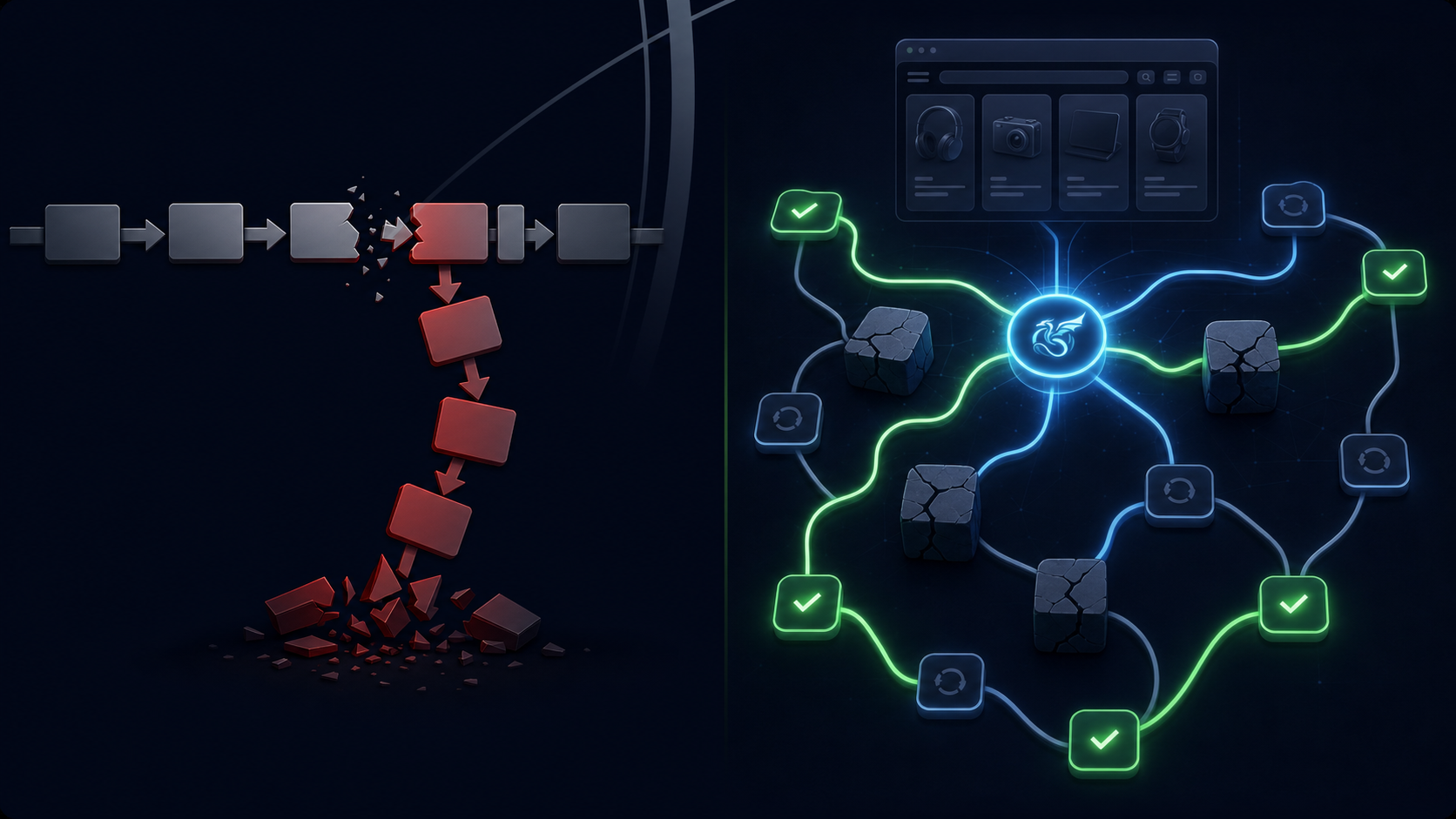
RPA and scripted automation were built around a core assumption: the target system is stable. AI RPA changes that assumption entirely. You record a path through a workflow, encode that path as a sequence of selectors or script steps, and replay it. When the system holds still, this works. When it changes, the script breaks, often silently, and someone has to find the failure, diagnose it, and rewrite the path.
That maintenance burden is not incidental. RPA teams spend 30 to 70% of their effort maintaining bots instead of building new ones, a pattern documented across best RPA software evaluations. The architecture makes this inevitable: every selector is a hard-coded assumption about where an element lives on a page. Change the element, break the assumption, break the workflow.
Agentic Process Automation (APA) starts from a different assumption entirely. Instead of encoding a fixed path, an APA system receives a goal and reasons about how to reach it at runtime, reading the current state of the page instead of replaying a recorded route. Human judgment still matters here. For compliance-sensitive workflows, such as prior authorization decisions or compliance filings, APA handles the data gathering and form execution while human review covers the decisions that carry legal or clinical weight.
There are three structural differences that separate the two approaches in practice.
Goal-Directed Execution vs. Path Replay
RPA follows a script. APA follows an intent. When a portal changes its layout, an RPA bot looks for a selector that no longer exists and fails. An APA agent reads the live page, identifies the relevant element by appearance and context, and keeps going. The workflow spec does not change when the portal does.
Exception Handling vs. Exception Crashing
Scripted automation has no vocabulary for situations it hasn't seen. An unexpected modal, a session timeout, a 2FA prompt that wasn't there during recording: any of these stops the bot cold. APA agents reason about new states as they appear, working through authentication flows, dismissing interstitials, and escalating to a human only when the situation genuinely requires judgment, not crashing on contact with the unexpected.
Structured Output vs. Raw Execution
RPA completes actions. APA returns results. An agent can be given an output schema upfront and will map whatever it extracts from the portal into a consistent JSON structure before handing off downstream. The receiving system gets the same format regardless of which portal variant the agent encountered during the run.
The Five Core Dimensions of APA Maturity
Maturity in agentic process automation doesn't move in a straight line across the whole organization. It moves dimension by dimension, and the teams that make the most progress are the ones that know which dimension they're actually improving at any given time.
Five dimensions determine where an organization sits on the APA maturity curve. Each one is independent enough that a team can be advanced in one area and early-stage in another.
Autonomy Level
This is the most visible dimension: how much of a workflow runs without human intervention. At the low end, every decision goes to a human. At the high end, agents handle multi-step processes across credential-guarded portals, work through authentication flows, and escalate only when they encounter genuinely ambiguous conditions. The practical question here is how many manual touchpoints remain per workflow run, and whether those touchpoints exist because the process requires human judgment or because the automation can't handle the step yet.
Scope of Automation Coverage
Autonomy level tells you how independent the agent is. Scope tells you how much of the organization's workflow surface that agent touches. A team running one portal workflow autonomously is in a different position than a team running forty. Coverage includes both breadth (how many distinct processes and portals) and depth (whether edge cases, exceptions, and less common workflow paths are handled or still routed manually).
Resilience and Self-Healing Capability
Portals change. Layouts shift, login flows rotate, vendors push updates without notice. Resilience measures how the automation responds when those changes happen. Fragile automation breaks silently and waits for someone to notice. Mature automation detects the change, adjusts, and if it can't adjust, escalates with enough context for the operator to act quickly. When an agent encounters a portal that has added an interstitial session-timeout warning mid-workflow, it retains that dismissal pattern and applies it on the next run against any portal in that group.
Governance and Auditability
This dimension covers whether anyone can answer the question "what did the agent do, and why?" after a run completes. Immature governance means logs are incomplete or hard to interpret. Mature governance means every action, credential use, decision point, and exception is traceable, and that trace is accessible to compliance teams without requiring engineering support. In compliance-bound environments, audit trails aren't optional infrastructure. They're the product.
Integration Depth
The last dimension is how well the automation connects to the systems around it. An agent that fills a form and emails a screenshot is less mature than one that delivers structured JSON to a downstream system, fires a webhook on completion, and handles partial results gracefully when a portal times out. Integration depth determines whether automation creates real process throughput or just moves the manual step one layer downstream.
The table below summarizes each dimension and what movement along it looks like in practice.
Dimension | Early Stage | Mature Stage |
|---|---|---|
Autonomy Level | Human approves each step | Agent runs end-to-end; escalates only on genuine exceptions |
Scope of Coverage | One or two stable portals | Dozens of portals including edge cases and exception paths |
Resilience | Breaks on layout changes; failures are silent | Self-heals on known patterns; escalates with context when it can't |
Governance | Partial logs, engineer-dependent review | Full audit trail, compliance-accessible, action-level traceability |
Integration Depth | Screenshot or email output | Structured output to downstream systems, webhook on completion |
No organization is at the same stage across all five dimensions. Autonomy Level moves independently from Integration Depth; Governance can lag behind Scope of Coverage. The maturity model is useful precisely because it stops the conversation from defaulting to "are we automating or not?" and forces a more specific diagnosis of where the friction actually lives.
The APA Maturity Model: Five Stages
The maturity model has five stages, each representing a distinct shift in how organizations think about, deploy, and govern automation. Progress through them follows a pattern: new capability exposes new failure modes, which forces new infrastructure, which opens the door to the next stage.
Stage 1: Scripted Automation
At this stage, teams write brittle scripts against specific pages or APIs. When a portal changes, the script breaks. Maintenance is manual and reactive. Coverage is narrow because each new workflow requires new code.
Stage 2: RPA Deployment
Recorded workflows replace hand-coded scripts. Teams gain some visual flexibility, but the fundamental brittleness remains. RPA maintenance statistics as underlying applications update, and the workflows still require technical staff to diagnose and repair failures.
Stage 3: AI-Augmented Automation
LLMs and computer vision enter the stack. Tools start reading pages visually instead of relying on fixed selectors, a pattern covered in depth in the guide to what is AI automation. Self-healing becomes possible: when a portal moves a button, the agent re-reads the page and keeps going. Skyvern operates here and beyond, reading live page state at runtime instead of matching against a cached selector map. As an Agentic Process Automation platform, the browser execution layer is the mechanism for reaching portals with no API; credential management, approval gates, audit trails, and exception escalation are the production layer built on top.
Stage 4: Agentic Process Automation
Individual tasks chain into multi-step workflows. Agents handle authentication, work through exceptions, and return structured output without human intervention at each step. Governance infrastructure catches up: audit trails, approval gates, and role-based access become requirements, not afterthoughts.
Stage 5: Autonomous Operations
Agents coordinate across systems, escalate edge cases with context, and self-correct based on run history. Human oversight shifts from task-level intervention to policy-level governance. Few organizations have reached this stage in mid-2026, and those who have built the governance layer in Stage 4 first.
How to Assess Your Current APA Maturity Level
Before you can move forward on the maturity model, you need a clear-eyed read of where you actually stand today. Most teams overestimate their maturity because they conflate activity with capability: running scripts counts as automation, but it does not count as agentic operation.
Four dimensions give you the clearest signal on current maturity level.
- Scope of Automation Coverage. Look at the percentage of your high-volume production workflows that run without manual intervention. If that number is well below half your high-volume workflows, you are almost certainly at Level 1 or Level 2. If coverage is broad but concentrated on API-accessible systems while portal-based workflows still run manually, you are at Level 2 regardless of how sophisticated your covered workflows look.
- Maintenance Burden as a Percentage of Automation Effort. This is the most telling indicator teams consistently underreport. Track how many engineering or operations hours per month go toward fixing broken automations instead of building new ones. RPA teams spend 30 to 70% of effort maintaining bots, and that ratio holds across most Level 1 and Level 2 deployments. If your maintenance share is above 40%, your architecture has not yet crossed into self-healing territory.
- Exception Handling Rate. Pull your last 90 days of automation runs and count what percentage required human intervention to complete. A Level 3 deployment handles exceptions autonomously for the majority of cases. A Level 4 deployment escalates only genuinely novel edge cases that fall outside any prior pattern.
- Cross-System Coordination. Ask whether your automations operate in isolation or whether they hand off state, data, and decisions across systems without manual glue. Isolated automations that do not coordinate indicate Level 1 or Level 2. Workflows that chain across systems with conditional branching and structured output delivery indicate Level 3 or higher.
The table below summarizes how each dimension maps to maturity level.
Dimension | Level 1 | Level 2 | Level 3 | Level 4 |
|---|---|---|---|---|
Automation coverage | Below 30% of workflows | 30 to 60%, API-accessible only | 60 to 80%, includes portal workflows | 80%+ including credential-guarded portals |
Maintenance burden | 50%+ of automation effort | 30 to 50% | Below 30% | Below 15%, self-healing on layout changes |
Exception handling rate | Most require human intervention | Majority handled, edge cases escalate manually | Minority require human escalation | Escalation reserved for genuinely novel cases |
Cross-system coordination | None, isolated scripts | Partial, with manual handoffs | Structured handoffs, conditional branching | Fully autonomous multi-system orchestration |
Why Enterprises Stall at Early APA Maturity Stages
Most enterprises don't stall because they lack ambition. They stall because the underlying conditions that made early automation work stop scaling, and the fixes require architectural changes that early-stage tooling wasn't designed to support. In fact, four reasons repeatedly show up at organizations stuck between Level 1 and Level 3.
The Maintenance Trap
Scripts and selector-based bots work until they don't. A portal update, a form field rename, a login flow change: any of these breaks a workflow that was running fine the day before. RPA teams spend 30 to 70% of effort maintaining bots instead of building new ones, which means the automation program grows slower than the manual workload it was supposed to replace. The team that was supposed to scale automation is spending most of its time keeping existing automation alive.
The IT Bottleneck
Early APA tooling requires developer involvement for every new workflow: writing scripts, configuring selectors, handling edge cases. When business teams identify new processes to automate, they join a queue. That queue grows faster than it clears. The result is an automation backlog that makes the program look like it's expanding when it's actually stagnating, with demand outpacing delivery by a widening margin.
The Credential and Authentication Wall
Portal-based workflows require credentials that rotate, 2FA flows that change, and session behaviors that vary by payer, carrier, or agency. Early-stage automation handles the happy path. It fails on the session-timeout modal, the interstitial MFA prompt, the portal that redirects after login. Each failure either requires a developer fix or gets routed back to a human, which is exactly the manual work the automation was supposed to eliminate.
The Governance Gap
As automation volume grows, so does audit exposure. Compliance-bound industries need a traceable record of every action an agent took, every exception it escalated, every output it delivered. Scripts don't produce that by default. Adding audit trails to selector-based automation after the fact is expensive and fragile. Organizations that didn't build governance into their automation architecture early find themselves unable to expand into compliance-sensitive workflows, which are often the highest-value targets.
These four patterns compound. Maintenance burden slows new development. The IT bottleneck delays fixes. Authentication failures create manual exceptions. Governance gaps close off entire workflow categories. Enterprises that haven't tackled all four tend to plateau well before autonomous operations become viable.
Governance and Human-in-the-Loop Controls by Maturity Stage
Governance and compliance controls follow the same arc as automation capability itself. Early-stage organizations tend to treat oversight as an afterthought, a manual check performed after a workflow completes, if it gets performed at all. As agentic systems take on higher-stakes tasks, that approach stops working. The controls have to mature alongside the automation.
Here is how governance structures typically evolve across those five maturity stages.
Stage 1 and 2: Informal and Reactive Controls
At the scripting and basic RPA stages, governance is mostly informal. Someone watches the output, spots errors after the fact, and fixes the script. There is no audit trail, no approval gate, and no escalation path beyond a Slack message or a support ticket. This works when the stakes are low and the workflows are simple, but it creates real risk when automation touches anything consequential.
Stage 3: Structured Approval Gates
As organizations move into coordinated automation, governance starts to formalize. Teams introduce approval checkpoints before high-risk actions, logging for compliance review, and role-based access to workflow configuration. Human-in-the-loop steps stop being improvised and become part of the workflow design itself.
Stages 4 and 5: Governed Autonomy
At the coordinated and autonomous stages, intelligent process automation governance becomes an architectural requirement, not simply a process layer. The controls worth building out at this level include:
- Approval gates that fire automatically when an agent encounters an out-of-bounds condition, such as a transaction above a set dollar threshold or a form field requesting data outside the defined scope, so a human reviews before any action is taken.
- Full audit trails covering page state, action sequence, authentication steps, structured output, and any exception that fired, giving compliance teams a traceable record of every run.
- Role-based access that separates who can configure workflows, who can approve exceptions, and who can review logs, so governance is not a single point of failure.
- Escalation paths for ambiguous or novel situations that agents cannot confidently resolve, with clear handoff logic so tasks surface to a reviewer instead of dropping silently.
Human judgment still matters at every stage, and in compliance-bound contexts, including healthcare prior authorization, legal e-filing, and financial reporting, it is not optional. Agentic systems at full maturity do not eliminate oversight; they structure it so that human attention lands where it is actually needed instead of being spread across every routine step.
Metrics That Signal Stage Advancement
Each stage of the maturity model produces different signals, and knowing which ones to watch tells you whether progression is real or just cosmetic.
Teams advancing from ad hoc scripts to structured workflows typically see script failure rates drop as coverage expands. A reasonable signal: fewer than one in five runs requiring manual recovery before the team moves to the next stage.
What to Measure at Each Stage
The metrics shift as automation matures. Here is what each stage produces that actually matters:
- At the scripted stage, the primary signal is maintenance hours per workflow per month, a benchmark tracked across intelligent process automation tools. If your team spends more time fixing scripts than the scripts save, you have not crossed into the next stage regardless of how many automations you have deployed.
- At the orchestration stage, the signal is exception escalation rate. Workflows that route edge cases to humans without failing entirely are behaving as designed. A drop in unhandled failures combined with a stable or falling escalation rate means the orchestration layer is working.
- At the supervised autonomy stage, watch human intervention frequency per thousand runs. The direction matters more than the absolute number. Teams that see this figure fall quarter over quarter without a corresponding rise in error rates are advancing. Teams where it flatlines have hit a ceiling they have not yet diagnosed.
- At full autonomy, audit trail completeness becomes the governing metric, particularly in compliance-bound workflows where explainable AI automation tools provide the traceability compliance teams require. An autonomous system that cannot produce a full trace of every decision and action it took is not production-ready for compliance-sensitive contexts, regardless of its success rate.
No single metric tells the whole story. The accurate read comes from watching the cluster: if maintenance burden falls while escalation rate stays flat and intervention frequency drops, that is real advancement. If one number improves while the others stagnate, something in the architecture has not crossed the threshold yet.
Selecting the Right Processes for Each Maturity Stage
Picking the wrong workflow to automate at the wrong maturity stage is one of the most reliable ways to sink an Agentic Process Automation (APA) pilot. The process fails, confidence drops, and the broader program gets blamed for a mismatch that was actually a selection problem.
Four axes determine whether a workflow is ready for your current capability level.
- Process stability measures how frequently the underlying system changes. A government form that updates once a year is a different target than an insurance carrier portal that pushes layout changes without notice, exactly the tradeoff covered in browser automation research. Low-maturity programs cannot absorb high-instability targets without burning the maintenance budget they were trying to eliminate.
- Exception rate tracks what share of runs require a human to intervene before the workflow completes. High exception rates are among the common mistakes in browser automation that indicate a selection mismatch. As a rough rule, if a process routes more than 20% of cases to manual review under current conditions, it is not a low-exception workflow. Deploying it at Stage 2 or 3 means you have automated the easy path while leaving the hard path exactly as it was.
- Data structure refers to whether inputs arrive in predictable, parseable formats. Structured inputs like a standardized CSV, a form with defined fields, or a database export are appropriate early. Unstructured inputs such as freeform clinical notes, scanned PDFs, or email threads requiring interpretation demand reasoning capability that belongs at Stage 4.
- Regulatory stakes set the floor for governance maturity the workflow requires. A process where an error triggers a compliance finding or delays patient care cannot be deployed without audit trails and escalation paths in place. Stage 2 governance cannot carry Stage 5 risk.
The table below summarizes how each axis maps to maturity stage, organized by the conditions that make a workflow ready for the automation layer you have today.
Maturity Stage | System Stability | Exception Rate | Input Structure | Regulatory Stakes |
|---|---|---|---|---|
Stage 2-3 | High, infrequent changes | Below 20% | Structured, predictable | Low to moderate |
Stage 4-5 | Variable, portal-heavy | Higher exceptions acceptable | Unstructured or mixed | High, with governance in place |
Stage 2 and 3 organizations should start with workflows that are repetitive, structurally stable, and produce clearly defined outputs. Batch eligibility checks across a single payer, invoice downloads from a portal with a consistent layout, or status lookups against a government database with a fixed, predictable format are good starting candidates.
Stage 4 and 5 programs can absorb credential-guarded portals with rotating login flows, multi-system orchestration where an agent triggers downstream actions based on extracted data, and exception-heavy workflows where the value is precisely in handling the cases that humans would otherwise manage. The governance infrastructure built in Stage 4 is what makes this expansion genuinely safe, both in practice and in technical terms.
Human review still matters for the highest-stakes outputs at any stage. The selection framework does not eliminate judgment calls. It clarifies which workflows are ready for the automation layer you have today.
Where Skyvern Fits in an APA Maturity Journey
Skyvern sits most naturally at Levels 3 and 4 of the maturity model, handling the class of workflows that rule-based automation and basic AI orchestration cannot reach. See what tasks Skyvern automates for a full breakdown: portal-heavy processes with no API, authentication flows that rotate credentials, and multi-step operations that require real-time visual reasoning instead of replaying a recorded path. Skyvern is an Agentic Process Automation platform. The browser execution layer, computer vision and live page reading, is how it operates portals that have no API; the platform layer is what makes it production-grade: credential management, approval gates, audit trails, and exception escalation.
At Level 3, where teams are moving from fragile scripts to goal-directed automation, Skyvern's Agentic Process Automation (APA) approach covers the gap directly. Instead of a developer maintaining a selector map that breaks every time a carrier portal updates its layout, Skyvern reads the live page state at runtime, works through login flows and 2FA prompts as they appear, and returns structured output to whatever downstream system needs it.
At Level 4, the execution pattern shifts from individual workflow automation to coordinated multi-workflow execution across a portfolio of portals. Three capabilities become load-bearing at this stage:
- Concurrent task execution across dozens of portals simultaneously, so insurance eligibility checks, carrier quote requests, and permit filings run in parallel instead of queued sequentially behind a single bot.
- Exception escalation with a full audit trail, so when an agent encounters an edge case requiring human judgment, it flags the run, preserves the session state, and routes to the right reviewer without dropping the task.
- Self-healing behavior when portals change: when an agent encounters new form validation or a portal that redirects after login, it retains that pattern and applies it on the next run against the same site or form type.
Teams that are still at Level 1 or 2, automating a single stable internal tool with an existing API, will not see a return on the setup investment. The visual-AI layer is built for portal sprawl and layout instability. If neither applies, the overhead is unnecessary.
Final Thoughts on Measuring and Growing Your Automation Maturity
The five-stage model works because it stops the conversation from defaulting to "are we automating?" and forces a more specific question: which dimension is actually blocking the next stage? Governance gaps close off entire workflow categories. Maintenance debt slows new development. Authentication failures recreate the manual work you were trying to eliminate. Pick the right dimension to fix first, and the rest of the progression follows a clearer path. When you're ready to see what Agentic Process Automation looks like across portal-heavy workflows, book a demo with Skyvern, an Agentic Process Automation platform built for the portal-heavy, credential-guarded workflows that sit at Levels 3 and 4.
FAQ
How is agentic process automation different from RPA?
RPA replays a recorded path through a fixed selector map and breaks the moment a portal renames a button or restructures a form. Agentic Process Automation receives a goal and reasons about how to reach it at runtime, reading the live page state instead of matching against a cached script. The structural difference matters in practice: RPA teams spend 30 to 70% of their effort maintaining bots instead of building new ones, while APA systems self-heal through layout changes without code edits.
What's the fastest way to assess where my automation program sits on the APA maturity model?
Track your maintenance burden as a share of total automation effort: if it's above 40%, your architecture has not crossed into self-healing territory regardless of how many workflows you've deployed. Then pull your last 90 days of runs and count what percentage required human intervention to complete. Those two numbers, maintenance share and exception escalation rate, give you a more reliable read of current maturity than workflow count alone.
What processes should I automate first when moving from scripted automation to APA?
Start with workflows that are repetitive, structurally stable, and produce clearly defined outputs: batch eligibility checks across a single payer, invoice downloads from a portal with a consistent layout, or status lookups against a government database with a fixed, predictable format. The four axes that determine readiness are process stability, exception rate, input structure, and regulatory stakes. If a process routes more than 20% of cases to manual review under current conditions, deploying it at Stage 2 or 3 means you've automated the easy path while leaving the hard path exactly as it was.
How do I know when my organization is ready for Stage 4 agentic process automation?
The signal is whether your Stage 3 governance infrastructure is actually in place (full audit trails, role-based access, and approval gates), not whether your agents can technically execute multi-step workflows. Organizations that try to expand into credential-guarded portals and exception-heavy workflows without that governance layer in place find they've built capability without the controls that make it safe to run at scale. The governance you build at Stage 3 is what makes Stage 4 expansion viable, in practical and technical terms.
Should I build automation governance before or after expanding workflow coverage?
Build it before. Organizations that skip governance infrastructure and expand coverage first end up unable to move into compliance-sensitive workflows (which are often the highest-value targets) because they have no traceable record of what agents did or why. Audit trails, escalation paths, and role-based access aren't afterthoughts to retrofit onto a running automation program; they're the architectural requirement that determines whether the program can absorb higher-stakes work.
Keep reading
What Is Agentic Automation? The Ops Team Guide (July 2026)
Long gone are the days when 'automate it' meant recording a click path and hoping the portal never changed. That model breaks too often, costs too much to maintain, and falls apart the moment a vendor redesigns a form. Agentic automation takes a different architectural approach, and for ops teams managing portal-heavy workflows, the distinction matters considerably more than the marketing around it. Here's what it actually means and how to think about whether it fits your situation. TLDR: * A
RPA vs AI Agents: Comparing Methods and Choosing Right (July 2026)
The days of treating RPA and AI agents as two versions of the same thing are catching up with teams managing real production workflows. One replays a recorded sequence and breaks when the page changes. The other reads the current state of the page and reasons through whatever it finds. The comparison below maps out where each approach holds up, where it breaks, and how to match your actual workflow conditions to the right tool. TLDR: * RPA automates a fixed path and breaks silently when porta
APA Control Plane for Agentic Automation (July 2026)
If you're running agentic process automation across more than a handful of portals, the wall where individual agents fall short is familiar. State doesn't persist across session timeouts. Exceptions have nowhere to go. There's no audit trail when something goes wrong. APA control plane agentic process automation is the infrastructure layer that solves those problems, and understanding how it works changes how you think about building automation that actually holds up in production. Skyvern is an
Put the browser to work
Use Skyvern for the work that lives in a browser.
Turn repetitive browser tasks into reliable workflows with Skyvern.