Skyvern Changelog — June 2026
 Suchintan Singh5 min read
Everything we shipped in June 2026 — weeks of June 1, 8, 15, and 22.
Workflows Are Now Agents
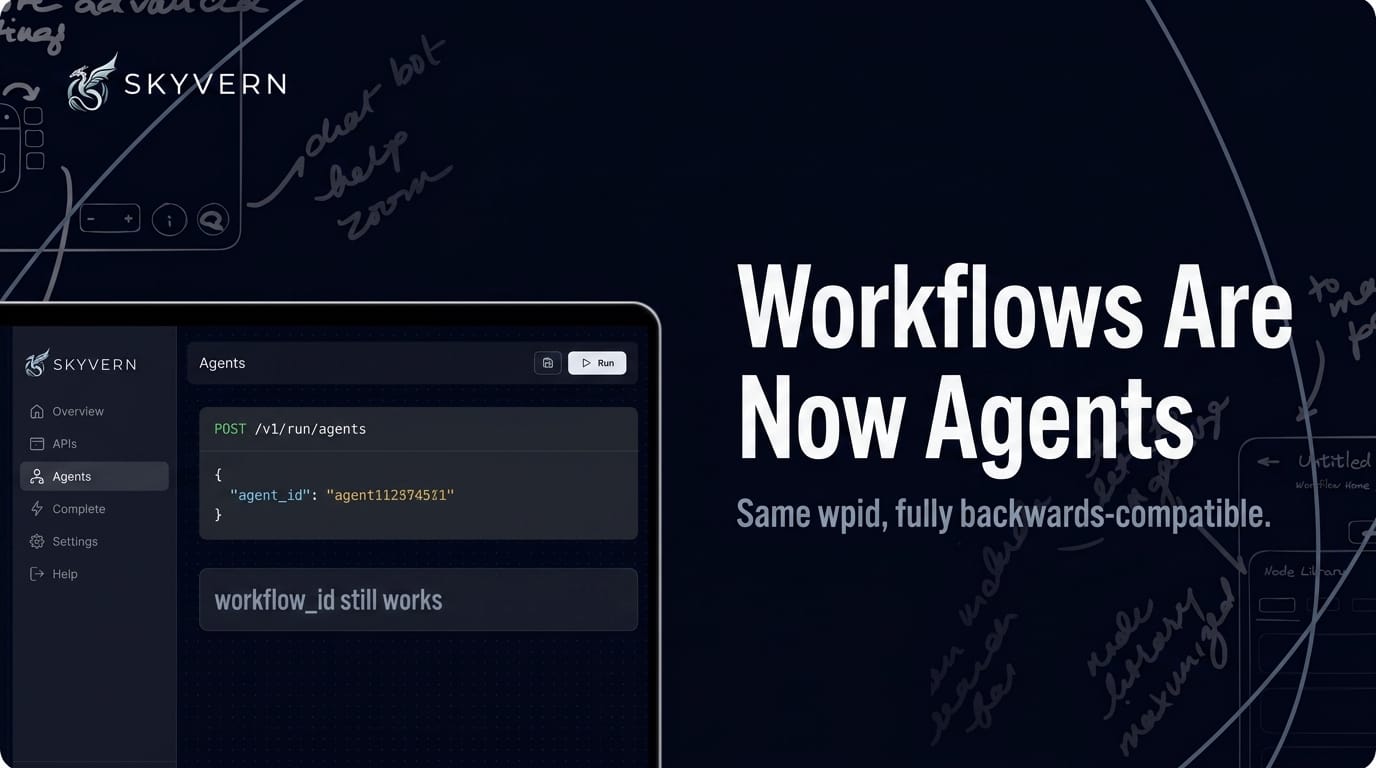
We renamed Workflows to Agents across the product, the public API, and the docs. The API now lives under /agents (e.g. POST /v1/run/agents) and accepts an agent_id alias for workflow_id — same wpid_ value, echoed back in responses. It's fully backwards-compatible: your existing workflow_id inputs, /workflows endpoints, SDK methods, and bookmarked doc URLs all keep working.
Workflow Studio (Beta)
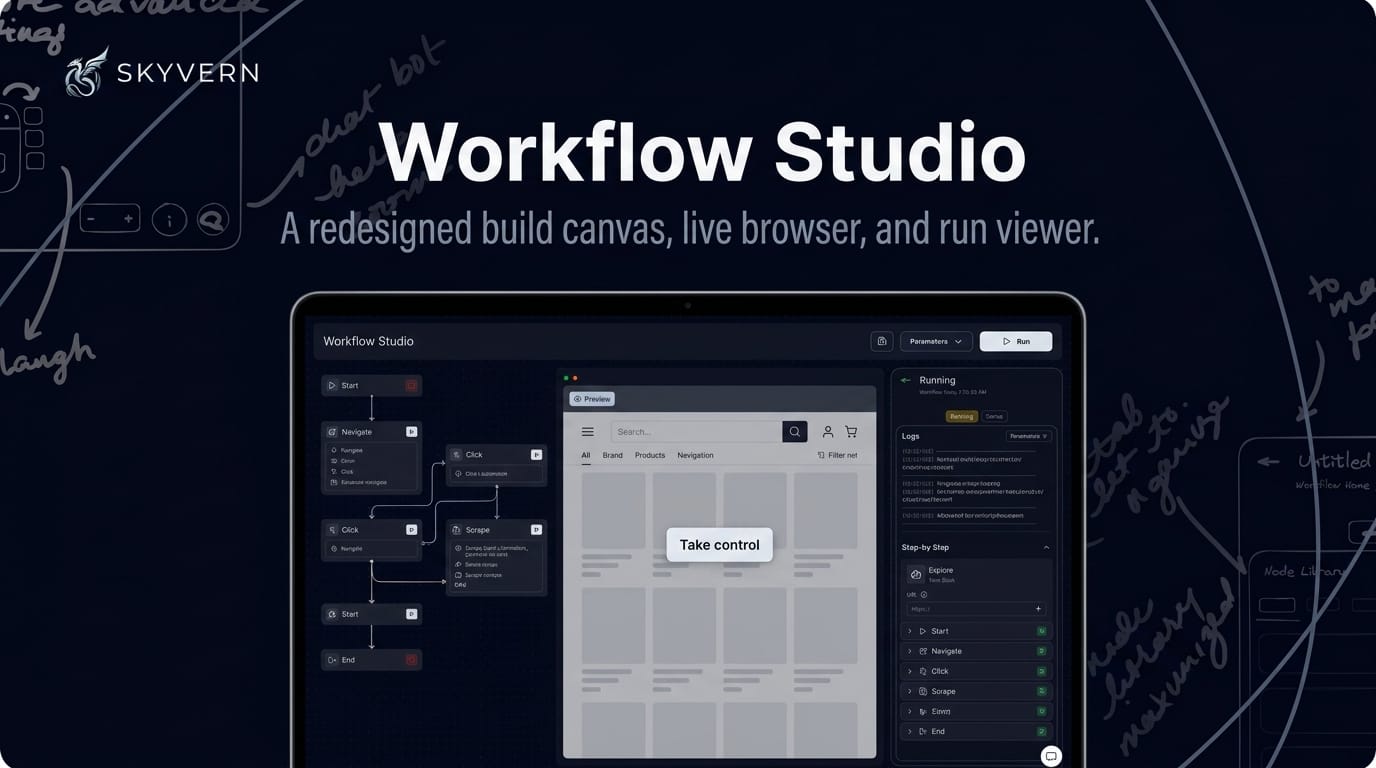
Meet the next-generation editor. Workflow Studio is an opt-in preview that reimagines how you build: a refreshed build canvas, an integrated live browser view, and a built-in run viewer — all in one place. Take control of the live browser, center the viewport, and watch a run unfold without leaving the editor. Flip it on from Feature Preview in Settings.
Code-First Code Blocks (Beta)
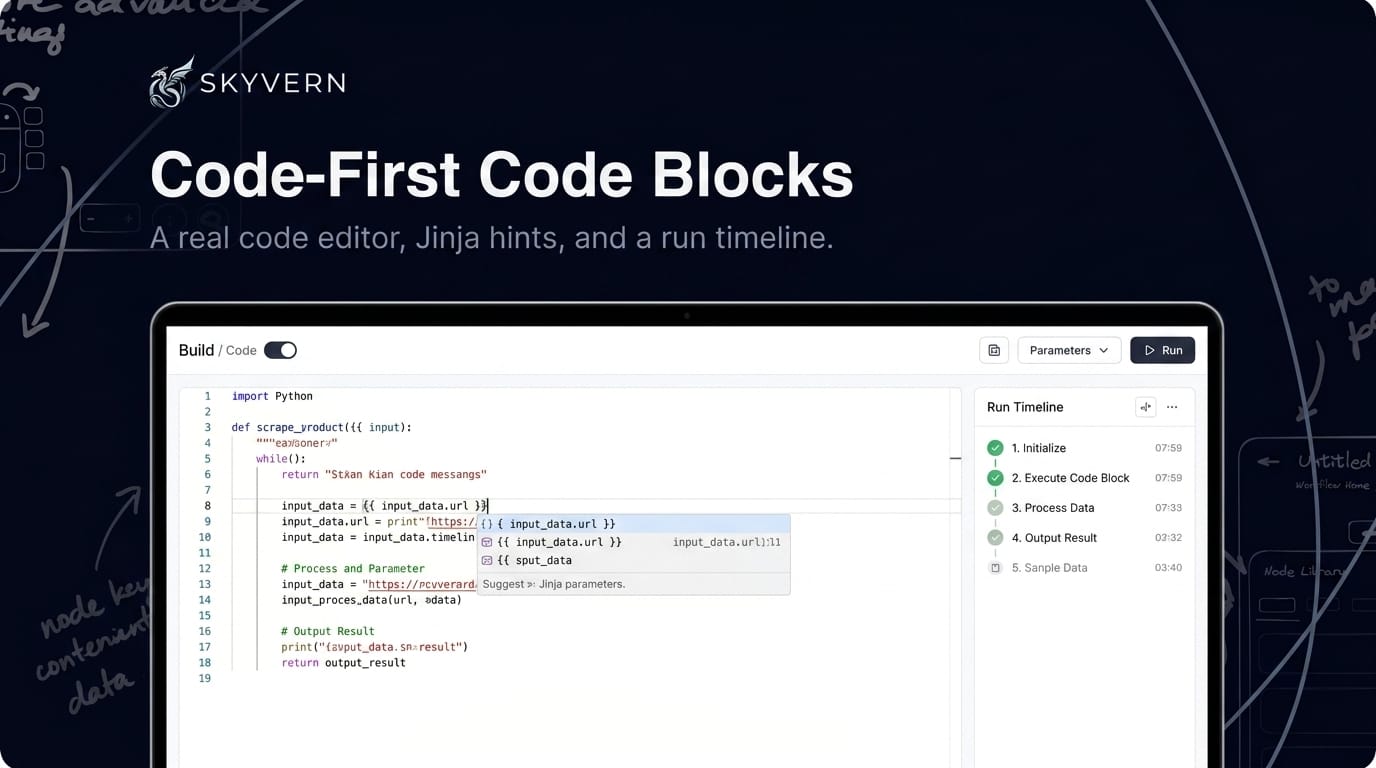
For when you want to drop to code. Code blocks now have a dedicated code editor with syntax highlighting, Jinja parameter hints, and a run timeline that records every action — including page.evaluate(...) calls. A Build ↔ Code toggle flips between visual and code editing, block labels and extraction output render correctly, and Copilot-generated code blocks support a typed extraction schema and fill logins with your stored credentials.
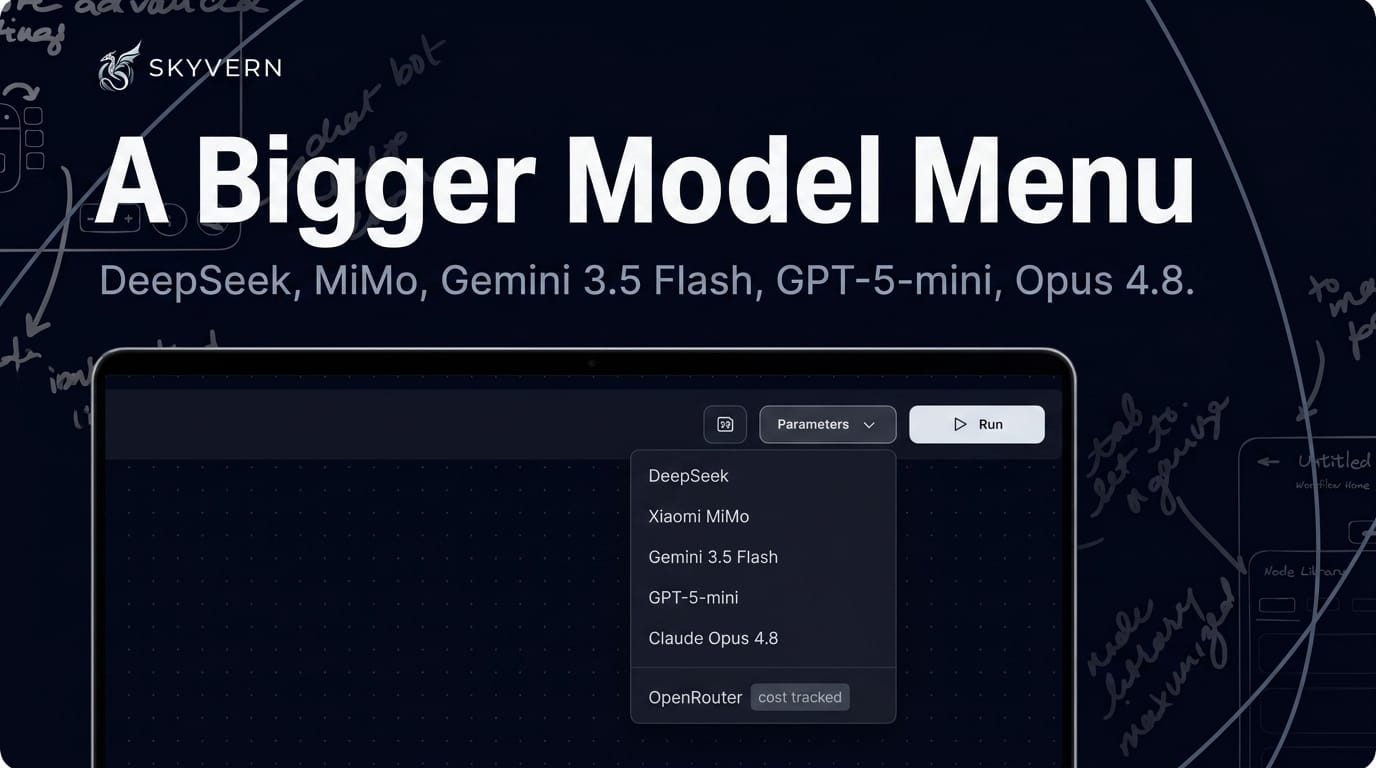
A Bigger Model Menu
More choice for every run. New this month: DeepSeek, Xiaomi MiMo (and MiMo-V2.5 via OpenRouter), Gemini 3.5 Flash, GPT-5-mini (your own OpenAI key or via OpenRouter), and Claude Opus 4.8 (Anthropic + Bedrock). OpenRouter runs now track token counts and cost like every other provider. (Gemini 2.5 Pro/Flash are deprecated; CUA and the Claude Opus family are now enterprise-only.)
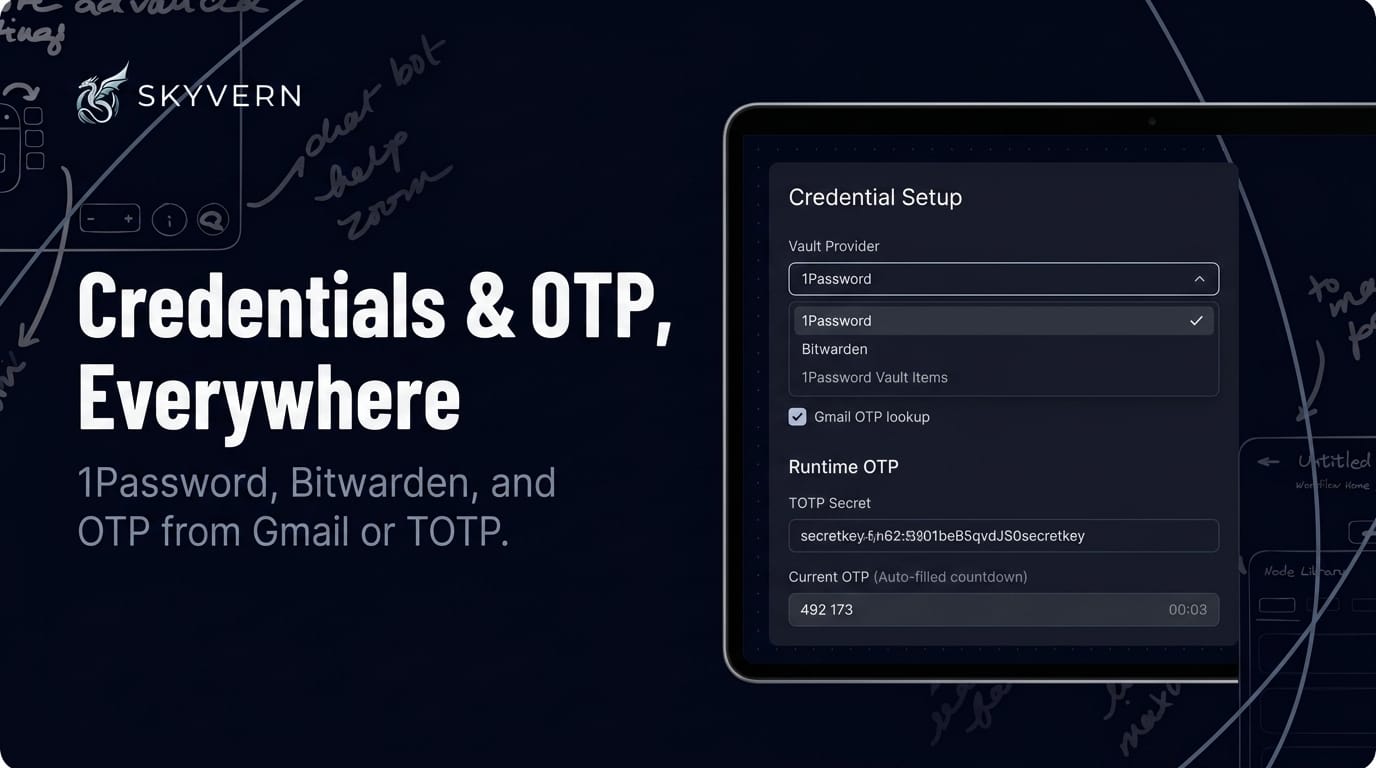
Credentials & OTP, Everywhere
Logins that just work. Pull credentials straight from 1Password (with an item picker) or Bitwarden, look up one-time passcodes from Gmail via OAuth, and fill OTP at runtime from your stored TOTP secrets — even inside code blocks. Expired credential sessions auto re-save, and you can clear a saved credential without deleting and recreating it.
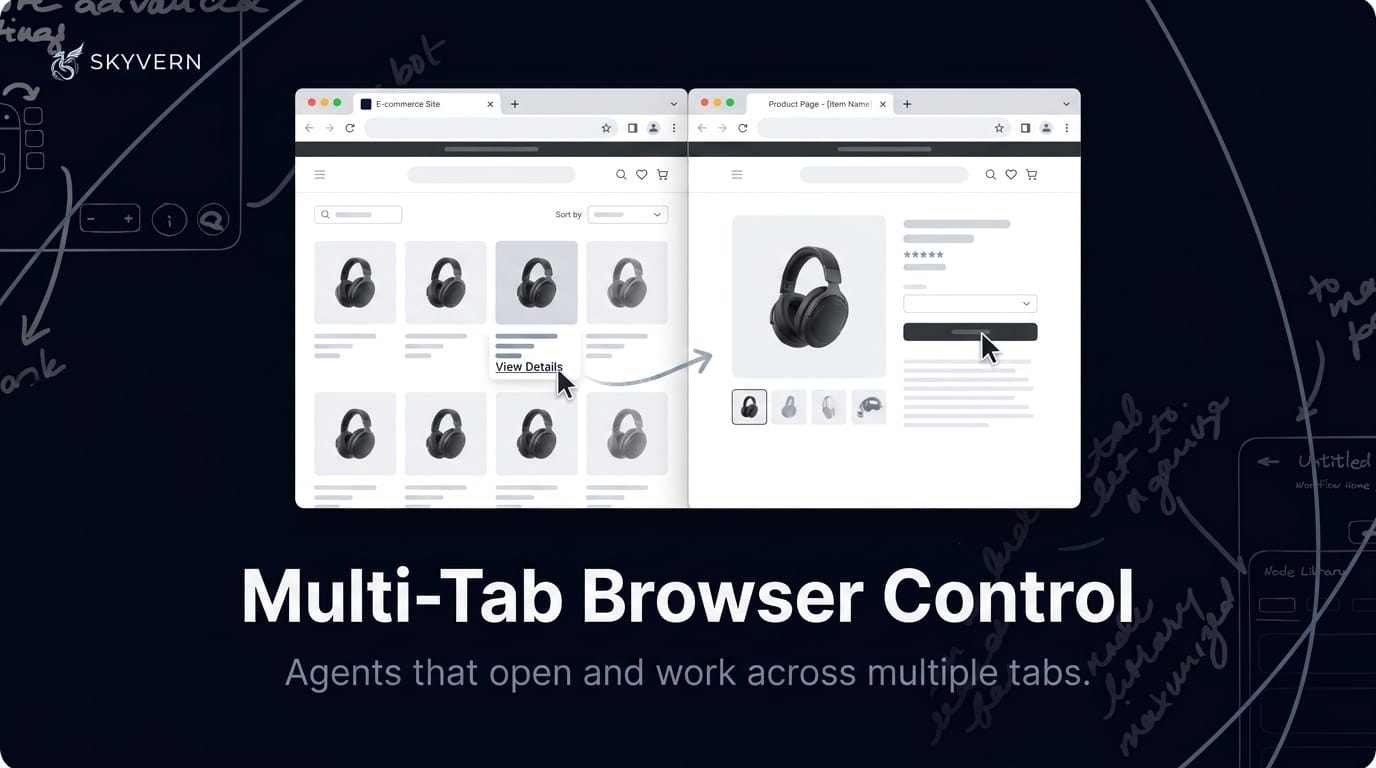
Multi-Tab Browser Control
Automations that span tabs. The autonomous agent loop can now open and work across multiple browser tabs at once — following new-tab links and handling pop-ups — so flows that jump between tabs no longer dead-end.
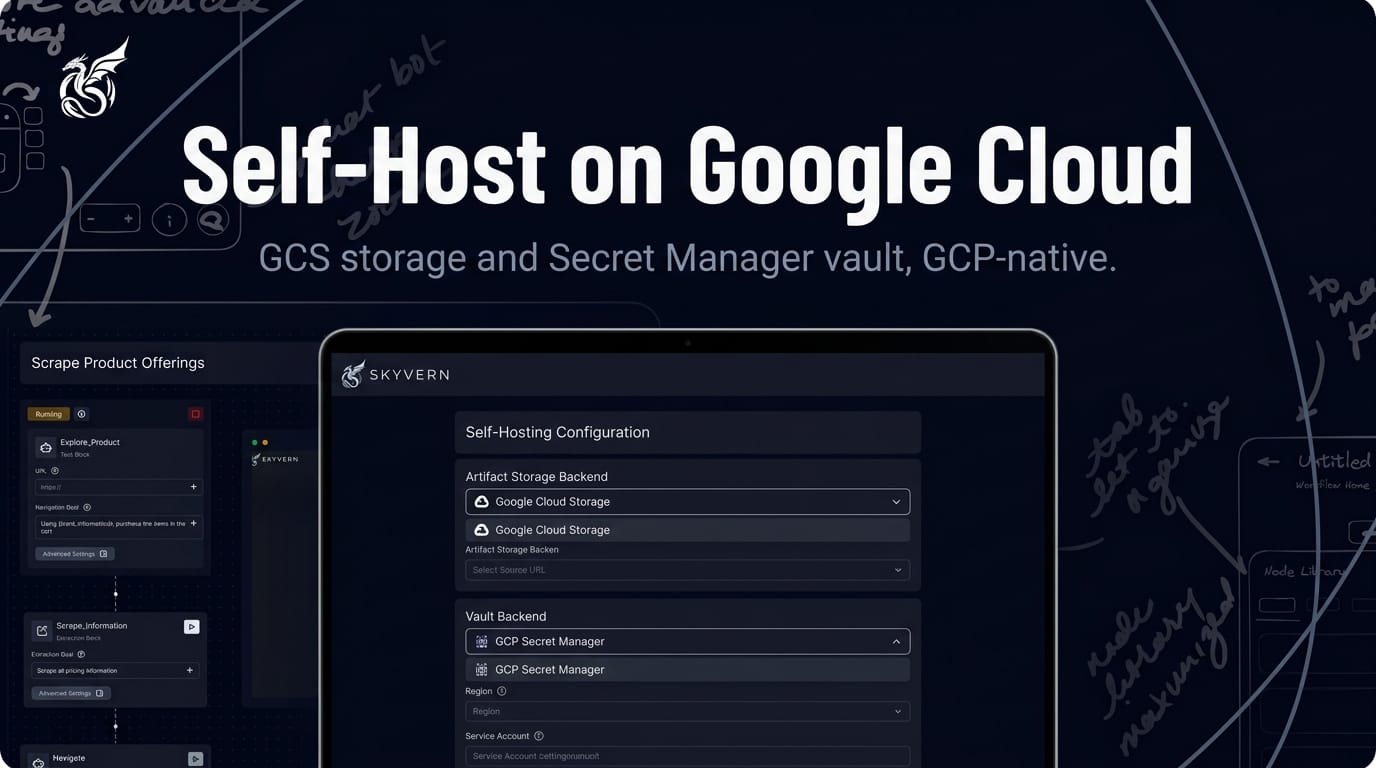
Self-Host on Google Cloud
Full GCP-native deployments. Self-hosted Skyvern now supports Google Cloud Storage for artifacts and GCP Secret Manager as a vault backend — so you can run the whole stack on Google Cloud with your own storage and secrets.
Quick List — June
New features
- Analytics drill-down & tag filters — period-aware per-agent drill-down (avg duration, credits/run, period-over-period trends) plus filtering runs and metrics by workflow tag
- Agent Directory Tree — the agents/folders list is now a navigable tree for nested hierarchies
- Self-serve editor onboarding — a get-started modal, a 4-stop guided tour, and smart empty states for faster time-to-first-automation
- Bulk actions on the agents list — select multiple agents and act on them at once
- Label management in Settings — rename, recolor, and soft-delete tags
- Browser profiles in MCP sessions — associate a browser profile with MCP-driven runs for credential/state reuse
- Feature Preview panel in Settings — opt into upcoming features before they're fully released
- Workflow schedules in open source — self-hosted deployments now support schedules
- Uncapped workflow runtime — configure long-running automations with no maximum time limit
Improvements
- Structured output is verified against its schema before a run is marked complete
- Tasks return a best-effort partial deliverable when they exhaust their credit budget
- The task planner prefers loop-based tasks for repeated same-shaped work, and can now emit EXTRACT_INFORMATION / GOTO_URL actions
- The agent acts immediately on stalled pages and halts reliably on terminal blockers instead of spinning
- Remote browser sessions capped at 4 hours; debug sessions stay open after a run so you can inspect the final page
- End-state screenshots captured for every open tab at completion; per-run recordings clipped to the run window and stored as downloadable artifacts
- Run app + recording URLs surfaced in MCP and CLI responses; run-ID search fallback on the runs list
- Batched cache invalidation on workflow save (removed a per-block N+1) for faster saves on large workflows
- OpenRouter cost tracking; analytics tag filters accept labels, groups, or
group:label - Improved authenticator-2FA credential setup; PDF field mapping by positional labels
- Copilot data-write blocks default to
continue_on_failure=false; code-repair progress shown as quiet indicators
Bug fixes
- Fixed the workflow builder freezing on an infinite FlowRenderer layout loop
- Fixed the code editor crashing (stack overflow) on large or deeply-nested JSON
- Fixed the app failing to load after a deploy from stale chunks — it now auto-recovers with a cache-busting reload
- Fixed login credentials not reattaching after editing a workflow via MCP
- Fixed conditional routing not being preserved when loading a v1-format workflow
- Fixed the active run context being lost when switching organizations
- Fixed multi-step logins not advancing when credentials filled JavaScript-gated fields
- Fixed scanned PDFs being parsed as a single page instead of page-by-page
- Fixed shadow-DOM text nodes being missed during element text extraction
- Fixed runs not stopping when a configured time limit was exceeded
- Fixed credits not recorded when data was captured inside a Navigate block
- Fixed telephone inputs dropping digits on bare NANP-format numbers
- Fixed persistent sessions reporting a stale cached session as live
- Fixed FileUpload blocks silently skipping when no file was provided (now a clean no-op)
- Fixed the block library drawer overflowing its container in the workflow builder
Keep reading

Skyvern August Changelog: Building Agents just got 10x easier
Everything we shipped in August 2026 — weeks of August 3, 10, 17, and 24.
Skyvern Changelog — July 2026
Everything we shipped in July 2026 — weeks of June 30, July 6, 13, 20, and 27.
Skyvern Changelog — April & May 2026
Two months of shipping in one email — a draggable editor, cleaner MCP OAuth, stronger run controls, and plenty more. Headliners first, the full list at the end. April 2026 Workflow Copilot v2 The workflow copilot got a lot more hands-on. Hard-cancel a run mid-flight instead of waiting it out, and follow it live as it streams status narration and surfaces block-level events (starts, completions, errors) while your workflow runs. When a test trips, it hands back the work-in-progress workflow
Put the browser to work
Use Skyvern for the work that lives in a browser.
Turn repetitive browser tasks into reliable workflows with Skyvern.