What Are the Best Explainable AI Automation Tools for Compliance Teams (April 2026)?
 Suchintan Singh9 min read
Automation breaks down the moment an auditor questions a decision and you realize your logs don't explain how the system reached its conclusion. Transparent AI decisions matter more than speed when you're handling compliance-focused workflows like prior authorizations or entity registrations, because missing audit trails turn useful automation into compliance failures. We assessed tools against what auditors actually require when workflows get questioned, focusing on explainability that holds up under regulatory scrutiny instead of feature lists that look good on paper.
TLDR:
- Explainable AI automation logs every decision with timestamps and visual reasoning for audit trails
- Skyvern adapts to website changes while maintaining compliance records, avoiding broken audit trails
- UiPath and Automation Anywhere require RPA developers and cost $100K+ annually for enterprise teams
- Look for SOC 2, HIPAA support, 2FA handling, and human oversight integration in compliance tools
- Skyvern offers audit-ready automation for external portals at transparent pay-per-step pricing
What is Explainable AI Automation for Compliance
Explainable AI automation refers to systems that can execute complex workflows and clearly account for every decision they make along the way. In a compliance context, that second part matters as much as the first. Standard automation tells you what happened. Explainable AI automation tells you why: which data was pulled, how it was mapped to a specific field, and what logic drove each step. For compliance teams, that distinction separates a useful tool from an audit-ready one.
But regulators and internal auditors want a traceable record: what triggered the action, what inputs were used, and whether the system followed the correct logic at every stage. Without that transparency, automated workflows can actually introduce risk instead of reducing it.
"Audit-ready automation isn't about moving faster. It's about moving faster while leaving a clear paper trail."
The bar for explainability scales with the sensitivity of the workflow. Tax filings, KYC checks, prior authorizations, and entity registrations all sit in compliance-focused territory where a missing audit trail can mean a compliance failure, regardless of whether the underlying task was completed correctly.
How We Ranked Explainable AI Automation Tools for Compliance
Picking the right tool for compliance automation means looking past feature checklists. Tools were assessed against what auditors and regulators actually require when something gets questioned. There are six criteria that shaped every ranking here:
- Audit trail completeness: Does the system log every decision with timestamps, inputs, outputs, and traceable reasoning that holds up under scrutiny?
- Explainability depth: Can it explain decisions in plain language instead of raw technical logs that only engineers can read?
- Compliance framework support: Does it handle SOC 2, HIPAA, GDPR, the EU AI Act, and financial services regulations out of the box?
- Layout resistance and adaptability: Can it keep working when target websites change without breaking audit trails or requiring manual reconfiguration?
- Authentication and access control: Does it support 2FA, MFA, and secure credential management with proper access logs?
- Human oversight integration: Can compliance teams insert human review into sensitive decisions without losing traceability?
Every tool in this list was assessed against all six. Some check most boxes. Few check all of them.
Best Overall Explainable AI Automation Tool for Compliance Teams: Skyvern
Skyvern combines AI-powered browser automation with built-in explainability across healthcare credentialing, government filings, financial document retrieval, and insurance portal operations. Every run is traceable by design, not bolted on after the fact.
Key features:
- Built-in explainable AI that explains every field decision, showing which data was mapped where and why so auditors get a clear decision record without extra documentation work
- Complete audit trails with screenshots, video replays, and full execution logs for every run, giving compliance teams the evidence they need when regulators come asking
- SOC 2 certified with HIPAA-capable deployment for compliance-focused environments that cannot compromise on data handling standards
- Native 2FA and CAPTCHA solving without requiring separate compliance documentation or manual intervention during sensitive workflows
- Self-healing automation that adapts to website changes while maintaining audit trail integrity so a redesigned portal does not break your compliance record
- YAML-based workflow definitions that work across multiple sites without site-specific configuration, cutting maintenance overhead across large portal footprints
Limitations:
- Requires familiarity with API concepts and YAML for workflow creation, which adds a short ramp-up period for non-technical teams
- Smaller community compared to mature tools like Selenium, meaning fewer third-party resources and community-built integrations
- Cloud pricing scales with usage volume at higher automation loads, so cost planning matters for teams running high-frequency workflows
Bottom line:
Best for compliance teams managing workflows across multiple portals who need AI adaptability with full audit readiness instead of maintaining brittle scripts that break with every UI update. It's ideal for healthcare, insurance, and government-adjacent teams, but teams with no technical resources may face an initial configuration period before hitting their stride.
UiPath
UiPath provides an "AI Trust Layer" that logs every action an AI agent takes, giving banks and large enterprises a traceable record for EU AI Act and U.S. Executive Order on AI Safety compliance. Its WorkFusion acquisition added financial crime capabilities, making it a heavier-weight option for fraud detection and sanctions workflows.
Key features:
There are a number of features that make UiPath worth considering for large compliance teams.
- Financial crime compliance combining AI agents and workflow automation for sanctions screening, alert review, and adverse media monitoring with clear audit trails
- ISO 27001 certification, SOC 2 Type 2 reports, and HIPAA Type 2 attestations
- Integration with hundreds of enterprise applications and systems
- Orchestration layer for coordinating AI agents with human decision-making checkpoints
Limitations:
- Requires specialized RPA developers for implementation and ongoing configuration, which adds a lot of staffing cost
- Cloud Starter pricing begins around $750 per user per month, with unattended bot licenses running $500 to $1,000 per bot monthly, which is steep for mid-market teams
- Integrations still require maintenance as underlying systems change, so the configuration burden doesn't disappear after launch
- Relies on traditional selector-based automation that breaks when websites update their layouts, creating gaps in audit trail continuity
Bottom line:
Best for large financial institutions with dedicated RPA teams who need financial crime compliance workflows built on existing enterprise infrastructure. It's ideal for internal system automation at scale, but teams managing browser-based workflows across external portals will find the cost and maintenance overhead hard to support.
Automation Anywhere
Automation Anywhere's Automation 360 targets banking, healthcare, and telecom with over 1,200 prebuilt bots, IQ Bot for document processing, and Bot Insight for real-time analytics on bot performance.
Key features:
- Role-based access control, encryption, and GDPR and HIPAA compliance support
- Both attended and unattended bot options for different workflow types
- No-code development with exception handling and workload management
Limitations:
- Annual contracts typically run $100,000 to $500,000+, making it difficult to support for mid-market compliance teams
- Advanced customization requires coding skills and a training investment
- Selector-based automation breaks when external portal UIs change, creating audit trail gaps at the worst possible moment
Bottom line:
Best for large enterprises in compliance-focused industries with dedicated RPA teams and budget for full-scale internal process automation. It's ideal for structured, internal system workflows, but compliance teams managing external browser-based portals will find the maintenance burden and cost hard to absorb.
Code Example: AI Automation for Compliance Teams
Here is a practical Python example using Skyvern's SDK to automate a compliance workflow, in this case, a prior authorization submission with full audit trail output. Every run produces screenshots, a video replay, and a timestamped execution log that compliance officers can hand directly to auditors.
import asyncio
from skyvern import Skyvern

# Initialize the Skyvern client with your API key
skyvern = Skyvern(api_key="YOUR_API_KEY")

async def submit_prior_authorization():
    """
    Automates a prior authorization submission on a payer portal.
    Skyvern handles login, 2FA, form filling, and document upload
    while maintaining a complete audit trail for compliance records.
    """
    task = await skyvern.run_task(
        # Target payer portal URL
        url="https://covermymeds.com",

        # Plain-language goal — no selectors or scripts required
        prompt=(
            "Log into the portal and submit a prior authorization request "
            "for the patient listed in the payload. Upload the attached "
            "clinical documentation. COMPLETE when a confirmation number "
            "is displayed. TERMINATE if the portal is unavailable."
        ),

        # Patient and request data passed as structured JSON
        navigation_payload={
            "patient_name": "Jane Doe",
            "date_of_birth": "1985-03-14",
            "member_id": "UHC-987654321",
            "drug_name": "Dupixent 300mg",
            "diagnosis_code": "J45.51",
            "prescriber_npi": "1234567890",
            "clinical_notes_path": "/files/clinical_notes_doe.pdf"
        },

        # Structured schema for the data Skyvern extracts and returns
        data_extraction_schema={
            "type": "object",
            "properties": {
                "confirmation_number": {
                    "type": "string",
                    "description": "Prior auth confirmation number from the portal"
                },
                "submission_timestamp": {
                    "type": "string",
                    "description": "Timestamp shown on the portal confirmation screen"
                },
                "status": {
                    "type": "string",
                    "description": "Approval status returned by the portal"
                }
            }
        },

        # Block until the task completes — useful for synchronous audit logging
        wait_for_completion=True,
    )

    # Extracted compliance data — ready to log or send to your system of record
    print("Submission data:", task.output)

    # Full audit trail artifacts produced by every Skyvern run
    print("Video replay URL:", task.recording_url)      # Full session recording
    print("Screenshot URLs:", task.screenshot_urls)     # Step-by-step screenshots
    print("Run ID for audit log:", task.run_id)         # Unique ID for traceability

    return task

asyncio.run(submit_prior_authorization())
Feature Comparison Table of Explainable AI Automation Tools
Feature | Skyvern | UiPath | Automation Anywhere |
|---|---|---|---|
Explainability Approach | Built-in explainable AI explains every field decision with visual reasoning | AI Trust Layer provides audit trails of agent actions | Bot Insight provides performance metrics and process analytics |
Audit Trail Completeness | Screenshots, video replay, full execution logs with timestamps for every run | Transparent audit trail of AI agent actions | Bot analytics and process insights |
Layout Resistance | Yes: computer vision adapts to website changes automatically | No: selector-based automation breaks with UI updates | No: element-based RPA requires maintenance when interfaces change |
Multi-Site Reuse | Yes: single YAML workflow works across different websites | No: requires site-specific configuration | No: requires bot configuration per system |
Authentication Handling | Native 2FA, TOTP, CAPTCHA solving built-in | Requires separate integration for authentication complexity | Supports authentication methods through configuration |
Compliance Certifications | SOC 2 certified, HIPAA-capable deployment | ISO 27001, SOC 2 Type 2, HIPAA Type 2 | GDPR and HIPAA compliance support |
Deployment Options | Managed cloud or open-source self-hosted | Cloud and on-premise options | Cloud-native with on-premise available |
Pricing Model | Transparent pay-per-step pricing | Starting ~$750/user/month plus $500 to $1,000/bot/month | Enterprise contracts $100,000 to $500,000+ annually |
Browser Workflow Focus | Yes: designed for external portal automation | No: designed for internal system integration | No: designed for internal business process automation |
Coding Required | No: YAML-based workflow definitions | Yes: requires RPA developers | Partial: no-code interface, advanced customization requires skills |
Best For | Compliance teams automating external portals with full audit readiness | Enterprises with RPA teams managing financial crime compliance | Large enterprises running internal process automation at scale |
The table above covers the dimensions that matter most for compliance teams: how each tool explains its decisions, how complete its audit records are, and whether it holds up when websites or internal systems change without warning. Skyvern is purpose-built for browser-based portal workflows, while UiPath and Automation Anywhere are stronger fits for internal enterprise process automation with existing RPA infrastructure.
Why Skyvern is the Best Explainable AI Automation Tool for Compliance Teams
Regulatory pressure on AI decision-making is intensifying. The EU AI Act transparency requirements, U.S. sector-specific rules, and rising audits for algorithmic fairness are turning explainability from a nice-to-have into a hard requirement. Compliance teams that cannot show exactly how an automated decision was made face real exposure: failed audits, regulatory penalties, and reputational damage that no productivity gain offsets.
Skyvern builds explainability into the automation architecture from the start. Every run produces visual field-level reasoning, video replay, and a timestamped execution log that compliance officers can hand directly to auditors. No translation needed, no after-the-fact documentation scramble.
Where tools like UiPath and Automation Anywhere rely on selector-based automations that break when portals change, Skyvern's computer vision layer adapts automatically and keeps the audit trail intact through every website update. That gap matters most in production, when auditors ask questions and broken automations cannot answer them.
Final Thoughts on Implementing Explainable AI for Compliance Teams
Your compliance automation should explain decisions without requiring engineers to decode technical logs every time an auditor asks a question. Regulatory automation tools built with explainability from the start give you visual reasoning, complete execution logs, and video replays that work as audit evidence without translation. Portal layouts change, authentication methods shift, and your automation needs to adapt while keeping the audit trail intact. Book a demo to see how Skyvern tackles healthcare credentialing, tax filings, and insurance workflows with full transparency built in instead of bolted on after the fact.
FAQ
How should you assess explainable AI automation tools for compliance workflows?
Look for audit trail completeness first: the system should log every decision with timestamps, inputs, outputs, and traceable reasoning that holds up under scrutiny. Then assess explainability depth (can it explain decisions in plain language instead of raw technical logs), compliance framework support (SOC 2, HIPAA, GDPR, EU AI Act), and whether it keeps working when target websites change without breaking audit trails.
Which explainable AI automation tool works best for teams managing external portals?
Skyvern is built for browser-based portal workflows with computer vision that adapts to website changes while maintaining complete audit trails. UiPath and Automation Anywhere are stronger fits for internal enterprise process automation with existing RPA infrastructure, but they break when external portal UIs change and require dedicated RPA developers for implementation.
Can explainable AI automation tools handle authentication complexity in compliance-focused workflows?
It depends on the tool. Skyvern includes native 2FA, TOTP, and CAPTCHA solving built into the platform with full audit trail documentation. UiPath and Automation Anywhere require separate integrations for authentication complexity, which adds configuration overhead and potential gaps in compliance documentation when authentication methods change.
What happens to audit trails when a target website changes its layout?
With selector-based tools like UiPath and Automation Anywhere, automations break when UIs update, creating gaps in audit trail continuity at the worst possible moment. Skyvern's computer vision approach adapts automatically to website changes and keeps the audit trail intact through every portal update, so compliance records stay complete even when target sites redesign their interfaces.
Keep reading
Automation Anywhere Alternatives: 6 Options and What AA Really Costs
If you’re looking for an Automation Anywhere alternative, you’re probably unhappy with something: the price, a workflow builder that feels clunky, or the effort it takes to keep your automations running. Those frustrations show up in Automation Anywhere’s reviews. Some reviewers describe expensive licensing, costs that become harder to predict as AI usage grows, and a steep learning curve for complex workflows. Others point to difficult debugging and resource-heavy deployments. A lot of the pe
Top 5 UiPath Alternatives Compared in 2026
Compare five UiPath alternatives for browser and desktop workflows, including their strengths, trade-offs, pricing, and migration effort.
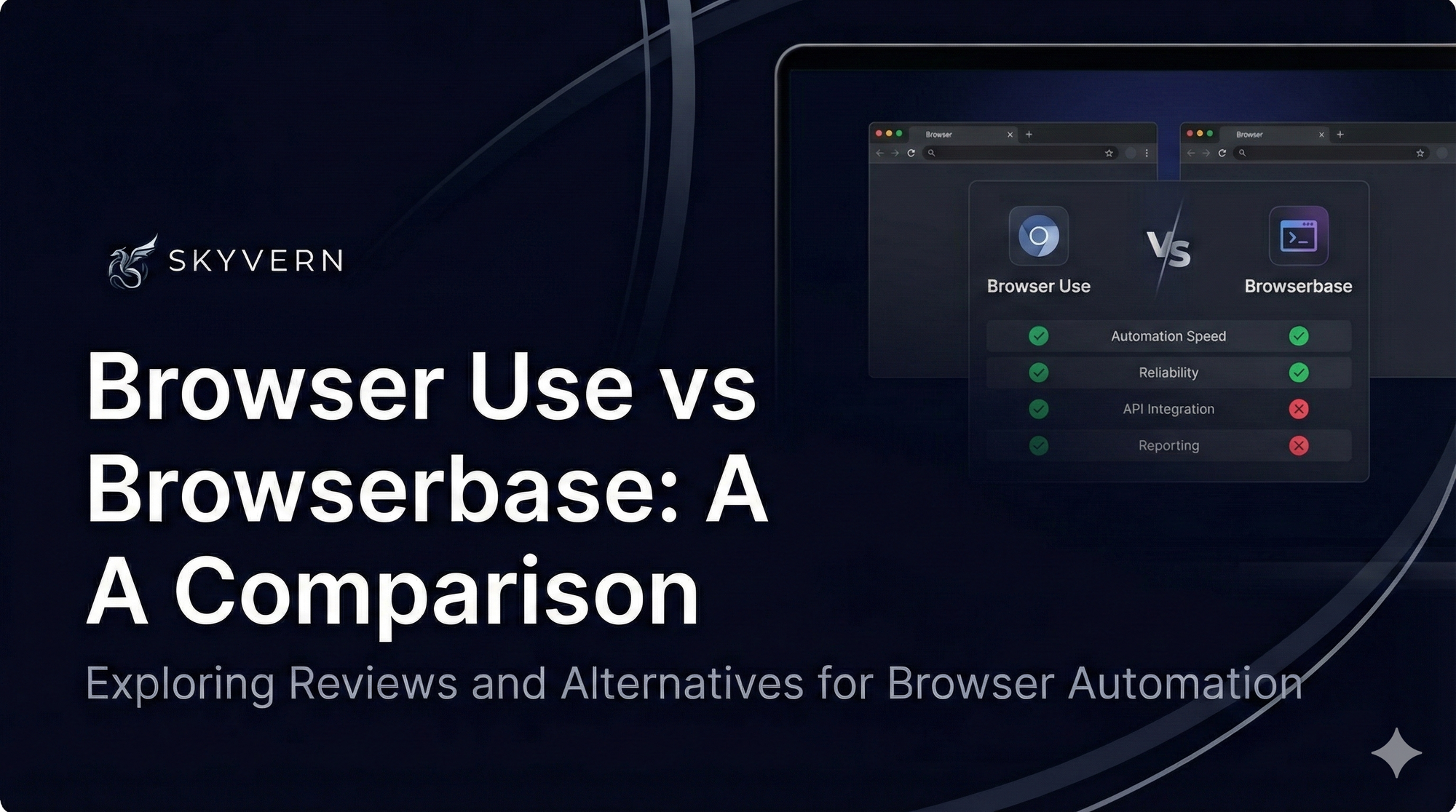
Browser Use vs Browserbase: my honest comparison
Browserbase and Browser Use can both automate work in a browser, from collecting product data to filling out forms. Choosing between them comes down to what you want to build: a task you hand to an AI agent, a custom agent inside your application, or browser infrastructure for scripts you already run. I’m Skyvern’s co-founder and CEO by the way. We build a competing product, so I have a stake in this comparison. But I promise I won't promote our product (even though it's a great alternative to
Put the browser to work
Use Skyvern for the work that lives in a browser.
Turn repetitive browser tasks into reliable workflows with Skyvern.