Skyvern blog
Agentic Process Automation & RPA
Guides to agentic and robotic process automation, from system design to costs and adoption.
Featured posts
 17 min read
What Is Agentic Automation? The Ops Team Guide (July 2026)
Long gone are the days when 'automate it' meant recording a click path and hoping the portal never changed. That model breaks too often, costs too much to maintain, and falls apart the moment a vendor redesigns a form. Agentic automation takes a different architectural approach, and for ops teams managing portal-heavy workflows, the distinction matters considerably more than the marketing around it. Here's what it actually means and how to think about whether it fits your situation. TLDR: * A
Suchintan SinghAgentic Process Automation & RPA 17 min read
RPA vs AI Agents: Comparing Methods and Choosing Right (July 2026)
The days of treating RPA and AI agents as two versions of the same thing are catching up with teams managing real production workflows. One replays a recorded sequence and breaks when the page changes. The other reads the current state of the page and reasons through whatever it finds. The comparison below maps out where each approach holds up, where it breaks, and how to match your actual workflow conditions to the right tool. TLDR: * RPA automates a fixed path and breaks silently when porta
Suchintan SinghAgentic Process Automation & RPA 17 min read
APA Control Plane for Agentic Automation (July 2026)
If you're running agentic process automation across more than a handful of portals, the wall where individual agents fall short is familiar. State doesn't persist across session timeouts. Exceptions have nowhere to go. There's no audit trail when something goes wrong. APA control plane agentic process automation is the infrastructure layer that solves those problems, and understanding how it works changes how you think about building automation that actually holds up in production. Skyvern is an
Suchintan SinghAgentic Process Automation & RPA
Latest
- 17 min read
What Is Agentic Automation? The Ops Team Guide (July 2026)
Long gone are the days when 'automate it' meant recording a click path and hoping the portal never changed. That model breaks too often, costs too much to maintain, and falls apart the moment a vendor redesigns a form. Agentic automation takes a different architectural approach, and for ops teams managing portal-heavy workflows, the distinction matters considerably more than the marketing around it. Here's what it actually means and how to think about whether it fits your situation. TLDR: * A
Suchintan SinghAgentic Process Automation & RPA - 17 min read
RPA vs AI Agents: Comparing Methods and Choosing Right (July 2026)
The days of treating RPA and AI agents as two versions of the same thing are catching up with teams managing real production workflows. One replays a recorded sequence and breaks when the page changes. The other reads the current state of the page and reasons through whatever it finds. The comparison below maps out where each approach holds up, where it breaks, and how to match your actual workflow conditions to the right tool. TLDR: * RPA automates a fixed path and breaks silently when porta
Suchintan SinghAgentic Process Automation & RPA - 17 min read
APA Control Plane for Agentic Automation (July 2026)
If you're running agentic process automation across more than a handful of portals, the wall where individual agents fall short is familiar. State doesn't persist across session timeouts. Exceptions have nowhere to go. There's no audit trail when something goes wrong. APA control plane agentic process automation is the infrastructure layer that solves those problems, and understanding how it works changes how you think about building automation that actually holds up in production. Skyvern is an
Suchintan SinghAgentic Process Automation & RPA  19 min read
The 2026 Enterprise Guide to Agentic Process Automation
Long gone are the days when 'we automated it' meant you were done maintaining it. If you're running RPA at scale, a big chunk of your team's time is probably spent on upkeep, patching bots every time a vendor portal renames a field or shuffles a form layout. This enterprise guide to agentic process automation breaks down why that maintenance burden is an architectural problem, not an implementation one, and how agents that read pages visually at runtime change the math on portal-heavy workflows
Suchintan SinghAgentic Process Automation & RPA 18 min read
Agentic vs. Traditional RPA: What's the Difference? (Updated July 2026)
There's a reason so many operations teams that started with RPA are asking about agentic automation now. It's not that their bots were built badly, it's that selector-based tools were built on a static assumption, and most real-world portals don't hold that assumption for long. The agentic process automation vs. RPA conversation is really a conversation about what breaks first: the page, or your maintenance backlog. Here's how the two approaches compare, where each one fits, and where the distan
Suchintan SinghAgentic Process Automation & RPA 19 min read
Building the Agentic Process Automation Stack in 2026 (July 2026)
Long gone are the days when you could record a login path once and trust it to run clean six months later. Portal layouts change, 2FA prompts rotate, session flows shift, and the script that worked last Tuesday silently delivers nothing this Tuesday. The agentic process automation stack is the architectural response to that compounding maintenance problem, and it's made up of four distinct layers that each carry a different set of responsibilities. Getting clear on what those layers are, and wh
Suchintan SinghAgentic Process Automation & RPA 18 min read
The Case for Agentic Process Automation in 2026
The portals your team depends on most, insurance payer systems, carrier quote platforms, government permit applications, were built for people, not for automation scripts. Every time one of them changes, someone pays for it in maintenance hours or broken workflows. Agentic process automation takes a different architectural approach entirely, and the business case for making that switch is clearest when you look at where traditional automation keeps failing the same way for the same reason. This
Suchintan SinghAgentic Process Automation & RPA 21 min read
Five-Layer Framework for Agentic Process Automation (July 2026)
Your automation breaks at the same places every time: the login flow changes, a form gets restructured, a modal fires mid-session, the output lands in the wrong schema. Those aren't random failures. They map to specific layers in how any Agentic Process Automation (APA) system is built, and each one has its own failure mode, its own fix, and its own architectural requirements. Walk through all five and you'll have a cleaner way to diagnose what's actually going wrong. TLDR: * Agentic Process
Suchintan SinghAgentic Process Automation & RPA 19 min read
APA Maturity Model: Stages, Metrics & Strategy (July 2026)
If your automation program has grown past a handful of scripts, you already know the gap between 'we have automation' and 'our automation scales.' Bots break when portals change, governance is an afterthought, and new workflows take longer to ship than they should. The scripts, though, are not usually the problem. The architecture is. An Agentic Process Automation (APA) maturity model gives you a way to diagnose what is actually blocking you. It maps where your program sits across five dimensio
Suchintan SinghAgentic Process Automation & RPA 13 min read
What Is APA Automation? Complete Guide Updated for 2026
The workflows that cost teams the most time are almost never the complex ones. They're the repetitive, portal-based tasks that have no API, that someone has to log into manually, and that break every script you build around them. Agentic Process Automation (APA) was built for exactly this gap. If you're trying to figure out what it is, how it actually works under the hood, and whether it's the right fit for your team, this guide covers all of it. TLDR: * APA agents read the live page state at
Suchintan SinghAgentic Process Automation & RPA 10 min read
What Is Agentic AI? A Complete Guide for February 2026
Most explanations of what is agentic AI focus on theory while you're trying to understand if it solves your actual workflow problems. Here's what matters: agentic AI takes a goal, breaks it into steps, executes those steps across different systems, and adjusts when something doesn't go as planned. That's not generative AI waiting for prompts or robotic process automation following rigid scripts. It's closer to having an assistant who checks your supplier portals, compares pricing, places orders,
Suchintan SinghAgentic Process Automation & RPA 11 min read
What Is AI Automation? Full Guide Updated for July 2026
Everyone talks about automating workflows, but your reality involves vendor portals without APIs, insurance forms that look different each time, and supplier sites that redesign without warning. Traditional scripts can't handle that variability. AI automation tools adapt to these changes by understanding what elements do instead of where they're located. We'll cover how this works in practice and which workflows benefit most from visual interpretation. TLDR: * AI automation uses LLMs and comp
Suchintan SinghAgentic Process Automation & RPA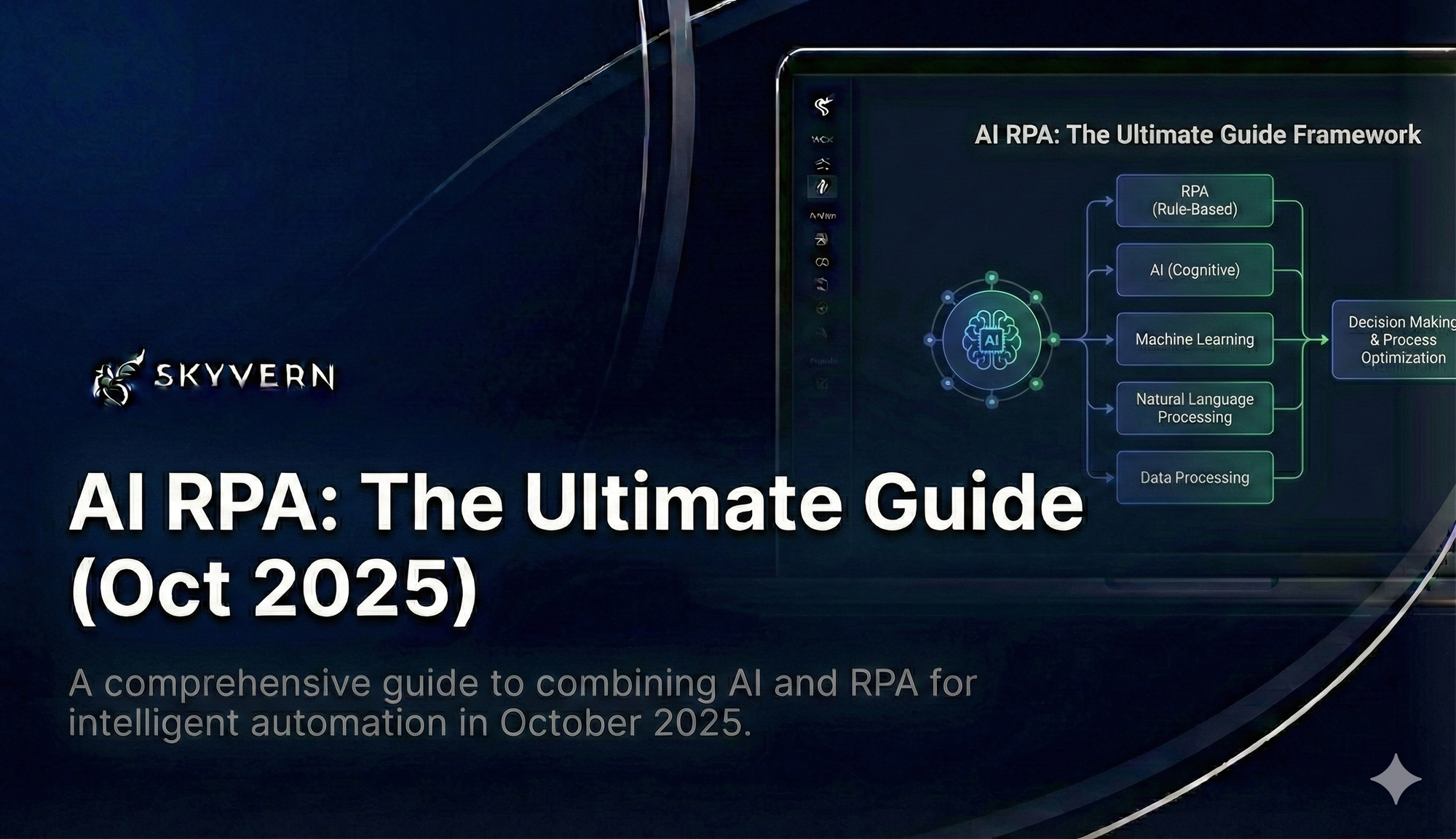 8 min read
AI RPA: The Ultimate Guide for October 2025
You've probably tried automating browser tasks, only to watch your scripts break when websites update. Traditional automation tools rely on brittle selectors that fail when buttons move or forms change, leaving you constantly fixing broken workflows instead of focusing on strategic work. Fortunately, modern AI RPA solutions use computer vision and language models to understand websites like humans do, adapting to changes automatically without requiring constant maintenance. This intelligent app
Suchintan SinghAgentic Process Automation & RPA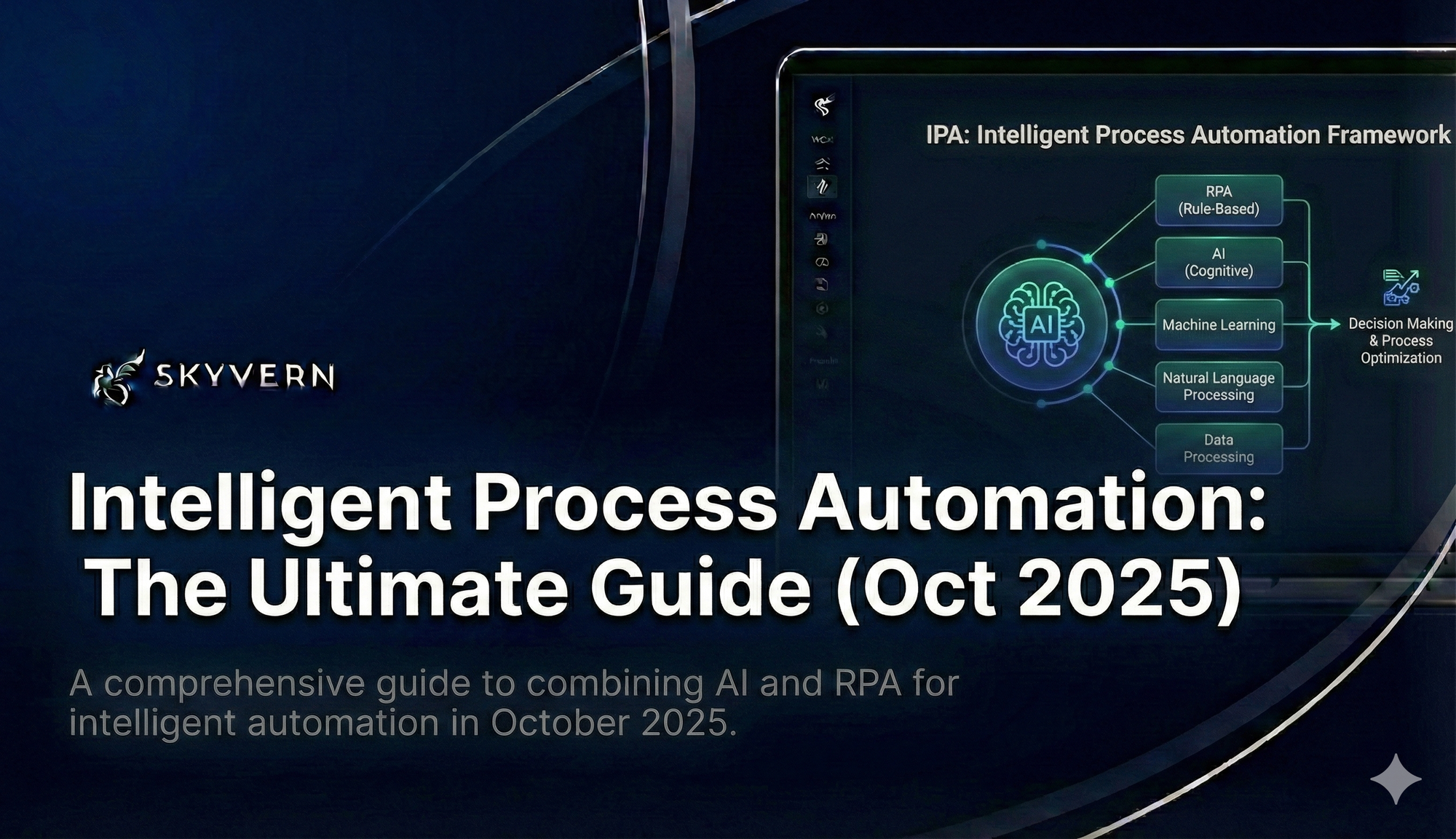 7 min read
Intelligent Process Automation: The Ultimate Guide for October 2025
Manual workflows likely eat up half your team's day, clicking through the same browser-based tasks over and over. Fortunately, intelligent process automation tools have finally evolved to the point where AI can actually handle those complex, unpredictable workflows that traditional automation scripts constantly break on. TLDR: * IPA combines AI with automation to handle complex workflows that break traditional scripts * Organizations achieve 50-70% task automation and 20-35% cost savings wit
Suchintan SinghAgentic Process Automation & RPA