Skyvern blog
The Skyvern journal
Read about AI agents, browser automation, and reliable web workflows.
August
 8 min read
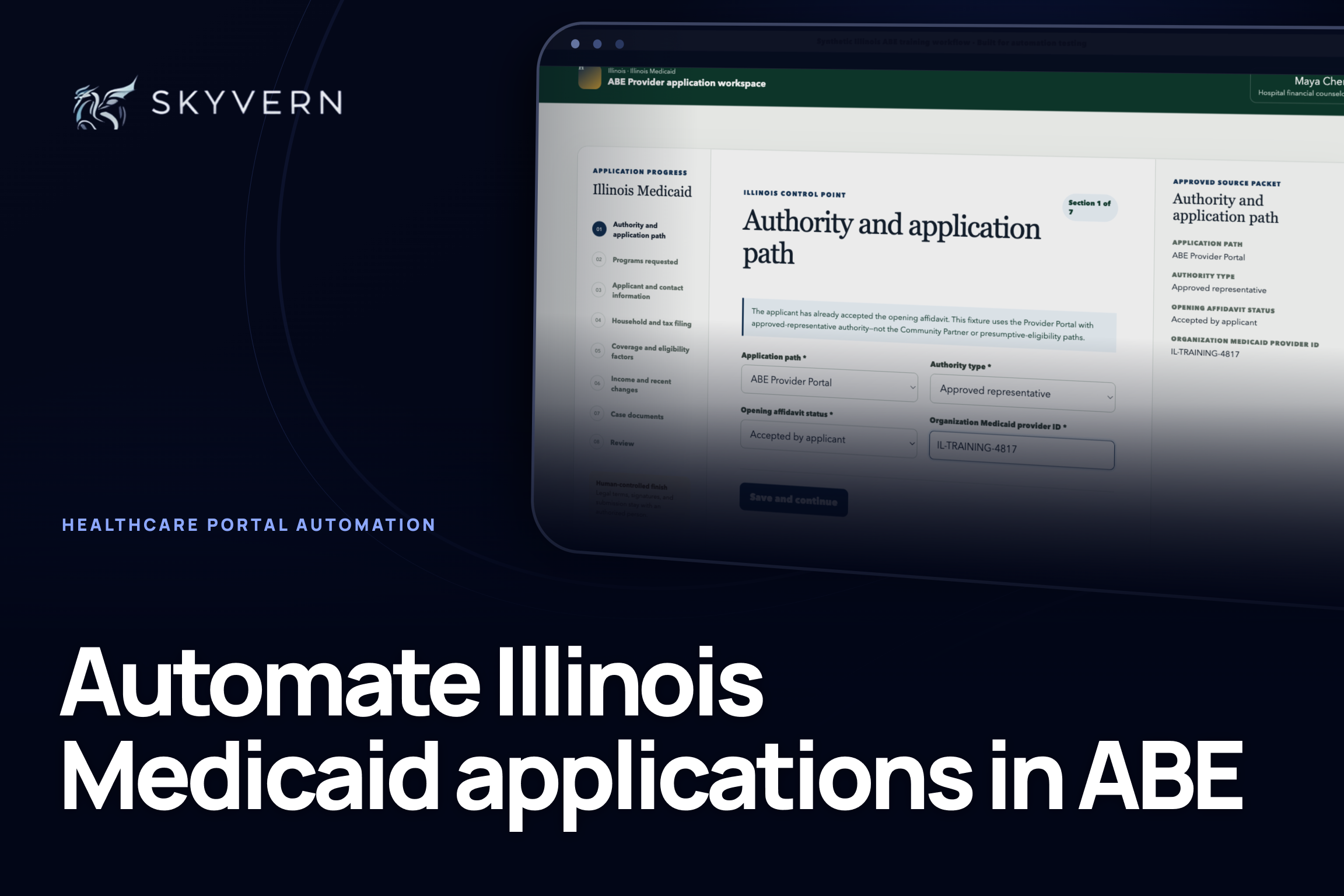
How to automate Illinois Medicaid application prep in ABE
A step-by-step tutorial showing how Skyvern prepares an Illinois Medicaid application in an ABE training workflow and stops for human review.
Healthcare Automation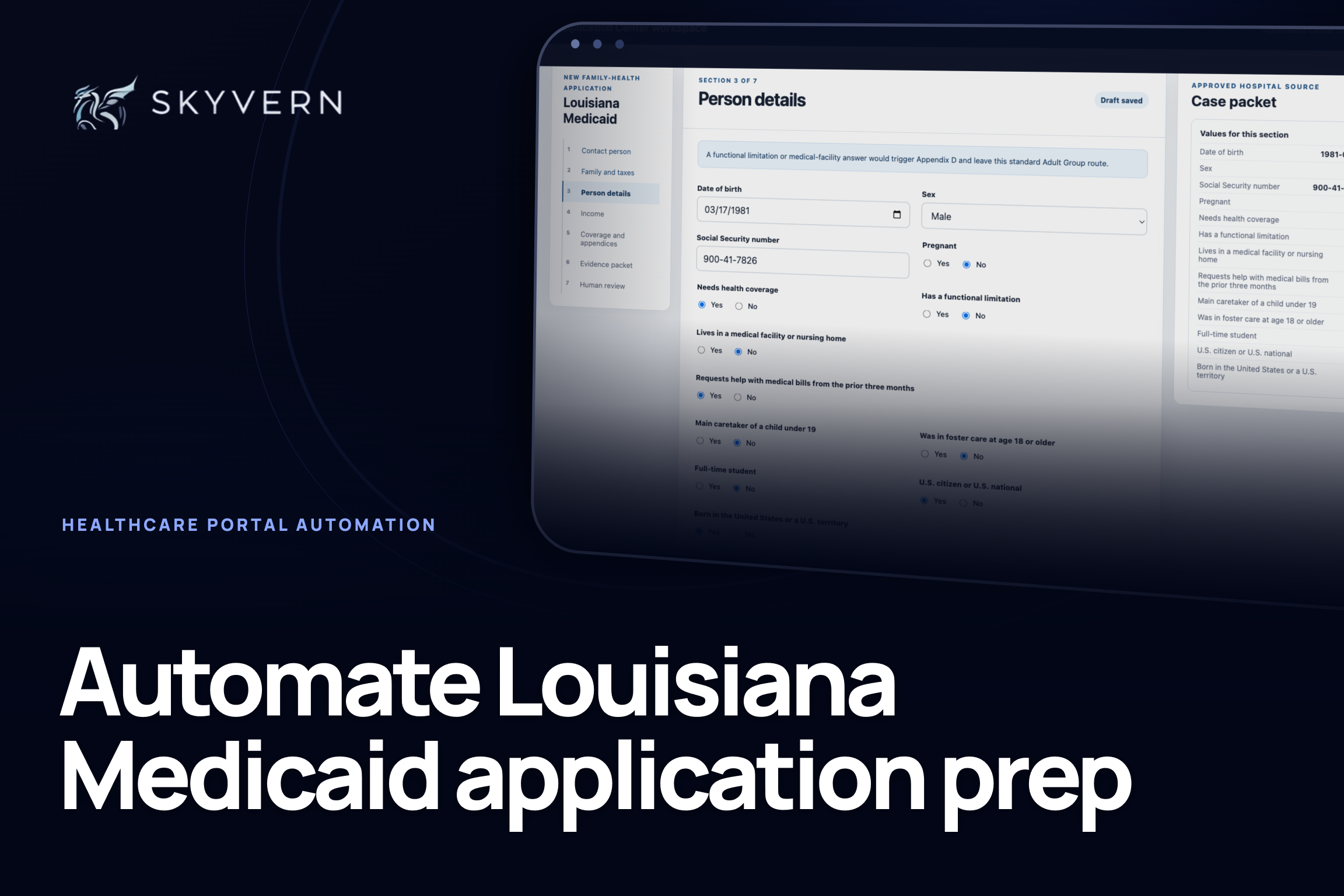 9 min read
How to automate Louisiana Medicaid application prep with Skyvern
A step-by-step tutorial showing how Skyvern prepared a synthetic Louisiana Medicaid application and stopped for human review.
Healthcare Automation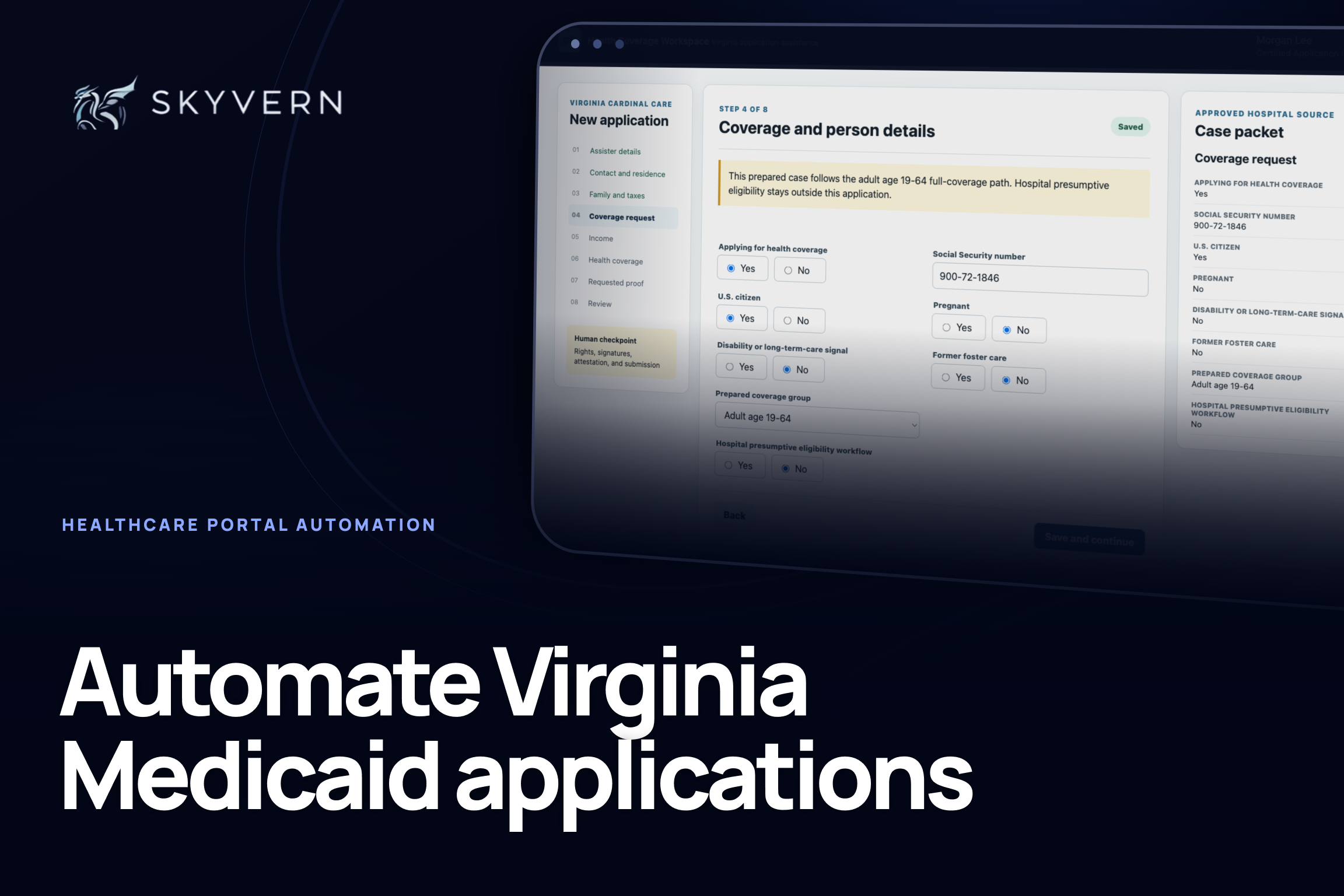 9 min read
How to automate Virginia Medicaid application prep in CommonHelp
A step-by-step tutorial showing how Skyvern prepared a synthetic Virginia Cardinal Care application and stopped for human review.
Healthcare Automation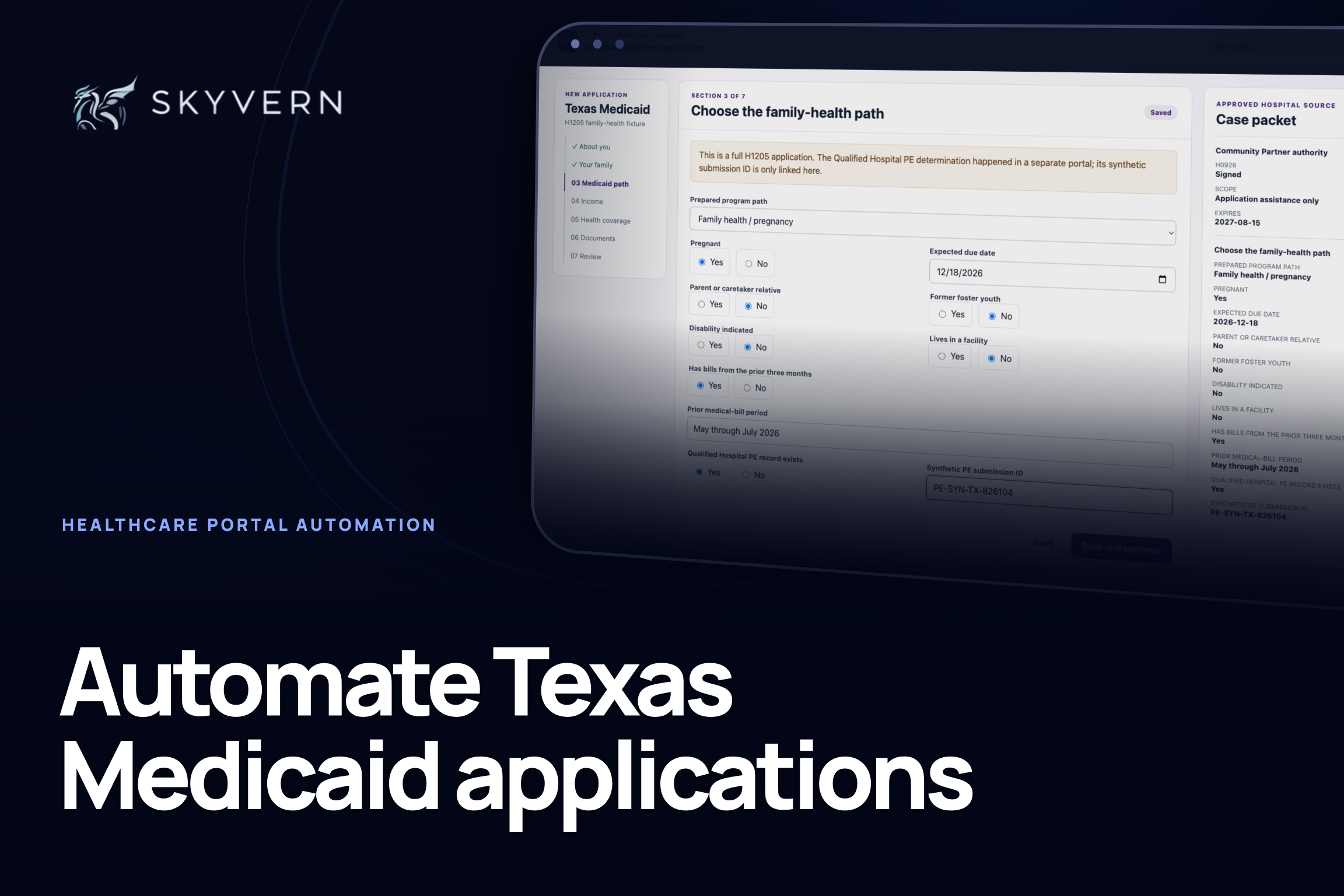 10 min read
How to automate Texas Medicaid applications in Your Texas Benefits
A step-by-step tutorial showing how Skyvern prepared a synthetic Texas Medicaid application, linked a hospital PE record, and stopped for human review.
Healthcare Automation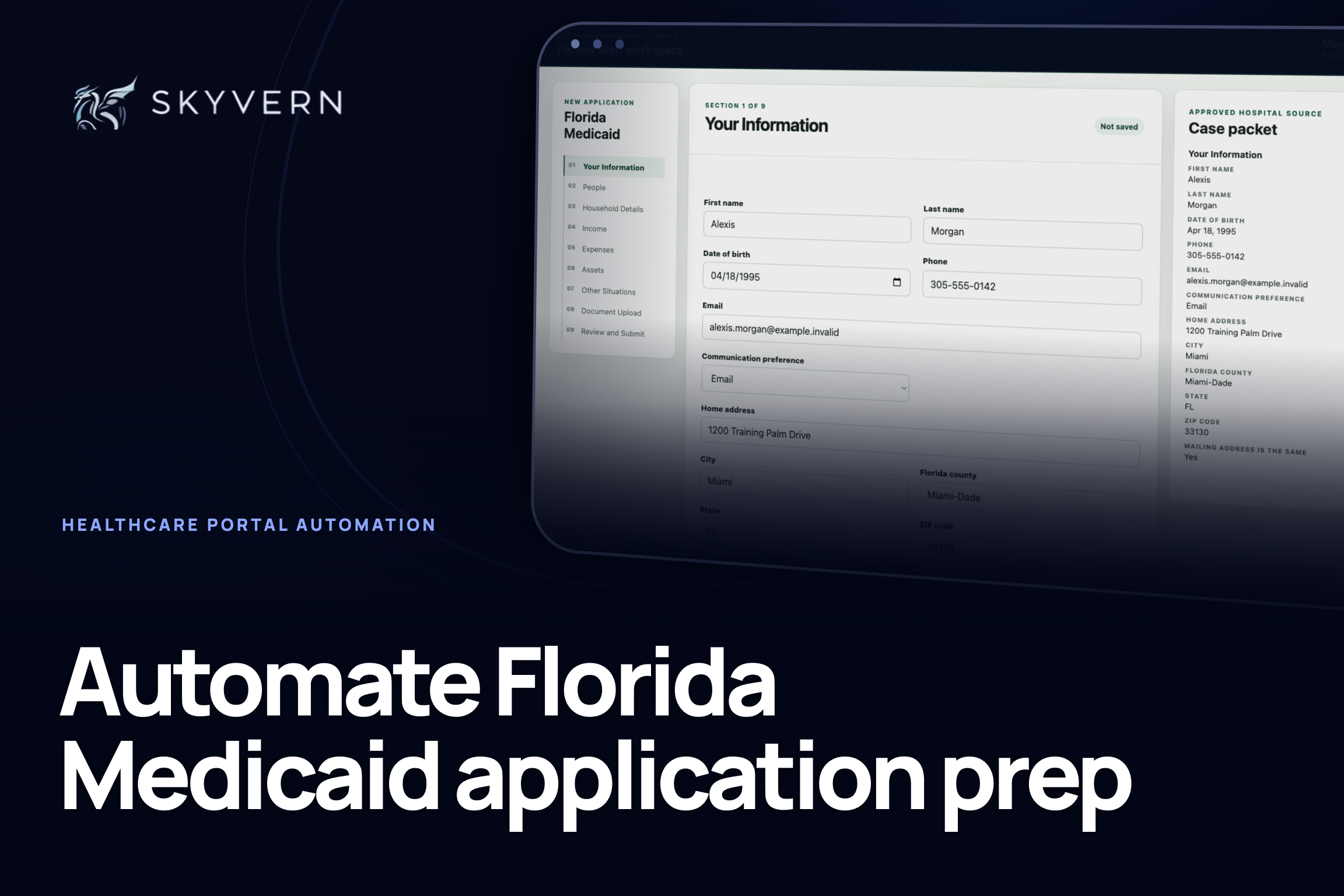 9 min read
How to automate Florida Medicaid application prep with Skyvern
A step-by-step tutorial showing how Skyvern prepared a synthetic Florida Medicaid application in a MyACCESS-style workflow and stopped for human review.
Healthcare Automation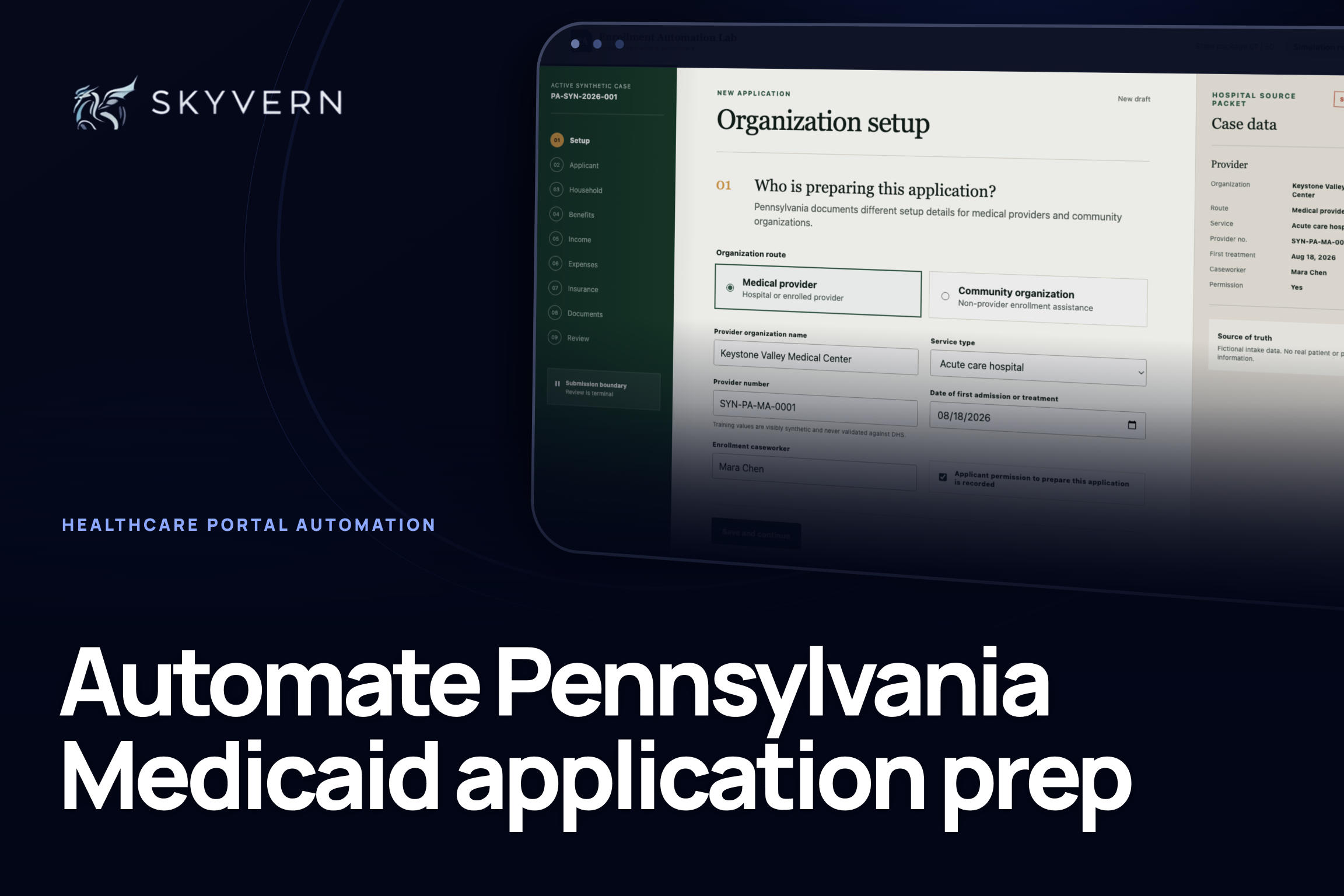 9 min read
How to automate Pennsylvania Medicaid application prep with Skyvern
A step-by-step tutorial showing how Skyvern prepared a synthetic Pennsylvania Medical Assistance application from a hospital case packet and stopped for human review.
Healthcare Automation 11 min read
9 Prior Authorization Companies Compared (2026)
Compare nine prior authorization companies by workflow coverage, setup, human review, who each product serves, and the work each leaves to your team.
Comparisons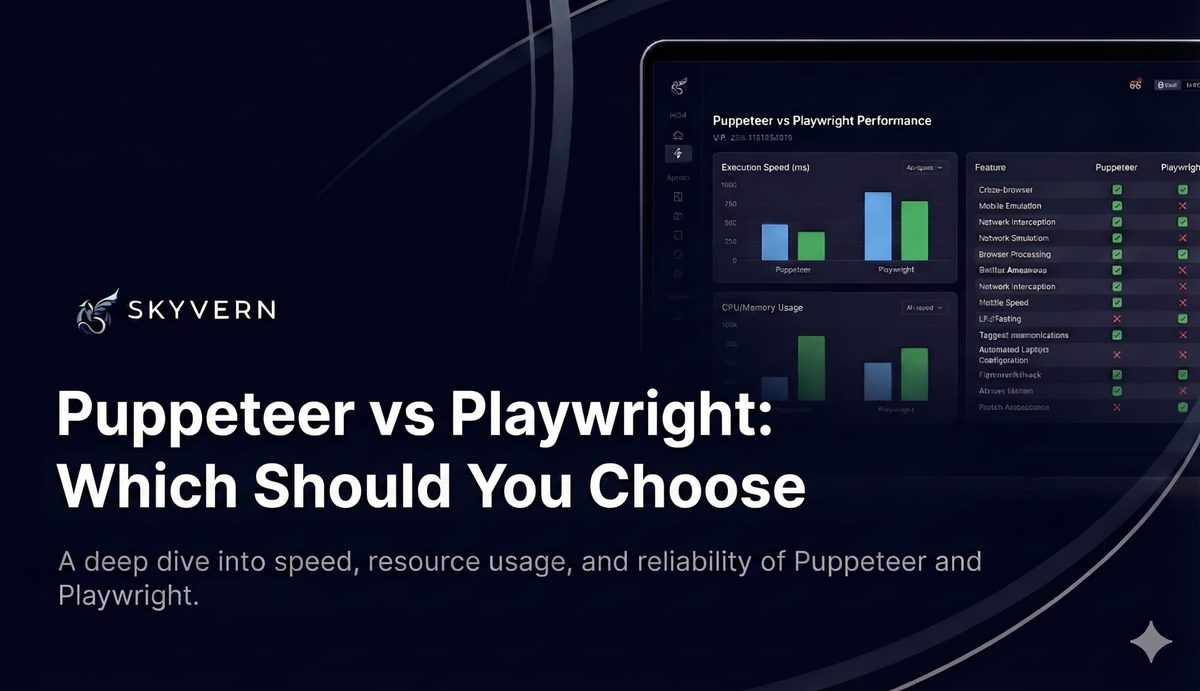 8 min read
Puppeteer vs Playwright: Which Should You Choose? (Benchmarked)
Compare Puppeteer and Playwright by browser coverage, test tooling, maintenance, and benchmark limits to choose the right automation library.
Comparisons 7 min read
Skyvern Changelog — July 2026
Everything we shipped in July 2026 — weeks of June 30, July 6, 13, 20, and 27.
Changelog 6 min read
Utility Bill Data Extraction Automation Guide (August 2026)
When your Puppeteer script can't find the download button after a portal redesign, you're not dealing with a small bug. You're looking at days of developer time to fix selectors, multiplied by however many vendor portals broke this month. Traditional utility bill data extraction automation fails at scale because it memorizes specific page structures instead of understanding what those pages actually do, which means every interface change becomes your problem to solve manually. TLDR: * Manual
Finance & Insurance Automation 14 min read
Airtop vs Skyvern: Head-to-Head (August 2026)
Most browser automation comparisons treat every tool as a variation of the same thing. Airtop and Skyvern aren't. One is cloud infrastructure for developers who want to manage their own agent logic. The other is a goal-directed execution platform built for ops teams running portal-heavy workflows that break scripts on every vendor update. That's the class of problem Agentic Process Automation platforms are built for — where browser execution is the mechanism, but autonomous operation, exception
Comparisons 15 min read
CloudCruise vs Skyvern: Side-by-Side (August 2026)
Most browser automation comparisons focus on features. The one that actually matters is what each tool does the first time a portal renames a button or adds a new login step. CloudCruise and Skyvern answer that question very differently, and your answer should probably follow from theirs. That question is what separates Agentic Process Automation platforms from session-replay tools — one class was built to handle change as runtime input; the other was built to replay a path that no longer exists
Comparisons 19 min read
Firecrawl vs Skyvern: Key Differences (July 2026)
You're trying to automate something web-based and you're weighing your options. Firecrawl and Skyvern both come up, they both handle browser content, and it's not immediately clear what separates them. But the architectural gap between the two is considerable: one reads public pages and returns the content, the other operates inside authenticated portals, handles 2FA, fills forms, and delivers structured output from workflows that have no API. That second class of problem (credential-guarded por
Comparisons
July
 17 min read
What Is Agentic Automation? The Ops Team Guide (July 2026)
Long gone are the days when 'automate it' meant recording a click path and hoping the portal never changed. That model breaks too often, costs too much to maintain, and falls apart the moment a vendor redesigns a form. Agentic automation takes a different architectural approach, and for ops teams managing portal-heavy workflows, the distinction matters considerably more than the marketing around it. Here's what it actually means and how to think about whether it fits your situation. TLDR: * A
Agentic Process Automation & RPA 17 min read
APA Control Plane for Agentic Automation (July 2026)
If you're running agentic process automation across more than a handful of portals, the wall where individual agents fall short is familiar. State doesn't persist across session timeouts. Exceptions have nowhere to go. There's no audit trail when something goes wrong. APA control plane agentic process automation is the infrastructure layer that solves those problems, and understanding how it works changes how you think about building automation that actually holds up in production. Skyvern is an
Agentic Process Automation & RPA 2 min read
Rustwright: Playwright rewritten in rust that occupies 70% less memory (and is 2.55x faster)
Hey everyone, Suchintan from Skyvern (YC S23). We run browser automation for AI agents at scale, and we're launching Rustwright: Playwright on an in-process Rust CDP engine. The engine consumes 70% less memory than Playwright, and is 2.55x faster to boot. We built this to improve Skyvern’s memory footprint, and thought this would be independently valuable to the broader community The whole idea fits in two lines: playwright-python: your code ──pipe──► Node driver ──CDP──► Chromium rustwrig
Engineering & Research 19 min read
Building the Agentic Process Automation Stack in 2026 (July 2026)
Long gone are the days when you could record a login path once and trust it to run clean six months later. Portal layouts change, 2FA prompts rotate, session flows shift, and the script that worked last Tuesday silently delivers nothing this Tuesday. The agentic process automation stack is the architectural response to that compounding maintenance problem, and it's made up of four distinct layers that each carry a different set of responsibilities. Getting clear on what those layers are, and wh
Agentic Process Automation & RPA 18 min read
The Case for Agentic Process Automation in 2026
The portals your team depends on most, insurance payer systems, carrier quote platforms, government permit applications, were built for people, not for automation scripts. Every time one of them changes, someone pays for it in maintenance hours or broken workflows. Agentic process automation takes a different architectural approach entirely, and the business case for making that switch is clearest when you look at where traditional automation keeps failing the same way for the same reason. This
Agentic Process Automation & RPA 21 min read
Five-Layer Framework for Agentic Process Automation (July 2026)
Your automation breaks at the same places every time: the login flow changes, a form gets restructured, a modal fires mid-session, the output lands in the wrong schema. Those aren't random failures. They map to specific layers in how any Agentic Process Automation (APA) system is built, and each one has its own failure mode, its own fix, and its own architectural requirements. Walk through all five and you'll have a cleaner way to diagnose what's actually going wrong. TLDR: * Agentic Process
Agentic Process Automation & RPA 19 min read
APA Maturity Model: Stages, Metrics & Strategy (July 2026)
If your automation program has grown past a handful of scripts, you already know the gap between 'we have automation' and 'our automation scales.' Bots break when portals change, governance is an afterthought, and new workflows take longer to ship than they should. The scripts, though, are not usually the problem. The architecture is. An Agentic Process Automation (APA) maturity model gives you a way to diagnose what is actually blocking you. It maps where your program sits across five dimensio
Agentic Process Automation & RPA 13 min read
What Is APA Automation? Complete Guide Updated for 2026
The workflows that cost teams the most time are almost never the complex ones. They're the repetitive, portal-based tasks that have no API, that someone has to log into manually, and that break every script you build around them. Agentic Process Automation (APA) was built for exactly this gap. If you're trying to figure out what it is, how it actually works under the hood, and whether it's the right fit for your team, this guide covers all of it. TLDR: * APA agents read the live page state at
Agentic Process Automation & RPA 15 min read
UiPath vs Skyvern: Full Comparison (July 2026)
Every RPA comparison of Skyvern vs UiPath tends to stack feature against feature, but the more useful question is what breaks first when a vendor updates their portal without warning. If your workflows run on stable internal systems like SAP or Oracle, that question barely matters. If they run on credential-guarded portals that change on someone else's schedule, it's the only question that matters. Here's how each tool handles the answer. That answer sits at the heart of what separates tradition
Comparisons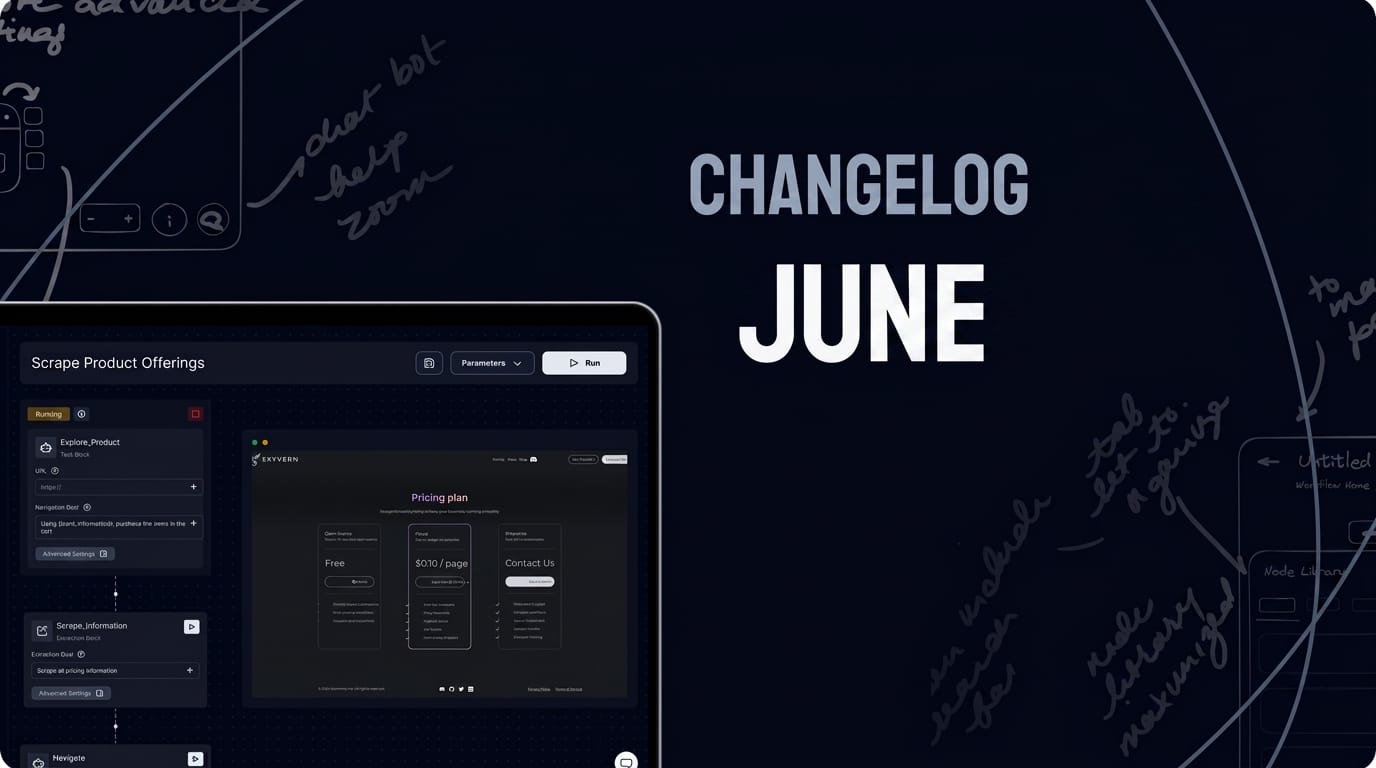 5 min read
Skyvern Changelog — June 2026
Everything we shipped in June 2026 — weeks of June 1, 8, 15, and 22. Workflows Are Now Agents We renamed Workflows to Agents across the product, the public API, and the docs. The API now lives under /agents (e.g. POST /v1/run/agents) and accepts an agent_id alias for workflow_id — same wpid_ value, echoed back in responses. It's fully backwards-compatible: your existing workflow_id inputs, /workflows endpoints, SDK methods, and bookmarked doc URLs all keep working. Workflow Studio (Beta) M
Changelog
June
 7 min read
How We Cut Token Count by 11% and Boosted Success Rate by 3.9% Using HTML Instead of JSON in LLM Calls (Updated June 2026)
Every time Skyvern takes an action on a web page, it sends an annotated screenshot plus a structured description of every interactable element to a multimodal LLM: buttons, inputs, dropdowns, the works. That description is where a lot of tokens go. We'd been representing those elements as JSON, which is readable and explicit, but also verbose. After hearing from others in the space that HTML and markdown representations could cut token counts by 15% or more, we decided to test it ourselves. The
Engineering & Research 12 min read
Kernel vs Skyvern: Which is Better for Browser Automation? (June 2026)
You've got a workflow that runs on a portal with no API, requires credentials that rotate, and breaks automation scripts every time the vendor updates their layout. Kernel provisions clean, fast browser sessions in 300 milliseconds and ships anti-detection configuration out of the box, but you still write and maintain the automation logic yourself. Skyvern reads the live page state visually, identifies interactive elements by appearance and context, and keeps going when portals change instead of
Comparisons