Skyvern blog
The Skyvern journal
Read about AI agents, browser automation, and reliable web workflows.
February
 8 min read
10 Insurance Carrier Workflows You Can Automate in February 2026
You're burning hours on repetitive insurance workflows that should run themselves. Policy renewals need data pulled from multiple portals, claims processing starts with manual FNOL entry, and compliance reports require aggregating information across systems that refuse to integrate. Every automation script you've tried breaks when websites change their layouts, leaving your team back at square one with manual data entry. The solution isn't better scripts but automation that reads screens like a
Finance & Insurance Automation 11 min read
What Is AI Automation? Full Guide Updated for July 2026
Everyone talks about automating workflows, but your reality involves vendor portals without APIs, insurance forms that look different each time, and supplier sites that redesign without warning. Traditional scripts can't handle that variability. AI automation tools adapt to these changes by understanding what elements do instead of where they're located. We'll cover how this works in practice and which workflows benefit most from visual interpretation. TLDR: * AI automation uses LLMs and comp
Agentic Process Automation & RPA 8 min read
How to Automate Immigration and Visa Applications on Government Portals (February 2026)
Government portals change their layouts constantly, breaking any automation that relies on fixed HTML selectors. Your team wastes hours rewriting Selenium scripts every time USCIS or UK Home Office updates their forms. The solution to reliably automate visa application forms isn't better XPath expressions but computer vision that reads forms like a human would, finding fields by their visible labels and context instead of code that breaks with every portal redesign. TLDR: * Manual visa proces
Legal & Compliance Automation 9 min read
Best Layout-Resistant Browser Automation Tools for Dynamic Websites (February 2026)
You've built automation workflows that work beautifully until the target website pushes an update. Then you're spending hours debugging selector failures and remapping element IDs across multiple sites. Layout-resistant automation solves this by treating web pages the way humans do, understanding visual context instead of relying on brittle technical identifiers. We tested eight tools to find which ones genuinely handle dynamic websites without constant maintenance. TLDR: * Layout-resistant t
Comparisons 12 min read
Best RPA Software, Compared by the Work You Automate
Are you evaluating RPA tools to automate some recurring work? At Skyvern, we build AI browser automation that lets ops teams create and maintain browser workflows themselves. We see a lot of teams coming from heavy, janky legacy RPA platforms, so we have strong opinions on them. In this article, we look at some of the most well-know enterprise RPA platforms, open-source tools, and AI browser automation, including Skyvern, to help you build a shortlist. We'll go over application support and AI
Comparisons 8 min read
Browser Use vs Airtop: Which Tool Works Better? (February 2026)
The browser automation space keeps adding new tools, and Browser Use versus Airtop is the latest comparison everyone's asking about. Here's what actually matters: Browser Use gives you a self-hosted Python library with more control over deployment, while Airtop removes infrastructure headaches with managed cloud browsers. The choice seems simple until you run into authentication challenges, need to handle CAPTCHAs reliably, or scale past the point where manual session management becomes a daily
Comparisons 9 min read
Browser Use vs UiPath: Which is Better? (February 2026)
You've narrowed your automation solution search to Browser Use or UiPath. One gives you AI flexibility with Python required, the other offers visual builders with enterprise licensing costs. The real difference shows up three months in when your automated workflows start breaking because a vendor changed their form layout. We're walking through how each tool handles website updates, what breaks, and what keeps working. TLDR: * Browser Use uses AI to adapt to website changes automatically, whi
Comparisons 7 min read
Browserbase vs Airtop: Which Browser Automation Tool is Better? (February 2026)
When you're scaling browser automation, the infrastructure question eventually hits: build it yourself or use a managed service. Browserbase and Airtop both handle the headless browser complexity, but they solve different problems. One lets you migrate existing scripts with minimal changes, the other asks you to rethink your entire workflow around natural language commands. The choice depends on whether you need framework flexibility or you're willing to bet everything on AI-driven interactions.
Comparisons 8 min read
Browserbase vs UiPath: Which Is Better for Automation? (February 2026)
Your automation breaks every time a website changes, and you're trying to figure out which platform will reduce that maintenance burden. Browserbase offers cloud browser infrastructure with natural language methods through Stagehand. UiPath provides enterprise RPA with visual workflow design. The reality is that both still depend on selectors and UI descriptors that need manual updates when websites change their structure. TLDR: * Browserbase provides cloud browser infrastructure while UiPath
Comparisons 11 min read
Browserbase vs Stagehand for Automation (August 2026)
You're weighing Browserbase against Stagehand and the technical specs tell part of the story. One provides serverless browser infrastructure, the other adds natural language automation on top of existing frameworks. The hidden complexity comes out when you're juggling separate invoices for browser time, LLM tokens, and proxy bandwidth while your authentication workflows fail six times out of ten. We'll compare pricing structures, infrastructure requirements, and what each tool expects you to bui
Comparisons 6 min read
Browser Use vs Kernel Comparison: Which Tool Wins in February 2026?
The automation comparison between Browser Use and Kernel gets confusing because they're not competing products. One is an agent library that uses LLMs to decide which buttons to click, and the other is infrastructure that provisions browsers and manages their lifecycle. You might need Browser Use if your scripts break every time a website changes its layout, or you might need Kernel if spinning up browsers locally is eating your CI budget. Sometimes you need both, sometimes neither. TLDR: * B
Comparisons 11 min read
Firecrawl Alternatives: The Best Tools for Scraping, Search and Logged-In Workflows
Firecrawl is a web data API that turns websites into clean Markdown or structured JSON for LLM apps, through its scrape, crawl, map and search endpoints. People look for a Firecrawl alternative for one of three reasons. The bill grows faster than expected, especially with JSON extraction. Some target sites keep blocking requests. Or the job turns out to be a workflow in a logged-in portal: sign in, get past a CAPTCHA or a two-factor prompt, fill a form, download a file, and keep a record of wha
Comparisons
January
 12 min read
Best Browse AI Alternatives and Pricing (August 2026)
You've got a robot for each vendor portal. One breaks on Monday because the site moved a button. Another stopped pulling invoices last week: the login flow changed and nobody told you. A third never handled form submission in the first place, so that workflow still runs manually. Keeping all of them alive means constant retraining, separate tools stitched together for form filling, file downloads, and authentication, and a maintenance backlog that grows every time a supplier redesigns their site
Comparisons 3 min read
Launch Week - Day 5 - Simpler Pricing Model
Update, November 2026: plans have changed since this post. See the current plans on the pricing page. Automation pricing is usually optimized for the vendor, not the user. You pay per step, per action, per minute, or per obscure unit that only makes sense if you already understand the internals of the system. The result is predictable: people under-automate, over-optimize prematurely, or stop experimenting altogether because they don’t trust the bill. We’re changing that. Today we’re launchi
Product Updates 14 min read
Axiom Reviews, Pricing, and Alternatives (Updated July 2026)
Axiom breaks the moment a website redesigns its checkout flow, renames a button, or shifts a menu. You rebuild the selector, test it, and ship again. Three weeks later, the same thing happens. If you're watching costs push past $300 monthly while half your time goes to patching broken workflows instead of building new ones, it's worth knowing what else is available. This guide covers the alternatives to Axiom that tackle layout changes without rebuilding, what they cost, and what tradeoffs you'r
Comparisons 2 min read
Launch Week - Day 4 - SOP Upload to build new Workflows
Most companies already know how their work gets done. It’s written down somewhere: * internal SOPs * runbooks * onboarding docs * Notion pages no one wants to maintain The problem isn’t lack of documentation. It’s that documentation doesn’t run. Today we’re shipping SOP Upload, a way to turn existing process documentation directly into executable browser automation. The gap between “written” and “working” Traditional automation tools assume you’ll start from scratch: * re-specify t
Product Updates 8 min read
CloudCruise Reviews, Pricing, and Alternatives (January 2026)
You're looking into CloudCruise because you need browser automation, but the pricing model creates budget uncertainty, and the workflow structure requires separate configurations for each site you automate. That graph-based DSL looks organized until you realize you're building and maintaining different workflows for every vendor portal, insurance site, or government form you interact with. Even with LLM help, those workflows depend on selectors that break during website updates. Here's what Clou
Comparisons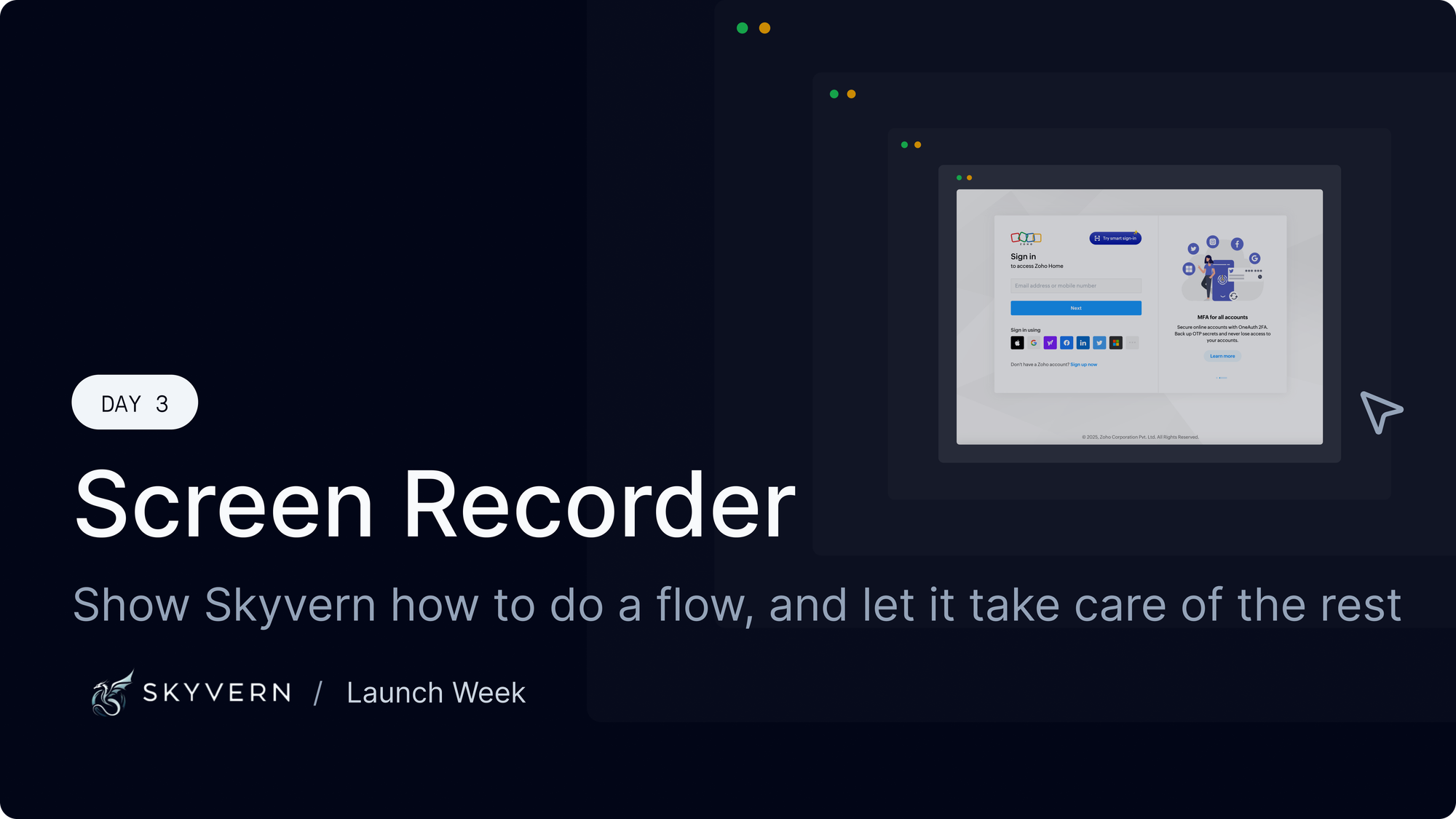 2 min read
Launch week - Day 3 - "Show don't tell" - Screen record your workflows with Skyvern
Most browser automation fails because the interface between humans and automation is wrong. We ask users to describe workflows that are fundamentally visual and stateful. Then we’re surprised when the agent breaks, edge cases pile up, and maintenance cost dominates everything else. We built the Skyvern Screen Recorder to change that interface. Instead of telling an agent what to do, you show it. Give it a try here: app.skyvern.com The core idea If a human can complete a workflow in a brow
Product Updates 5 min read
Launch Week - Day 2 - New and improved SDK
Skyvern SDK v1+ lets you run tasks and workflows and share browser state over a CDP connection. The SDK supports two modes: embedded (local) and remote (cloud). Embedded (Local) mode Get started locally: * uv venv && source .venv/bin/activate — optional but recommended to create a virtual env * uv pip install skyvern — install the Skyvern SDK * skyvern quickstart — follow prompts to configure the environment (AI API keys, etc.) Python example: import asyncio from skyvern import Skyver
Product Updates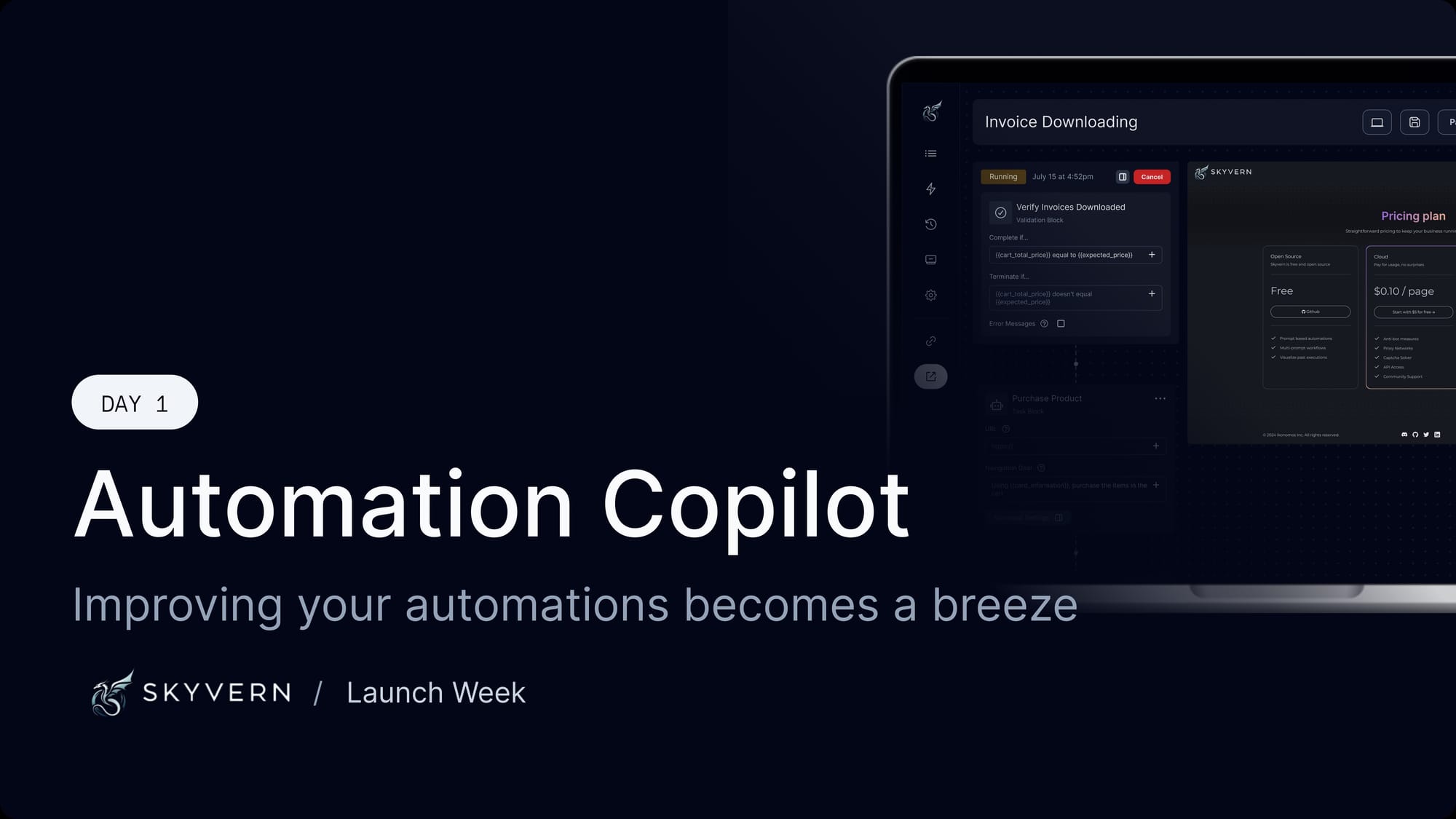 1 min read
Launch Week Day 1 - Automation Copilot: Faster Time-to-Automation
Automation Copilot reduces time-to-automation. Not by making automation “easier to start,” but by making it faster to: * build * modify * and maintain real, production browser workflows. What it is Automation Copilot is an in-product, workflow-aware chat interface. It can: * generate new Skyvern workflows from prompts * edit existing workflows in place * reason about failures and apply targeted fixes It operates directly on Skyvern’s workflow graph. Outputs are executable, not sugg
Product Updates 11 min read
Sola Reviews, Pricing, and Alternatives (January 2026)
Everyone loves the idea of recording a workflow once and letting a bot handle it forever. Sola delivers on that promise for simple, repetitive tasks on familiar interfaces. But the copilot model requiring human intervention doesn't scale when you're automating across dozens of websites with different layouts, or when you need bots running unsupervised overnight. We're walking through Sola's capabilities, pricing, and the alternatives that handle autonomous multi-site automation without breaking
Comparisons 9 min read
UiPath Pricing: What Each Plan Costs and What You'll Pay
UiPath sells its automation platform through four plans: a free Community plan, a Basic plan that starts at $25 a month, and Standard and Enterprise plans that are priced by quote. Only the first two have a public price, so for most businesses, the price comes from a sales conversation. The plan price is also only part of the bill. A UiPath contract combines user licenses, robots and usage units, and the people who build and maintain the automations are a cost that never appears in the quote.
Comparisons 9 min read
Kernel Reviews, Pricing, and Alternatives (January 2026)
You need browser automation infrastructure, and Kernel keeps coming up in your research. The 300ms launch times and managed proxies sound perfect, but there's something important to understand before you commit: Kernel solves the infrastructure problem, not the maintenance problem. You still write selector-based automation code that breaks when websites change. For teams automating across many sites that update frequently, that maintenance burden becomes the real cost. Here's what Kernel offers,
Comparisons 10 min read
Director Reviews, Pricing, and Alternatives (Updated July 2026)
Director promises no-code browser automation through plain English descriptions, but every tool has limitations. Skyvern is a Director alternative built for teams that need AI-powered automation without vendor lock-in. This review covers Director's pricing, user experiences, and the best alternatives available in July 2026. TLDR: * Director is Browserbase's no-code tool that generates Stagehand scripts from plain English * You're locked into Browserbase's cloud with no self-hosted option or
Comparisons 10 min read
Steel Reviews, Pricing, and Alternatives (August 2026)
We're comparing Steel against alternatives because browser automation shouldn't mean rewriting scripts every time a website changes its layout. Steel gives you API-based browser control, but it lacks the visual understanding and workflow orchestration that production systems need. You'll find Steel's pricing details, candid reviews from teams using it, and alternatives that handle complex automation without the brittleness. TLDR: * Steel provides API-based browser control but requires explici
Comparisons