
Skyvern blog
Suchintan Singh
272 posts by Suchintan Singh.
Stories and ideas from the Skyvern team.
February
 8 min read
Browserbase vs UiPath: Which Is Better for Automation? (February 2026)
Your automation breaks every time a website changes, and you're trying to figure out which platform will reduce that maintenance burden. Browserbase offers cloud browser infrastructure with natural language methods through Stagehand. UiPath provides enterprise RPA with visual workflow design. The reality is that both still depend on selectors and UI descriptors that need manual updates when websites change their structure. TLDR: * Browserbase provides cloud browser infrastructure while UiPath
Comparisons 11 min read
Browserbase vs Stagehand for Automation (August 2026)
You're weighing Browserbase against Stagehand and the technical specs tell part of the story. One provides serverless browser infrastructure, the other adds natural language automation on top of existing frameworks. The hidden complexity comes out when you're juggling separate invoices for browser time, LLM tokens, and proxy bandwidth while your authentication workflows fail six times out of ten. We'll compare pricing structures, infrastructure requirements, and what each tool expects you to bui
Comparisons 6 min read
Browser Use vs Kernel Comparison: Which Tool Wins in February 2026?
The automation comparison between Browser Use and Kernel gets confusing because they're not competing products. One is an agent library that uses LLMs to decide which buttons to click, and the other is infrastructure that provisions browsers and manages their lifecycle. You might need Browser Use if your scripts break every time a website changes its layout, or you might need Kernel if spinning up browsers locally is eating your CI budget. Sometimes you need both, sometimes neither. TLDR: * B
Comparisons 7 min read
Browserbase vs Kernel: Which is Better for Your Needs? (August 2026)
Most comparisons of Browserbase versus Kernel miss the real question: neither service solves why your automation breaks when websites change. They both run your Playwright or Puppeteer scripts in the cloud, which removes infrastructure burden but not script maintenance. The actual difference is how they trade off speed and debugging. Kernel gets you faster browser cold starts through unikernel architecture. Browserbase gives you automatic session recordings that save hours troubleshooting failur
Comparisons 12 min read
Firecrawl Review & Alternatives: July 2026 Update
If you're reading this Firecrawl review, you're probably trying to figure out whether the credit system and token subscriptions will cover your scraping needs or leave you scrambling for workarounds. The short answer is that Firecrawl excels at converting web pages into LLM-ready formats but stops short of workflow automation, form filling, and handling authentication. Here's what the alternatives offer when you need those capabilities built in. TLDR: * Firecrawl converts websites to LLM-read
Comparisons
January
 12 min read
Best Browse AI Alternatives and Pricing (August 2026)
You've got a robot for each vendor portal. One breaks on Monday because the site moved a button. Another stopped pulling invoices last week: the login flow changed and nobody told you. A third never handled form submission in the first place, so that workflow still runs manually. Keeping all of them alive means constant retraining, separate tools stitched together for form filling, file downloads, and authentication, and a maintenance backlog that grows every time a supplier redesigns their site
Comparisons 3 min read
Launch Week - Day 5 - Simpler Pricing Model
Automation pricing is usually optimized for the vendor, not the user. You pay per step, per action, per minute, or per obscure unit that only makes sense if you already understand the internals of the system. The result is predictable: people under-automate, over-optimize prematurely, or stop experimenting altogether because they don’t trust the bill. We’re changing that. Today we’re launching a new pricing model for Skyvern, designed around a single goal: make it obvious what automation cost
Product Updates 14 min read
Axiom Reviews, Pricing, and Alternatives (Updated July 2026)
Axiom breaks the moment a website redesigns its checkout flow, renames a button, or shifts a menu. You rebuild the selector, test it, and ship again. Three weeks later, the same thing happens. If you're watching costs push past $300 monthly while half your time goes to patching broken workflows instead of building new ones, it's worth knowing what else is available. This guide covers the alternatives to Axiom that tackle layout changes without rebuilding, what they cost, and what tradeoffs you'r
Comparisons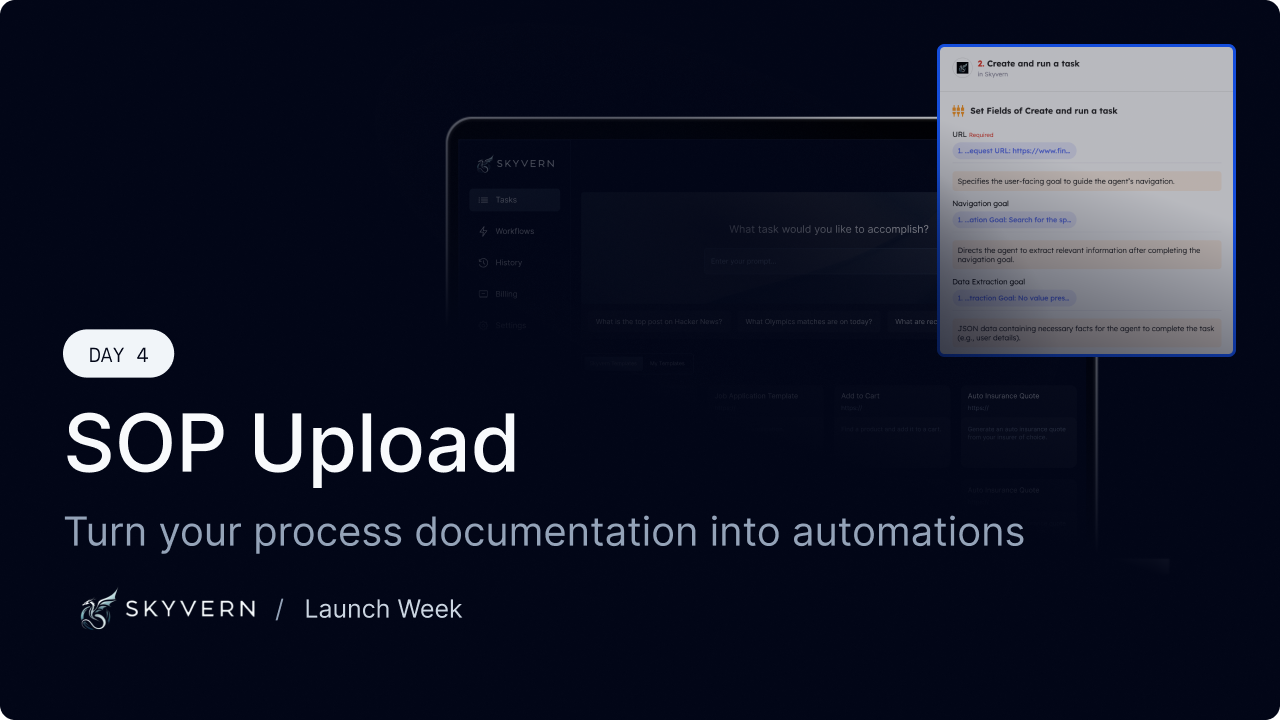 2 min read
Launch Week - Day 4 - SOP Upload to build new Workflows
Most companies already know how their work gets done. It’s written down somewhere: * internal SOPs * runbooks * onboarding docs * Notion pages no one wants to maintain The problem isn’t lack of documentation. It’s that documentation doesn’t run. Today we’re shipping SOP Upload, a way to turn existing process documentation directly into executable browser automation. The gap between “written” and “working” Traditional automation tools assume you’ll start from scratch: * re-specify t
Product Updates 8 min read
CloudCruise Reviews, Pricing, and Alternatives (January 2026)
You're looking into CloudCruise because you need browser automation, but the pricing model creates budget uncertainty, and the workflow structure requires separate configurations for each site you automate. That graph-based DSL looks organized until you realize you're building and maintaining different workflows for every vendor portal, insurance site, or government form you interact with. Even with LLM help, those workflows depend on selectors that break during website updates. Here's what Clou
Comparisons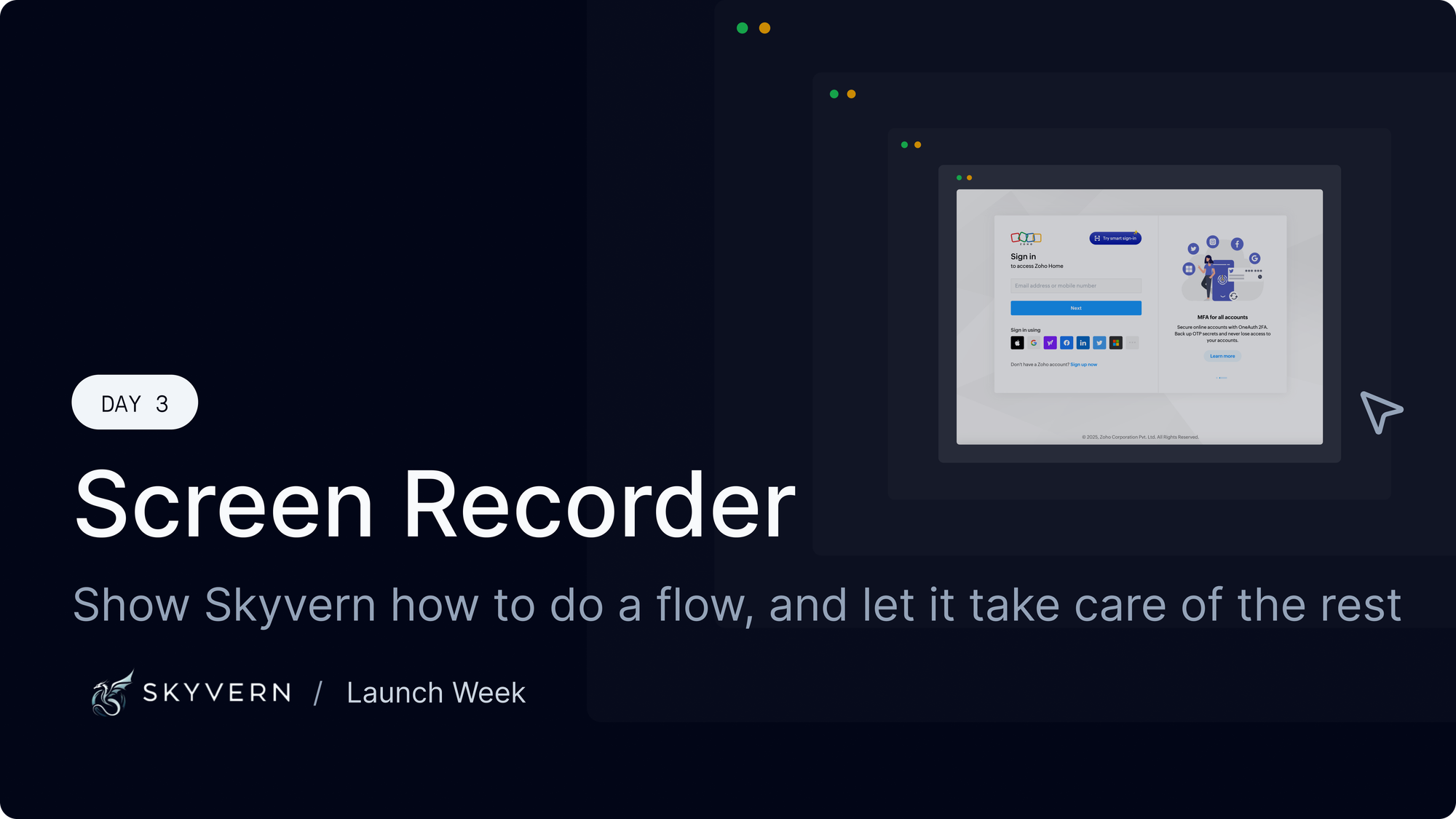 2 min read
Launch week - Day 3 - "Show don't tell" - Screen record your workflows with Skyvern
Most browser automation fails because the interface between humans and automation is wrong. We ask users to describe workflows that are fundamentally visual and stateful. Then we’re surprised when the agent breaks, edge cases pile up, and maintenance cost dominates everything else. We built the Skyvern Screen Recorder to change that interface. Instead of telling an agent what to do, you show it. Give it a try here: app.skyvern.com The core idea If a human can complete a workflow in a brow
Product Updates 5 min read
Launch Week - Day 2 - New and improved SDK
Skyvern SDK v1+ lets you run tasks and workflows and share browser state over a CDP connection. The SDK supports two modes: embedded (local) and remote (cloud). Embedded (Local) mode Get started locally: * uv venv && source .venv/bin/activate — optional but recommended to create a virtual env * uv pip install skyvern — install the Skyvern SDK * skyvern quickstart — follow prompts to configure the environment (AI API keys, etc.) Python example: import asyncio from skyvern import Skyver
Product Updates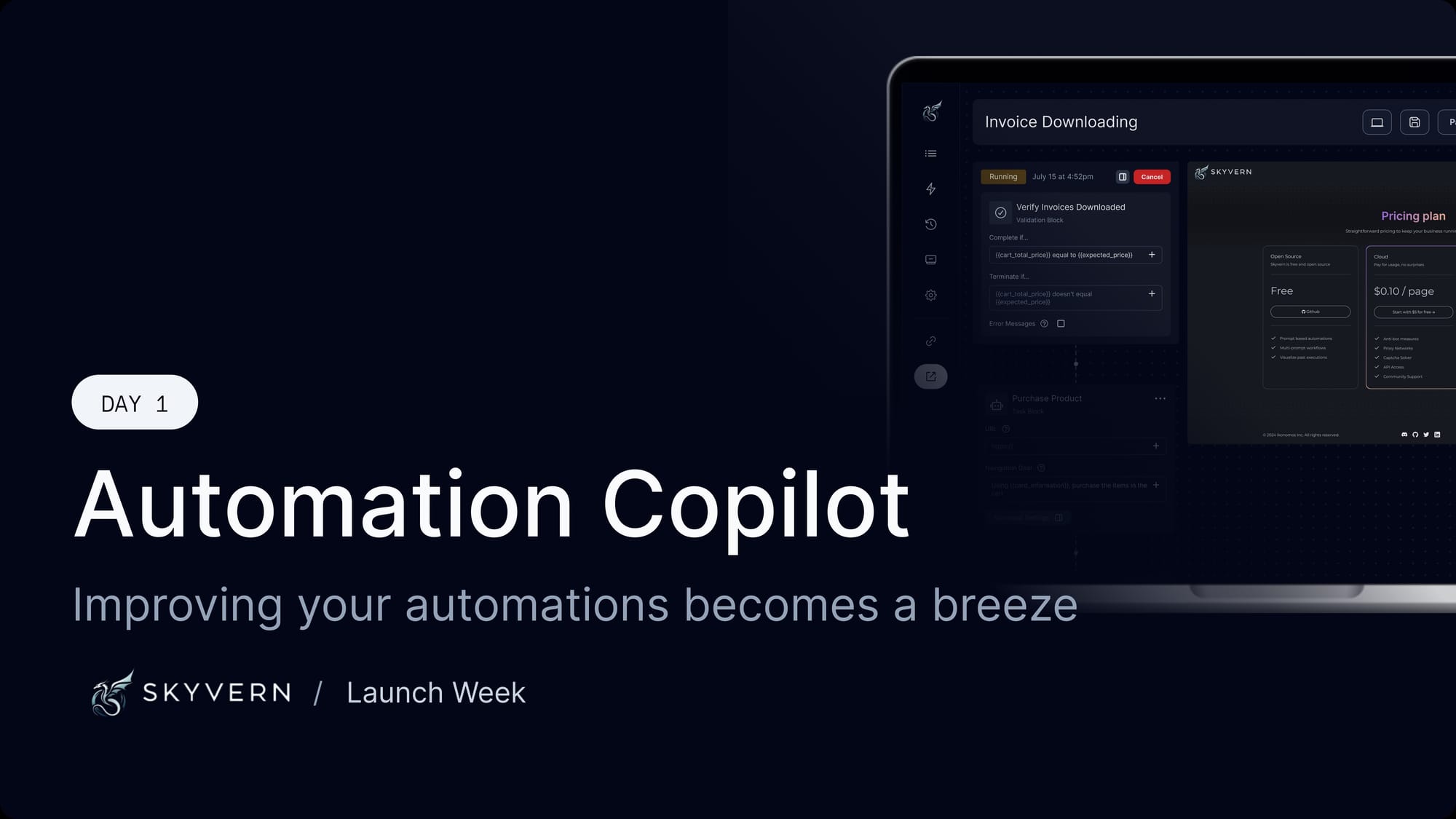 1 min read
Launch Week Day 1 - Automation Copilot: Faster Time-to-Automation
Automation Copilot reduces time-to-automation. Not by making automation “easier to start,” but by making it faster to: * build * modify * and maintain real, production browser workflows. What it is Automation Copilot is an in-product, workflow-aware chat interface. It can: * generate new Skyvern workflows from prompts * edit existing workflows in place * reason about failures and apply targeted fixes It operates directly on Skyvern’s workflow graph. Outputs are executable, not sugg
Product Updates 11 min read
Sola Reviews, Pricing, and Alternatives (January 2026)
Everyone loves the idea of recording a workflow once and letting a bot handle it forever. Sola delivers on that promise for simple, repetitive tasks on familiar interfaces. But the copilot model requiring human intervention doesn't scale when you're automating across dozens of websites with different layouts, or when you need bots running unsupervised overnight. We're walking through Sola's capabilities, pricing, and the alternatives that handle autonomous multi-site automation without breaking
Comparisons 8 min read
UiPath Reviews, Pricing & Best Alternatives (Updated July 2026)
You've been comparing UiPath alternatives and realized the licensing model doesn't fit your use case, or your automations keep breaking after website updates. UiPath works well for enterprise teams running thousands of stable desktop processes, but browser workflows expose its limitations because it requires manual configuration for each site and breaks when layouts change. This review covers what you'll actually pay, where UiPath fits, and which alternatives handle adaptive web automation bette
Comparisons 9 min read
Kernel Reviews, Pricing, and Alternatives (January 2026)
You need browser automation infrastructure, and Kernel keeps coming up in your research. The 300ms launch times and managed proxies sound perfect, but there's something important to understand before you commit: Kernel solves the infrastructure problem, not the maintenance problem. You still write selector-based automation code that breaks when websites change. For teams automating across many sites that update frequently, that maintenance burden becomes the real cost. Here's what Kernel offers,
Comparisons 10 min read
Director Reviews, Pricing, and Alternatives (Updated July 2026)
Director promises no-code browser automation through plain English descriptions, but every tool has limitations. Skyvern is a Director alternative built for teams that need AI-powered automation without vendor lock-in. This review covers Director's pricing, user experiences, and the best alternatives available in July 2026. TLDR: * Director is Browserbase's no-code tool that generates Stagehand scripts from plain English * You're locked into Browserbase's cloud with no self-hosted option or
Comparisons 10 min read
Steel Reviews, Pricing, and Alternatives (August 2026)
We're comparing Steel against alternatives because browser automation shouldn't mean rewriting scripts every time a website changes its layout. Steel gives you API-based browser control, but it lacks the visual understanding and workflow orchestration that production systems need. You'll find Steel's pricing details, candid reviews from teams using it, and alternatives that handle complex automation without the brittleness. TLDR: * Steel provides API-based browser control but requires explici
Comparisons 9 min read
Anchorbrowser Reviews, Pricing, and Alternatives (January 2026)
Anchorbrowser works well for enterprise teams needing AI-native browser automation, but several factors make teams consider alternatives. This guide walks through Anchorbrowser's pricing, where it excels, where it doesn't, and which alternatives might fit your automation requirements better. TLDR: * Anchorbrowser offers AI browser automation with 89% Web Voyager accuracy but lacks self-hosting * Usage-based billing for browser hours, proxy bandwidth, and AI steps can spike unexpectedly * Cl
Comparisons 11 min read
Hyperbrowser AI Reviews, Pricing, and Alternatives (August 2026)
Looking into Hyperbrowser AI reviews because you need reliable browser automation? Hyperbrowser AI delivers fast session launches and solid anti-bot detection, which matters for large-scale projects. The catch is that you're building everything on top of that infrastructure yourself. Every website needs custom scripts, and those scripts need maintenance when layouts change. If your team has the developer resources for ongoing upkeep, that's fine. If not, you'll want to check out alternatives tha
Comparisons 11 min read
Airtop Reviews, Pricing, and Alternatives (January 2026)
You need browser automation that works reliably, and you're considering Airtop alongside other options. The challenge is figuring out which tool handles your specific requirements without breaking your budget or locking you into a proprietary system. This guide covers Airtop's real-world pricing, its core capabilities, and the alternatives that offer better control or more predictable costs. TLDR: * Airtop automates browsers with AI but limits you to TypeScript/Python SDKs and credit-based pr
Comparisons 8 min read
Browser Use vs Browse AI: Which Tool Fits Your Workflow? (December 2025)
You're looking at Browser Use options, such as Browse AI, and trying to figure out which makes sense for your workflow. Browser Use requires Python knowledge but gives you complete flexibility. Browse AI removes the coding barrier with a visual recorder. The right choice depends on who's building the automations and how complex your tasks are. Here's what you need to know. TLDR: * Browser Use requires Python coding for AI-controlled automation; Browse AI uses no-code recording * Browser Use
Comparisons
December
 7 min read
Browserbase vs Browse AI: Which Tool Fits Your Automation Needs? (December 2025)
You need to automate browser tasks, and now you're stuck choosing between tools that look similar but work completely differently. Browserbase versus Browse AI isn't really a fair comparison because one requires coding while the other doesn't. We'll break down what each tool actually does, who should use them, and where both fall short on complex workflows. TLDR: * Browserbase provides managed browser infrastructure for developers writing automation code. * Browse AI offers no-code web scrap
Comparisons 8 min read
Browser Use vs Autotab: Which AI Automation Tool is Better? (December 2025)
When you're comparing browser automation tools like Browser Use and Autotab, the differences matter more than the similarities. Browser Use interprets text descriptions through AI, analyzing pages and executing actions in real time. Autotab records your workflow demonstrations and generates Python code that replays those exact steps. One adapts to changes through AI reasoning, the other gives you explicit code you can modify and debug. Your decision hinges on whether you prefer AI-driven flexibi
Comparisons 8 min read
Browserbase vs Autotab: Which Browser Automation Tool Works Better? (December 2025)
The comparison between Browserbase and Autotab matters because they represent two fundamentally different ways to automate browsers. With Browserbase, you write Selenium or Playwright scripts that run on their cloud infrastructure. With Autotab, you show tasks through recordings and the system replicates them. Both approaches work until you hit the maintenance wall that comes with selector-based automation. TLDR: * Browserbase hosts cloud browsers but requires you to code all automation in Pl
Comparisons