CVO Credentialing vs an In-House Team: When to Outsource and When to Automate
 Suchintan Singh9 min read
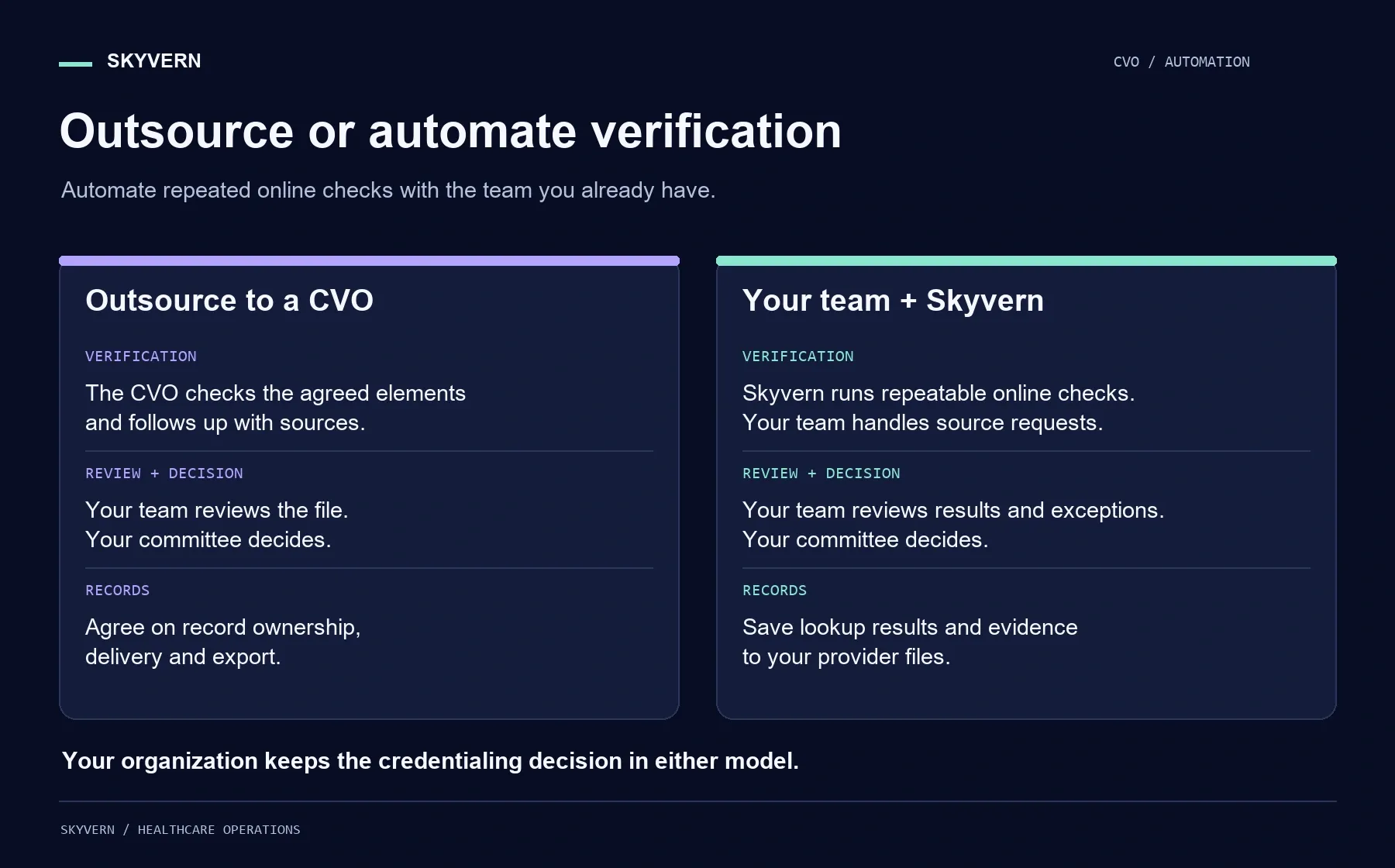
A credentials verification organization (CVO) checks a healthcare provider’s credentials with the original sources and reports the results to your organization. Outsourcing that work can make sense when you need outside expertise or extra capacity. If you already have a credentialing team, automating repeated online checks with Skyvern gives you a way to handle that work in-house instead of outsourcing it.
We build Skyvern, an AI browser agent that automates license lookups, exclusion searches and results collection. It helps an in-house team spend less time navigating portals and copying information into provider files, leaving more time for follow-up, exceptions and review. Your team keeps control of the process and the credentialing decisions.
This guide compares outsourcing verification to a CVO with automating repeatable checks using Skyvern. It explains when a CVO’s services and certification justify the cost, and when your existing team can keep the work in-house with automation.
Quick verdict
The choice between outsourcing and automation depends on whether you hold NCQA accreditation, the volume of verification work, and how much of it is a lookup on a public website.
| Your situation | Better fit |
|---|---|
| You're a health plan or another organization with NCQA accreditation that covers credentialing | An NCQA-certified CVO for verification |
| Low or uneven verification volume, and no credentialing staff | A CVO |
| Regular provider onboarding, an existing team, and mostly online sources | Automate the lookups with Skyvern and keep verification in-house |
| Many verifications that need letters, such as work history, training and military service | CVO support may help with requests; automate any repeatable online checks |
| A large network with spikes in provider onboarding | Automate routine checks and use a CVO for overflow |
What a CVO does in credentialing
A CVO verifies credentials and documents the results. Your organization still makes the credentialing decision. As the CVO Verisys puts it, "the healthcare organization's credentialing committee remains responsible for final credentialing decisions" (Verisys).
NCQA and URAC both run programs that review CVOs. NCQA runs Credentialing Certification, which older NCQA pages still call CVO Certification. It covers 11 elements, and a CVO can be certified for some or all of them (NCQA FAQ):
- License to practice
- DEA or CDS certification
- Education and training
- Board certification status
- Work history
- Malpractice claims history
- State licensing board sanctions
- Medicare and Medicaid sanctions
- Practitioner application processing
- Application and attestation content
- Ongoing monitoring of sanctions
NCQA says more than 90 organizations have earned it. URAC's CVO accreditation is the other route: 40 core standards, awarded for three years.
The term CVO also has a second use. Some health systems run a central verification office for their own hospitals and call it an in-house CVO (Credentialing Resource Center). This guide is about outside CVOs, but most of the comparison applies to a central office too.
Delegated credentialing is a different decision
Delegation moves the credentialing decision from a health plan to your organization. A CVO only takes on verification. People mix the two up because both move credentialing work away from the health plan.
When a plan delegates, NCQA holds the plan responsible for the delegated work and requires it to oversee the delegate. NCQA checks both sides: how the delegate performs the work, and whether the plan oversees it. So if your group takes on delegated credentialing, you also take on the plan's oversight: regular reports to the plan, plus its yearly review and file audit. You can then use a CVO, your own team, or both to do the verification part of that work.
When an NCQA-certified CVO is the right call
If your organization holds or is seeking NCQA accreditation, a certified CVO saves you oversight work that an in-house team or a software tool doesn't. NCQA's 2023 credentialing guide lists what changes when a health plan or other NCQA client delegates to a certified CVO, for each element the CVO is certified in:
- The client doesn't have to evaluate the CVO before delegating.
- The client doesn't have to receive and review semiannual reports from the CVO.
- The client doesn't have to evaluate the CVO's performance each year.
- The client doesn't have to audit the CVO's credentialing files each year.
- The client gets automatic credit for the CVO's verifications.
NCQA still assesses the client on how quickly it makes the credentialing decision.
Automation earns none of this relief. A team that runs its own lookups with Skyvern still verifies, documents and gets audited like any other in-house team. For an organization with NCQA accreditation, that oversight saving can outweigh everything else in this comparison.
A CVO is also the simpler choice when you hire a few providers a year and nobody on staff knows credentialing. At that volume, the work of building and documenting your own process is spread over very few files.
Which checks are website lookups and which need letters
The checks in a credentialing file fall into two groups, and the mix decides which model fits. Some are lookups on public websites that anyone with the provider's details can run. Others are requests to a person or an organization that replies on its own schedule.
| Check | Usual source | Lookup or request? |
|---|---|---|
| License and state board sanctions | The state licensing board's online lookup | Lookup |
| OIG exclusions | OIG's LEIE download and online search | Download, then lookup to confirm a possible match |
| Federal exclusions on SAM.gov | SAM.gov, which also offers an Exclusions API | API or lookup |
| State Medicaid exclusions | Each state's list | Lookup, where the state publishes one online |
| NPI | The NPPES API or NPI Registry | API |
| Behavioral health certification | The BACB Certificant Registry | Lookup |
| Nursing licenses | Nursys | Use Nursys e-Notify (below) |
| Work history | Prior employers | Request |
| Education and training | Schools and training programs | Request, unless a recognized source covers it |
| Military service | Military records offices | Request |
Lookups are fast and repetitive. The same search runs at application, again before committee if the first result has aged, and again every month for monitoring.
Verification by request depends on a response from the employer, school or records office. A CVO can manage that correspondence and follow up, but it still depends on the source to reply. Separate time spent running lookups from time spent waiting for responses when you compare the options.
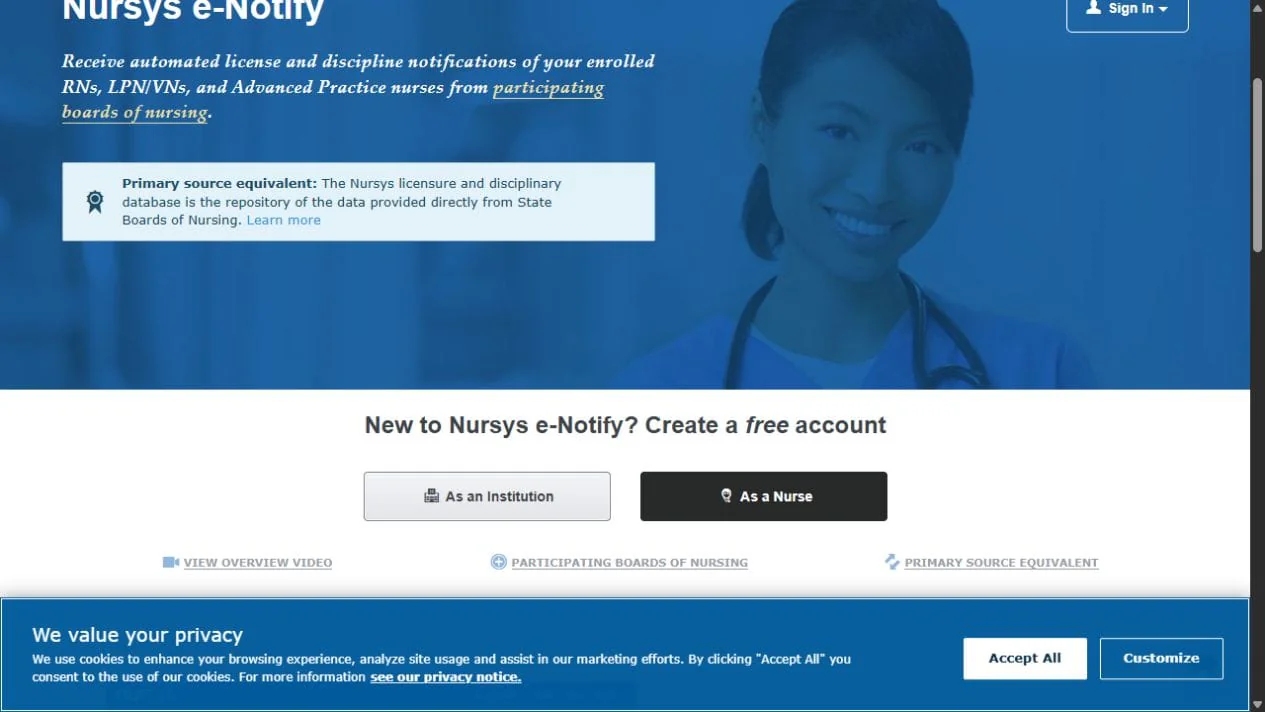
For nurses, use the source's own monitoring service before automating anything. NCSBN's Nursys e-Notify is free for institutions and sends automated license and discipline updates for enrolled nurses from participating boards of nursing.
Turnaround and monitoring
NCQA limits how old each verification can be, and it expects credentialing organizations to monitor providers between recredentialing cycles. Both rules mean the same lookups run more than once.
NCQA's September 2025 guide publishes the maximum age of a verification for each program. Credentialing Certification, the CVO program, has the shorter limits:
| Verification | Credentialing Accreditation | Credentialing Certification (CVOs) |
|---|---|---|
| License to practice | 180 days | 90 days |
| Board certification | 120 days | 90 days |
| Work history | 180 days | 120 days |
| Medicare/Medicaid exclusions | 120 days | 90 days |
Check the current standards for your survey year before you build a policy on these numbers.
Age limits create rework. If a file waits weeks for a work history letter, the license lookup done on day one can pass its limit before the committee meets, and someone has to run it again. With automated lookups, the re-check can run on its own, and a person only steps in when the result has changed.
Monitoring is a monthly job. NCQA describes accredited credentialing organizations as monitoring "practitioner sanctions, license expiration, complaints and quality issues between recredentialing cycles" every month. OIG publishes its exclusion list as a download with monthly supplement files. Whether a CVO or your team runs monitoring, ask how quickly a new exclusion or a lapsed license reaches the person who has to act on it.
Cost: compare price per file with time per file
Compare the CVO's quote per file with your own team's time per file, split into lookups and requests. The CVO sites we reviewed don't publish prices, so you'll need a quote.
To compare, take one month of files and work out:
- Files: how many initial credentialing and recredentialing files you process.
- Checks per file: how many are lookups and how many are requests, using the table above.
- Your time: minutes per lookup and minutes of follow-up per request. Time a week of real work rather than guessing.
- The CVO quote: price per file, which elements it covers, and what it excludes.
If most of your minutes go to lookups, automating those checks lets your existing team handle the repeated work instead of handing it to a CVO. If most of your minutes go to chasing letters, a CVO may cost less than the staff time, though it will wait on the same sources.
We walked through the same math for prior authorization in healthcare BPO vs automation.
What an in-house team automates first
Start with the lookups your team repeats most: state license checks and monthly exclusion screening. They come up every month, use public websites, and return a clear result.
A sensible order:
- State license lookups for each new provider, and again before committee if the first check has aged.
- Monthly exclusion screening. Match your roster against the LEIE download first, then confirm any possible match in OIG's online search. Add SAM.gov through its API, and the state Medicaid lists your policy requires.
- Specialty registries your providers need, such as the BACB registry for behavioral health.
- NPI checks through the NPPES API. A browser isn't needed when an API exists.
In Skyvern, a workflow takes each provider from your roster, opens the lookup site, runs the search and reads the result. It can save the result page as a PDF with the Print Page block, and Skyvern keeps a screenshot of each step and a recording of the session. That gives you a dated record for the provider's file.
Workflows can run on a schedule for monthly monitoring. When a name doesn't match or a license isn't active, a Human Interaction step can stop the run so a person reviews it. For logged-in sources such as CAQH ProView, Skyvern uses stored credentials and supports 2FA codes (pricing). Our credentialing automation guide covers CAQH and NPPES in more detail, and the RBT and BCBA guide covers behavioral health records.
Some work stays with people. Work history letters, peer references and committee review don't become faster with a browser agent. Read each source's terms of use before you automate it, and use the source's own feed or API where one exists. Skyvern's Enterprise plan includes HIPAA compliance and a SOC 2 report (pricing).
Hybrid models
Many organizations split the work between a CVO and their own team. Verisys, a CVO, says combining the two "tends to give organizations the most flexibility" (Verisys).
Two ways to split it:
- The CVO keeps the certified elements and the letters. The CVO verifies the elements it is NCQA-certified for, including the request-heavy ones like work history. Your team automates monthly monitoring and the re-checks before committee.
- Your team keeps the lookups, and the CVO takes overflow. Your team runs license and exclusion lookups for every file. The CVO handles peak hiring months or a new state where you don't know the sources yet.
In either split, write down who owns each element. NCQA's guidance on delegation stresses a written agreement that "clearly identifies the responsibilities of both delegate and health plan" (NCQA 2023 guide), and the same applies between your team and a CVO.
Questions to ask before you sign or renew a CVO contract
These questions show what you're paying for and where the work will still land on your team:
- What is your turnaround for each element, not just the overall average?
- Which elements are you NCQA-certified for, and are you URAC-accredited?
- Which sources do you verify by lookup, and which by request?
- Who owns the verification records and screenshots, and can we export them?
- How do you deliver results: API, file, or portal?
- How quickly do you alert us to a new exclusion or a lapsed license?
- What are the exit terms, and what happens to our files if we leave?
See what your credentialing team could automate
Skyvern fits teams that already know how to credential providers and spend too much time repeating online lookups. It can run license and exclusion searches and save the results for your files, giving staff more time for follow-up and review. You keep ownership of the process and the credentialing decision.
Book a credentialing workflow demo. Pick a lookup your team runs often and compare the manual process with a small Skyvern pilot. Measure staff time, record completeness and exceptions that need review; use those results to decide which checks to automate next.
FAQ
What does CVO mean in credentialing?
CVO stands for credentials verification organization. It's a company, or sometimes a central office inside a health system, that verifies providers' licenses, training, work history and sanctions with the original sources and reports the results. The organization that hired it still makes the credentialing decision.
Is delegated credentialing the same as using a CVO?
No. In delegated credentialing, a health plan hands the credentialing decision and its deadlines to a provider group or another organization, and NCQA requires the plan to oversee that work. A CVO only verifies credentials, and either the plan or the delegated group can hire one.
How is a CVO certified?
The two main routes are NCQA Credentialing Certification, which certifies a CVO for up to 11 verification elements, and URAC CVO accreditation, which covers 40 core standards and lasts three years. A health plan that delegates to an NCQA-certified CVO skips several oversight steps for the certified elements.
Keep reading
Insurance Eligibility Verification Software: Clearinghouses, Services and Portal Automation Compared
HIPAA was passed in 1996, beginning the move toward national standards for electronic healthcare transactions, including X12 270/271 eligibility inquiries and responses. The standard is more than twenty years old now, but an electronic check can still come back without what the front desk needs for the visit, like the copay or a visit limit. Someone has to go and get it. That's the buying decision I want to help you make with insurance eligibility verification software: who completes the check
OIG Exclusion List (LEIE): How to Run the Monthly Check for Your Whole Roster
The OIG exclusion list, officially the List of Excluded Individuals/Entities (LEIE), is the HHS Office of Inspector General's list of people and organizations barred from Medicare, Medicaid and all other federal health care programs (OIG). If your organization bills those programs, you need to know that nobody you employ or contract with is on it, when you hire them and every month after. OIG publishes the list in two forms: a free CSV file you can download, and an online search that takes up t
Healthcare BPO vs Automation for Prior Authorization: Growing Volume Without Growing the Team
Healthcare BPO, or business process outsourcing, means hiring another company to handle administrative work such as billing, insurance checks and prior authorization. It helps your practice growing without recruiting an internal team for every task. Much of that work still involves time-consuming, manual data entry and document retrieval. Someone copies patient details between systems, finds supporting records, uploads files and checks payer portals for updates. This is the type of work we bui
Put the browser to work
Use Skyvern for the work that lives in a browser.
Turn repetitive browser tasks into reliable workflows with Skyvern.