
Automating Mortgage and Lending Workflows on Lender Portals (March 2026)

Origination costs dropped to $3,200 per loan when digital tools took over, but underneath that number sits a processor manually logging into warehouse lender portals, copying borrower data across five different field structures, and waiting for 2FA codes. Your LOS handles internal pipeline work, but it doesn't touch the external portals where your team spends hours working through systems built without APIs. Mortgage portal automation fills that gap by replacing manual sessions with workflows that authenticate, extract data, and push results back into your systems without someone clicking through each step.
TLDR:
- Mortgage pros waste 2-4 hours daily on manual lender portal work that LOS systems don't touch
- AI-powered automation cuts portal turnaround time by 60% using visual understanding instead of brittle selectors
- Start with daily document downloads, then rate locks, then full applications to build trust before scaling
- Skyvern handles 2FA, CAPTCHAs, and dynamic forms across any lender portal without site-specific configuration
Why Mortgage Portal Workflows Remain Expensive and Error-Prone
Digital transformation cut average mortgage origination costs from $8,500 to $3,200 per loan in 2023, a number that looks impressive until you see how much manual portal work still sits underneath it. Origination costs dropped dramatically with digital adoption, yet loan officers and processors still spend hours each day logging into disconnected lender portals, copying data between systems, and waiting for sessions to load. Here are the challenges with these portals:
- No APIs
- Manual data entry
- Authentication
Legacy Portals Without APIs
FHA Connection, VA portals, warehouse lender systems, and most correspondent lender portals were built without external API access in mind. There's no endpoint to call, no webhook to subscribe to. If you want data out or a form submitted, someone has to open a browser and do it manually.
Manual Data Entry Across Disconnected Systems
Each portal has its own field naming conventions, input formats, and required sequences. Copying loan data across five portals introduces error at every step. A single transposed number on a rate lock or wire instruction can delay a closing.
Authentication That Breaks Traditional Automation
Most lender portals require 2FA, CAPTCHA challenges, or session tokens that expire mid-workflow. Selenium scripts and standard RPA tools fail the moment any of these appear. Teams end up babysitting automations or abandoning them entirely, which brings the manual headcount right back.
What Automation Actually Means for Lender Portal Operations
Most teams hear "mortgage automation" and think about their LOS. And yes, tools like Encompass or BytePro handle a lot of the internal pipeline work well. But there's a different problem that LOS software doesn't touch: the external portals. Internal automation moves data between systems you control. External portal automation handles the part where someone has to open a browser, log into a lender's website, and actually interact with it. Those are completely different problems.
Think about what a typical processor does across a single day:
- They check rate sheets on three separate wholesale lender portals, each with its own login and layout.
- They submit a loan package to a correspondent portal, working through multi-step upload flows.
- They pull documents from FHA Connection, check status on a VA case, and lock a rate before the window closes.
None of that lives inside your LOS. All of it requires logging into a portal someone else built and getting data in or out by hand.
Portal automation fills the gap between your LOS and every external system your team touches manually.
That gap is where the time goes. Mortgage portal automation means replacing the processor opening 15 browser tabs each morning with a workflow that handles authentication, extracts structured data, and pushes results back into your systems without a human at each step.
The bigger issue, though, is capacity. Manual portal work doesn't scale with loan volume. Automating those external interactions does.
The Hidden Bottlenecks in Multi-Portal Mortgage Workflows

Mortgage processors rarely describe their day as "inefficient." They describe it as busy. The distinction matters, because busy feels productive even when the underlying work is purely repetitive.
Here's where the time actually goes:
- Document downloads from warehouse lender portals can consume 2-4 hours per processor daily, working through login flows, locating the right account, selecting date ranges, and repeating across multiple lenders.
- Rate shopping across 10 or more wholesale portals requires a separate login and manual note-taking for each one. By the time the tenth portal loads, the first rates have changed.
- Application submission means re-entering the same borrower data into each lender's unique interface. Same loan, five different field structures, five separate sessions.
- Status tracking across 20+ portals forces processors to open each one individually, check what's there, and close it. There's no aggregated view.
Add these up across a team of five processors and you're looking at dozens of hours weekly spent on navigation, not lending. The work isn't complex. It's just relentless, and it scales in the worst direction: more loan volume means more portal sessions, not smarter ones.
How Visual AI Changes What Portal Automation Can Handle
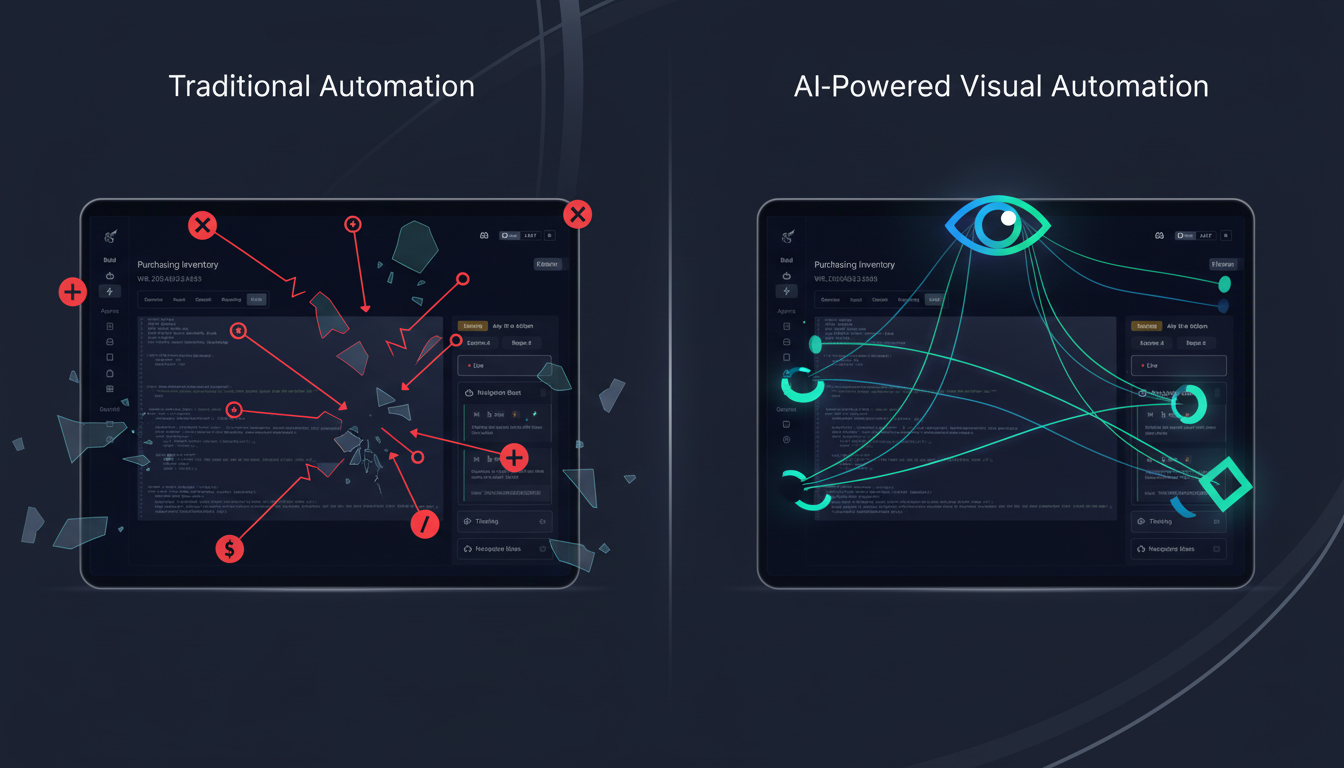
Traditional automation tools read portals the way a GPS reads a map that's already outdated. Selenium and standard RPA scripts identify page elements by their CSS selectors or XPaths, which means any time a lender portal updates its UI, the script breaks. And lender portals update constantly. Visual AI takes a different approach entirely. Instead of hunting through HTML structure, it reads what's displayed on screen, identifying buttons and form fields by their visible labels and context. If a portal moves its "Submit" button or renames a field, a visual AI agent adapts. The selector-maintenance cycle stops. Here's how a visual-AI based automation tackles some of the big challenges associated with traditional RPA-based automation.
Authentication That Doesn't Stall the Workflow
Most lender portals sit behind 2FA, CAPTCHA challenges, or both. Traditional scripts hit these and stop, requiring human intervention to continue. Skyvern handles 2FA via TOTP, email forwarding, or webhook-based code delivery, and resolves CAPTCHA challenges natively, so workflows complete without someone standing by to intervene.
Dynamic Forms That Shift Mid-Session
Lender portals are notorious for conditional logic: fields that appear based on loan type, property classification, or borrower status. AI-powered form filling tools handle dynamic fields that static scripts can't adapt to. Visual AI reasons through what's currently visible and responds accordingly, the same way a processor would.
Layout Resistance Over Time
Portal redesigns happen on lender schedules, with no advance notice. Every redesign breaks selector-based automation and triggers a maintenance cycle.
Side-by-Side Comparison of Traditional RPA and AI-Powered Visual Automation
Automation Challenge | Traditional RPA/Selenium Approach | AI-Powered Visual Automation (Skyvern) |
|---|---|---|
Portal Layout Changes | Breaks immediately when CSS selectors or XPaths change, requiring script rewrites and maintenance windows after every portal update | Reads portals by visible labels and context, continuing to work when layouts change without requiring updates or maintenance |
Authentication (2FA/CAPTCHA) | Stalls workflows when 2FA or CAPTCHA challenges appear, requiring human intervention to continue and forcing teams to babysit automations | Handles 2FA via TOTP, email forwarding, or webhook-based code delivery, and resolves CAPTCHA challenges natively without human intervention |
Dynamic Form Fields | Fails when conditional fields appear or disappear based on loan type, property classification, or borrower status because scripts follow fixed paths | Reasons through currently visible fields and responds accordingly, adapting to conditional logic the same way a processor would |
Multi-Portal Coverage | Requires separate scripts for each lender portal, creating maintenance overhead that scales linearly with the number of portals | Uses parameterized workflows where URL and credentials swap per run while underlying logic stays constant, handling multiple portals with one workflow structure |
Error Handling | Often fails silently or provides generic error messages hours after the failure, making it difficult to diagnose issues or recover specific transactions | Flags specific failure points, captures screenshots, and routes issues for human review via webhook so processors can intervene on individual loans instead of finding out about batch failures later |
Portal redesigns happen on lender schedules, with no advance notice. Every redesign breaks selector-based automation and triggers a maintenance cycle.
AI-powered mortgage portal automation can improve productivity by 2-3x while cutting turnaround time by up to 60%.
Layout resistance is what makes those numbers sustainable. When the portal changes, the workflow keeps running, which is the difference between automation that saves time this week and automation that saves time next year.
Building Workflows That Work Across Different Lender Portals
The hardest part of multi-portal automation isn't automating the first portal. It's avoiding the trap of building 50 separate automations for 50 separate lenders.
Skyvern workflows are parameterized, meaning the URL, credentials, and any lender-specific payload swap per run while the underlying logic stays constant. One workflow structure handles FHA Connection, a wholesale lender portal, and a warehouse line, with input parameters determining which portal loads and which credentials authenticate the session.
There are a few things that make this approach work in practice:
- Credential management handles login combinations securely, storing usernames, passwords, and TOTP secrets without exposing them to the underlying LLMs. Skyvern's credential vault supports Bitwarden integration or a custom credential API for teams with existing infrastructure.
- When portals behave unexpectedly, workflows don't silently fail. Error handling flags the specific step, captures a screenshot, and routes the issue for human review via webhook, so a processor can intervene on that one loan instead of finding out about a batch failure hours later.
What to Automate First in Your Portal Stack
Mortgage origination costs have climbed roughly 35% over the last three years, adding nearly $3,000 per loan to the cost of doing business. That pressure makes prioritization a financial decision, not a preference. The instinct for most teams is to automate the most complex thing first. Resist that. Start with what's high-frequency and low-risk, build confidence, then expand.
There are three tiers worth working through in sequence:
- Start with daily document downloads. Pick any servicer or warehouse lender portal your team visits every day. The workflow is consistent, the failure mode is obvious, and success is immediately measurable in hours recovered. A processor spending 90 minutes each morning pulling statements across four portals can reclaim that time in week one.
- Move to rate lock submissions once document downloads run reliably. These involve more steps and tighter time windows, so the stakes are higher if something goes wrong. But having already validated that authentication and navigation work on your target portals, you're building on a tested foundation instead of learning two things at once.
- Tackle full application submissions last. Multi-step flows deliver the biggest capacity gains, but dynamic fields, conditional logic, and lender-specific quirks also create the most failure points. Handling these third means your team already knows how to read workflow recordings and configure human-in-the-loop checkpoints before the stakes are highest.
Each tier builds trust in the automation before expanding its scope.
How Skyvern Automates Lender Portal Workflows Without Breaking
Skyvern connects to any lender portal on day one, with no site-specific configuration required. The same workflow that handles FHA Connection runs against a warehouse lender portal or investor delivery system by swapping the URL and credentials as parameters. Computer vision reads each portal by what's visible on screen, so layout updates don't require script rewrites or maintenance windows.
A typical mortgage workflow in Skyvern chains several blocks in sequence:
- A login block authenticates the session, including 2FA, so processors never get locked out mid-run due to expired credentials.
- A navigation block fills the application or rate lock form from a JSON payload that maps directly to your LOS data.
- A file download block pulls confirmations automatically after each submission.
- A webhook pushes structured results back to your system when the run completes.
Parallel execution means that same workflow runs across 20 warehouse lines or 30 investor portals simultaneously, not sequentially. What one processor handled across an afternoon completes in minutes. Every run produces a full recording, step-by-step screenshots, and an audit trail with full security measures, so compliance teams have documentation without asking processors to recreate what they did. When a portal behaves unexpectedly, the workflow flags the specific failure point and routes it for human review instead of silently dropping the task.
The result? A lender portal stack that scales with loan volume instead of headcount.
Final Thoughts on Fixing the Portal Problem in Mortgage Operations
Processor time spent logging into portals, copying borrower data, and downloading documents doesn't add value to your borrowers or your bottom line. Mortgage portal automation that handles authentication, works through dynamic forms, and scales across multiple lenders simultaneously changes the capacity equation completely. Your loan volume grows without proportional headcount increases, and layout changes stop breaking your workflows mid-run. Book time with us to see how this works with your actual lender portals.
FAQ
How long does it take to deploy your first mortgage portal automation?
Most teams deploy their first automated workflow in 2-3 hours for simple document downloads, while complex multi-step processes like rate lock submissions or full application workflows take 1-2 weeks to fully optimize and test across all systems.
What happens when a lender portal updates its layout or redesigns its interface?
Visual AI reads portals by what's visible on screen instead of relying on CSS selectors or XPaths, so workflows continue running when portals update their layouts without requiring script rewrites or maintenance windows.
Can portal automation handle 2FA and CAPTCHA challenges that typically break traditional scripts?
Yes. Skyvern handles 2FA via TOTP, email forwarding, or webhook-based code delivery, and resolves CAPTCHA challenges natively so workflows complete without human intervention when these security measures appear.
How do you automate across multiple lender portals without building separate scripts for each one?
Workflows are parameterized, meaning the URL, credentials, and lender-specific payload swap per run while the underlying logic stays constant, so one workflow structure handles multiple portals by changing input parameters instead of requiring separate automations for each lender.
What should you automate first in your mortgage portal stack?
Start with high-frequency, low-risk workflows like daily document downloads from servicer or warehouse lender portals to build confidence and show immediate time savings, then move to rate lock submissions, and tackle full application submissions last once your team understands workflow recordings and human-in-the-loop checkpoints.