
Launch Week - Day 4 - SOP Upload to build new Workflows

Most companies already know how their work gets done.
It’s written down somewhere:
- internal SOPs
- runbooks
- onboarding docs
- Notion pages no one wants to maintain
The problem isn’t lack of documentation.
It’s that documentation doesn’t run.
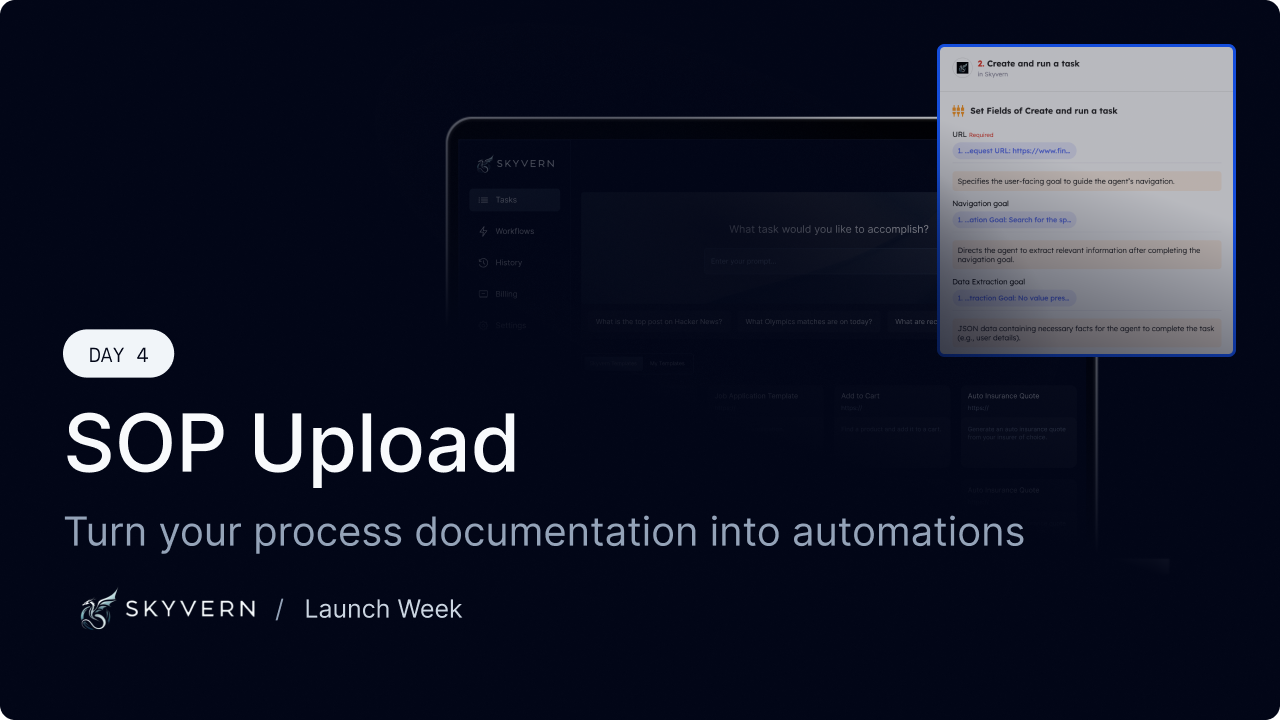
Today we’re shipping SOP Upload, a way to turn existing process documentation directly into executable browser automation.
The gap between “written” and “working”
Traditional automation tools assume you’ll start from scratch:
- re-specify the process
- translate steps into configuration
- debug mismatches between docs and reality
That’s wasteful. The intent already exists. The steps already exist. The missing piece is a system that can map human-written process descriptions to real execution.
SOP Upload is that bridge.
How it works
You upload an SOP—anything from a structured runbook to a messy internal doc—and Skyvern uses it as the source of truth for building a task.
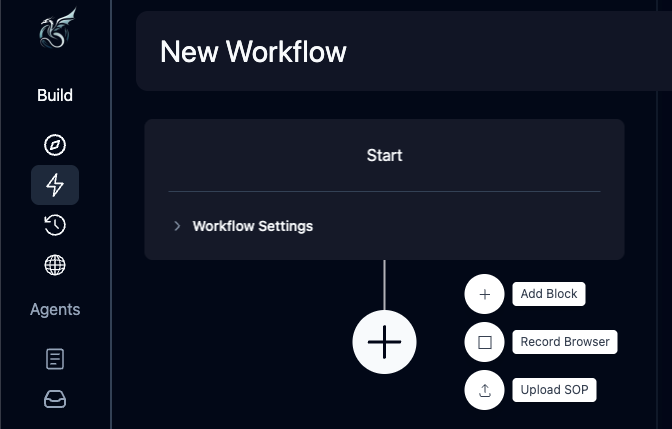
The system extracts:
- the navigation goal
- the data extraction goal
- required inputs and constraints
From there, it produces a runnable automation that can be executed, iterated on, and maintained like any other Skyvern workflow.
This isn’t static parsing. The SOP becomes a living artifact that drives automation behavior.
Why this matters in practice
In real organizations, automation rarely fails because people don’t know what to do.
It fails because translating “what we do” into “what the system runs” is slow, brittle, and expensive.
SOP Upload shortens that path:
- less re-specification
- less back-and-forth between ops and engineering
- faster time from documented process to working automation
It’s especially useful for workflows that are:
- already standardized
- repeated across teams
- painful but well understood
In other words: the exact workflows that should be automated first, but usually aren’t.
A different mental model for automation
This shifts automation from:
“build a workflow”
to:
“operationalize what we already wrote down”
Over time, that means SOPs stop being stale documentation and start becoming executable interfaces between humans and systems.
We think that’s a more realistic way automation actually gets adopted inside companies.