Hyperbrowser AI Reviews, Pricing, and Alternatives (August 2026)

Looking into Hyperbrowser AI reviews because you need reliable browser automation? Hyperbrowser AI delivers fast session launches and solid anti-bot detection, which matters for large-scale projects. The catch is that you're building everything on top of that infrastructure yourself. Every website needs custom scripts, and those scripts need maintenance when layouts change. If your team has the developer resources for ongoing upkeep, that's fine. If not, you'll want to check out alternatives that handle more of the automation logic for you. Browser automation is one execution layer within the broader category of Agentic Process Automation (APA), and the best tools in that space combine intelligent reasoning with production-ready infrastructure instead of leaving all the logic to you.
TLDR:
- Hyperbrowser AI provides managed browser infrastructure but requires custom scripts for each site
- Traditional tools break with site updates; Skyvern applies one workflow across multiple sites
- Alternatives like Browserbase and Airtop offer infrastructure or APIs but lack visual interpretation
- Skyvern combines AI automation with production reliability, transparent pricing, and open source options
What is Hyperbrowser AI and How Does It Work?
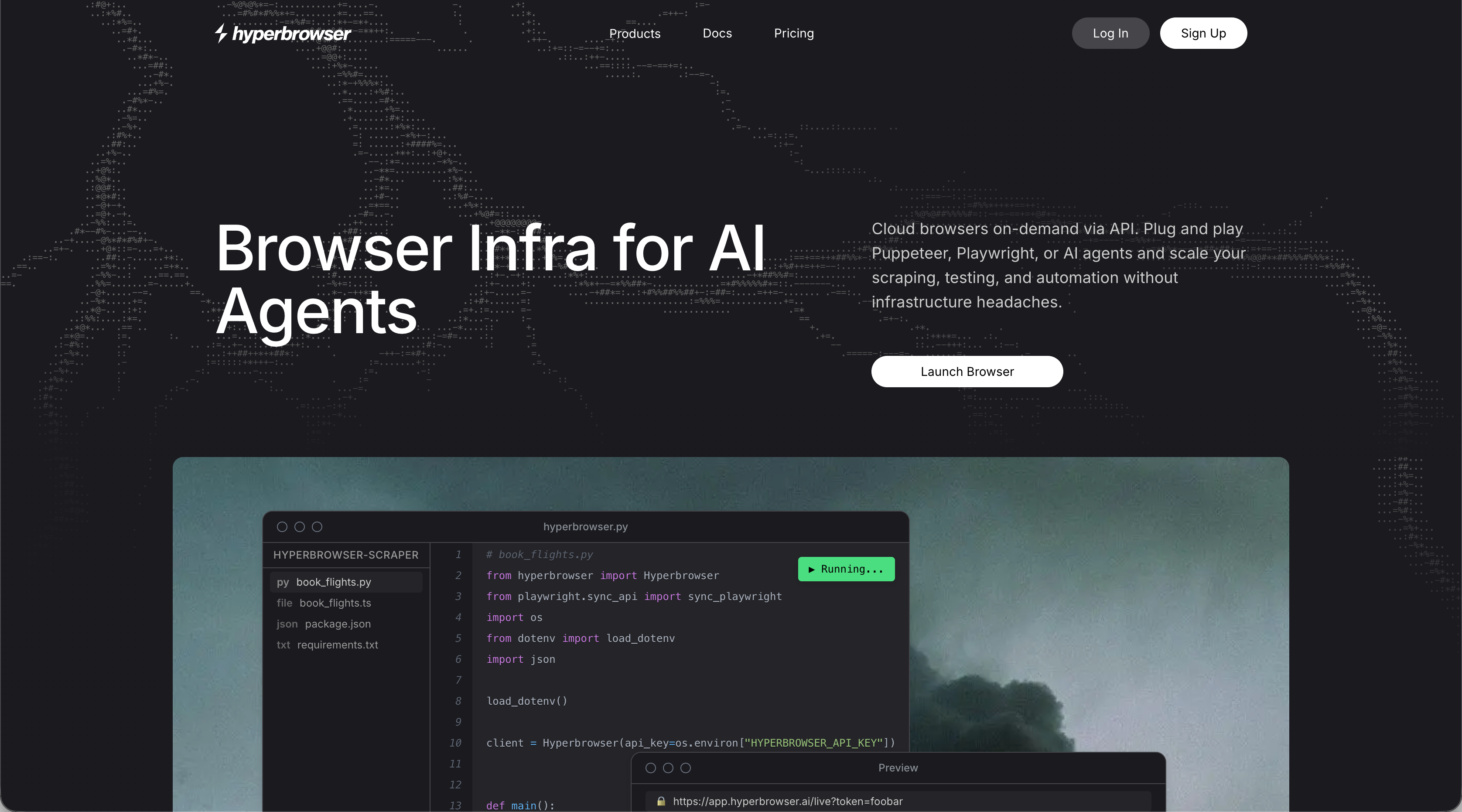
Hyperbrowser AI is a cloud browser infrastructure service that provides instant, scalable browser sessions with built-in CAPTCHA solving, proxy management, and anti-bot detection. The service targets developers, data scientists, and automation engineers who need reliable browser infrastructure to power AI agents, web scraping workflows, and automated testing at scale.
Instead of managing your own headless browser infrastructure, you connect automation scripts through standard tools like Playwright, Puppeteer, or Selenium. Hyperbrowser AI handles the backend work, spinning up isolated containerized browser sessions that bypass common bot detection measures automatically.
The service provides simple API methods like page.ai(), page.extract(), and executeTask() that let you control browsers using natural language commands. You can instruct the browser to complete tasks without writing detailed step-by-step code for every interaction.
Action caching lets you record workflows once, then replay them deterministically without making additional LLM calls, which saves on API costs and improves execution speed.
Hyperbrowser AI operates on a credit-based pricing model. You purchase credits, then consume them as you spin up browser sessions and use AI-powered features.
Why Consider Hyperbrowser AI Alternatives?
Hyperbrowser AI works well for teams with technical resources who need managed browser infrastructure with strong stealth capabilities. The sub-500ms browser launch speed supports thousands of concurrent sessions for large-scale web projects. But, you still need to write all automation logic yourself. Every website requires custom script development, and those scripts break when site layouts change. This works if you have developers available for ongoing maintenance. And, the credit-based pricing makes cost forecasting difficult. You need to estimate usage accurately upfront, which gets tricky with variable workloads or unfamiliar projects.
Teams typically look for alternatives when they want automation that adapts to website changes automatically instead of breaking when elements move. If you're automating across multiple unfamiliar websites without dedicated developers, infrastructure-only solutions leave you building everything from scratch.
Best Hyperbrowser AI Alternatives in November 2025
Skyvern: Best Overall Alternative
Skyvern provides AI-powered browser automation that uses computer vision and LLMs to interpret web pages visually, eliminating the need for brittle selectors or custom code for each website. Unlike infrastructure-only solutions like Hyperbrowser AI, Skyvern combines intelligent automation with the reliability needed for production workflows.
Where Hyperbrowser AI provides managed browser infrastructure but leaves you writing custom scripts for every site, Skyvern interprets pages visually and adapts automatically to layout changes. You write one workflow and apply it across hundreds of websites without modification. The platform handles complex reasoning through LLM interactions, including form filling, data extraction, and multi-step workflows that traditional automation tools can't manage.
Key Strengths
Skyvern includes several features that make it the strongest Hyperbrowser AI alternative:
- Visual interpretation of web pages that adapts automatically to layout changes without pre-determined XPaths,
- Single workflow applicable across large numbers of websites without customization for each site,
- Complex reasoning through LLM interactions including form filling, eligibility inference, and data extraction,
- Native 2FA, TOTP support, CAPTCHA solving, and proxy network capabilities with residential and ISP proxies and geographic targeting across 20+ countries, plus Bitwarden integration and TOTP authenticator app support for credential management,
- Managed cloud version with anti-bot detection, parallel execution, and SOC 2 compliance for production reliability,
- Open-source availability providing flexibility for self-hosting and customization,
- Transparent pricing with no hidden fees unlike credit-based models that make cost forecasting difficult, and
- Multi-step workflow chaining with live viewport streaming for debugging complex automations.
- Code-first workflow architecture that compiles successful AI-driven runs into deterministic Playwright code, cutting token consumption by approximately 90% on compiled paths and falling back to AI reasoning automatically when page layouts change.
- MCP server integration available to all customers by default, with the majority of workflows built and managed through MCP or API, allowing AI assistants and code-first teams to control browser automation without a visual interface.
- Government and regulated-industry workflow support across state tax filings, payroll registration, utility management, healthcare credentialing, and regulatory monitoring across 3,000+ government and county databases, running the same workflow definition across all 50 states without per-portal customization.
The Bottom Line
Skyvern eliminates the trade-off between intelligence and infrastructure that forces compromises with traditional browser automation tools, providing both AI-native capabilities and production-ready reliability in a single solution. While Hyperbrowser AI requires ongoing developer maintenance for custom scripts that break with site changes, Skyvern adapts automatically through visual interpretation. If you need automation that works across multiple unfamiliar websites without dedicated developers for script maintenance, Skyvern delivers the complete package: AI-powered intelligence, managed infrastructure, and transparent pricing.
Browserbase
Browserbase provides managed headless browser infrastructure designed for developers who need reliable, scalable browser sessions without managing their own infrastructure. The service offers a simple API that integrates with standard automation frameworks like Playwright, Puppeteer, and Selenium, making it easy to migrate existing scripts to cloud-based execution.
Like Hyperbrowser AI, Browserbase focuses on providing infrastructure with stealth capabilities and anti-bot detection. The platform handles the complexity of maintaining browser environments, proxy management, and session persistence, letting you focus on writing automation logic instead of managing servers.
Key Strengths
Browserbase includes several features that make it a viable infrastructure alternative:
- Serverless Chromium instances that scale automatically based on demand without capacity planning,
- Session persistence that maintains cookies, local storage, and authentication across workflow steps,
- Live session viewing and replay for debugging automation issues in real-time,
- Stealth features with built-in anti-bot handling and fingerprint randomization, and
- Standard framework compatibility allowing you to use existing Playwright, Puppeteer, or Selenium code.
The Bottom Line
Browserbase solves the infrastructure management problem that Hyperbrowser AI also tackles, but neither service eliminates the core challenge: you still write and maintain all automation logic using brittle selectors that break when websites change. If you're looking for managed infrastructure with familiar tooling, Browserbase delivers. If you want to eliminate selector maintenance entirely, you need AI-powered interpretation like Skyvern provides.
Airtop
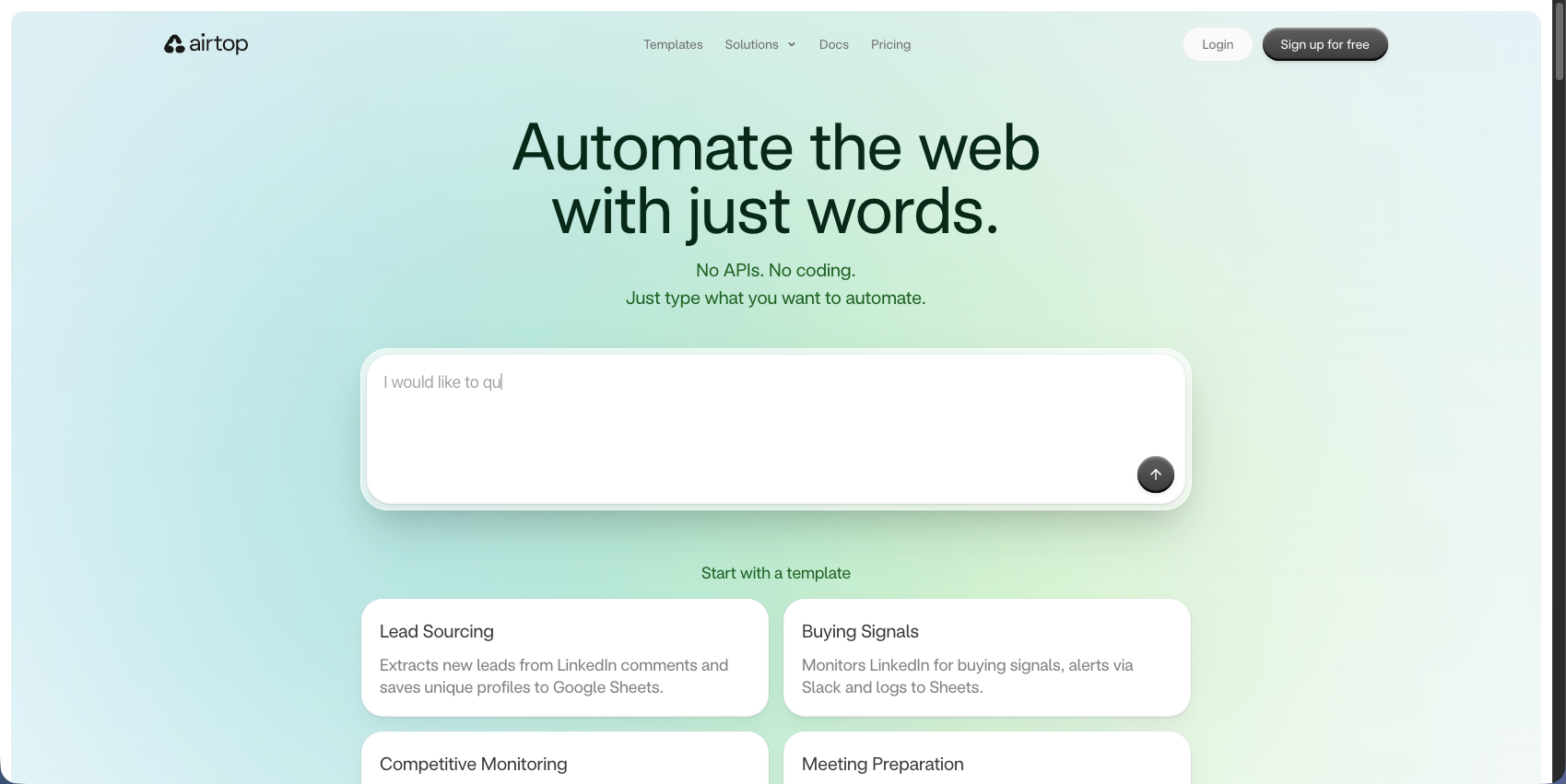
Airtop provides cloud-based browser automation with AI-powered natural language control, targeting developers who want to automate web workflows without writing traditional selector-based scripts. The platform offers managed browser infrastructure combined with APIs that accept natural language commands, positioning itself between pure infrastructure solutions like Hyperbrowser AI and fully AI-native platforms like Skyvern.
The service handles authentication complexity including OAuth, 2FA, and CAPTCHA solving automatically, while providing session persistence across workflow steps. Airtop's Act and Extract APIs let you control browsers using natural language instructions, though the implementation still requires technical expertise to integrate and maintain.
Key Strengths
Airtop includes several features that make it a viable alternative for teams seeking natural language automation:
- Natural language APIs that translate commands into browser actions without writing detailed step-by-step code,
- Built-in authentication handling for OAuth, 2FA, and CAPTCHA bypassing without additional configuration,
- Live View capabilities provide for human-in-the-loop workflows when automation needs manual intervention,
- Session continuity that preserves cookies, local storage, and authentication state across workflow steps,
- Managed infrastructure with scalable cloud browsers that handle anti-bot detection automatically, and
- Developer-friendly SDKs for TypeScript and Python with straightforward API integration.
The Bottom Line
Airtop bridges the gap between infrastructure-only solutions and fully AI-native automation, offering natural language control without the complexity of managing browser infrastructure. However, workflows are confined to proprietary APIs instead of open-source frameworks, and the platform currently supports only TypeScript and Python SDKs. If you need natural language automation with managed infrastructure but want more flexibility and visual interpretation capabilities, Skyvern provides broader framework support and adapts automatically to website changes without API limitations.
Browser Use
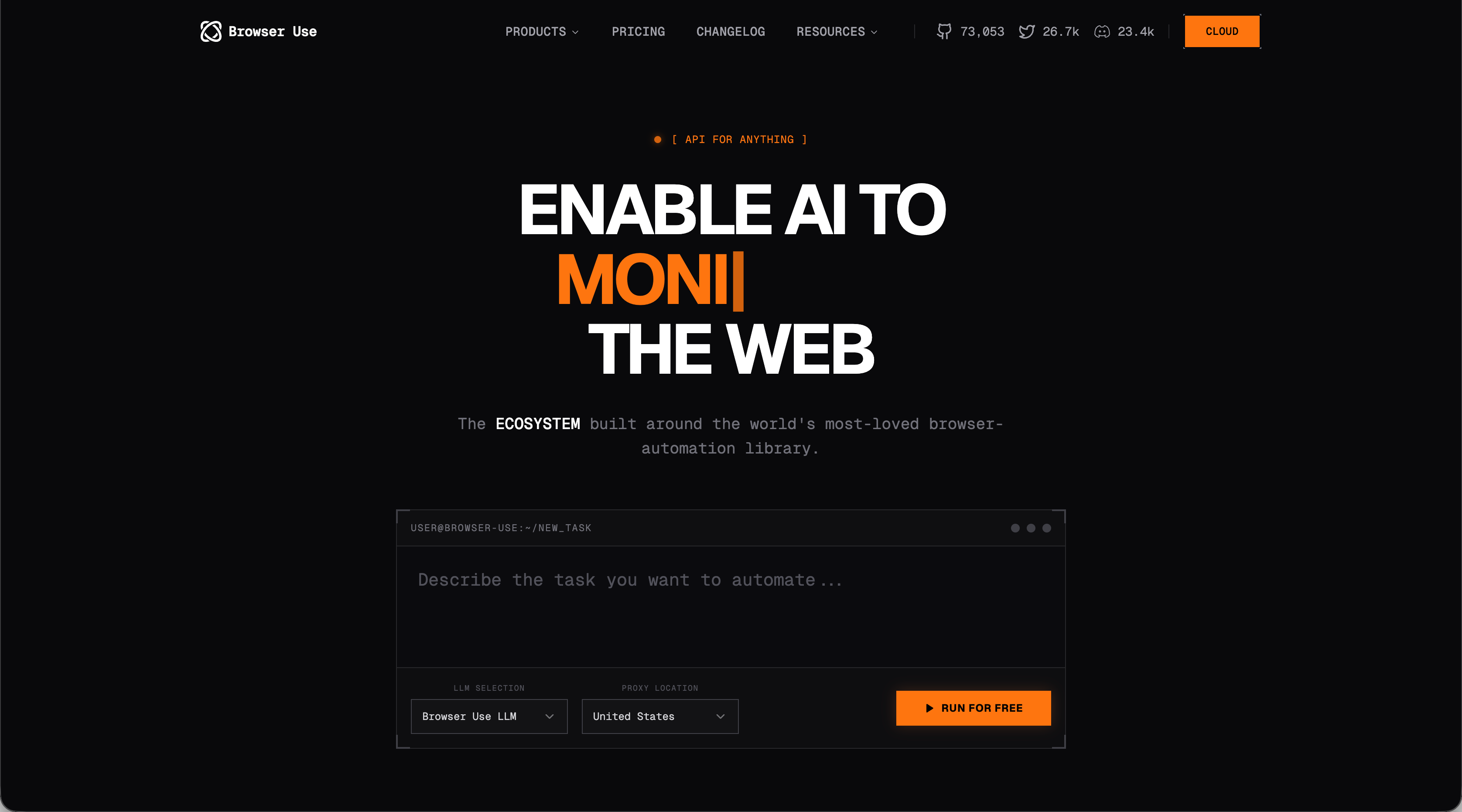
Browser Use is an open-source Python automation library that lets AI agents interact naturally with web pages through LLM-powered interpretation. The framework provides integration with multiple LLM providers including OpenAI, Anthropic, and local models, along with visual recognition capabilities for dynamic page elements. Unlike managed services like Hyperbrowser AI, Browser Use gives you complete control over the automation stack at the cost of managing your own infrastructure.
The library operates as a framework layer that sits between your code and browser automation tools like Playwright. You write workflows using natural language instructions, and Browser Use translates those into browser actions using LLM reasoning. This approach eliminates brittle selectors while maintaining the flexibility of open-source tooling.
Key Strengths
Browser Use includes several features that make it a viable alternative for teams with technical resources:
- Open-source flexibility with no vendor lock-in or usage-based pricing beyond LLM API costs,
- Multi-LLM support allowing you to choose between OpenAI, Anthropic, Azure, or local models based on cost and performance needs,
- Visual element recognition that identifies page elements through AI interpretation instead of fixed selectors,
- Natural language workflow definition that lets you describe automation tasks without writing detailed step-by-step code,
- Python-native implementation with straightforward integration into existing Python automation pipelines, and
- Community-driven development with active contributions and transparent roadmap.
The Bottom Line
Browser Use provides the AI-powered automation capabilities that infrastructure-only solutions like Hyperbrowser AI lack, but requires a lot of technical expertise to set up and maintain. You need to build and manage your own infrastructure layer for production deployments, handle LLM API management, and debug issues without managed service support. If you have the engineering resources and want complete control over your automation stack, Browser Use delivers. If you need production-ready infrastructure with AI capabilities out of the box, Skyvern combines both in a managed solution with transparent pricing and enterprise support.
Stagehand
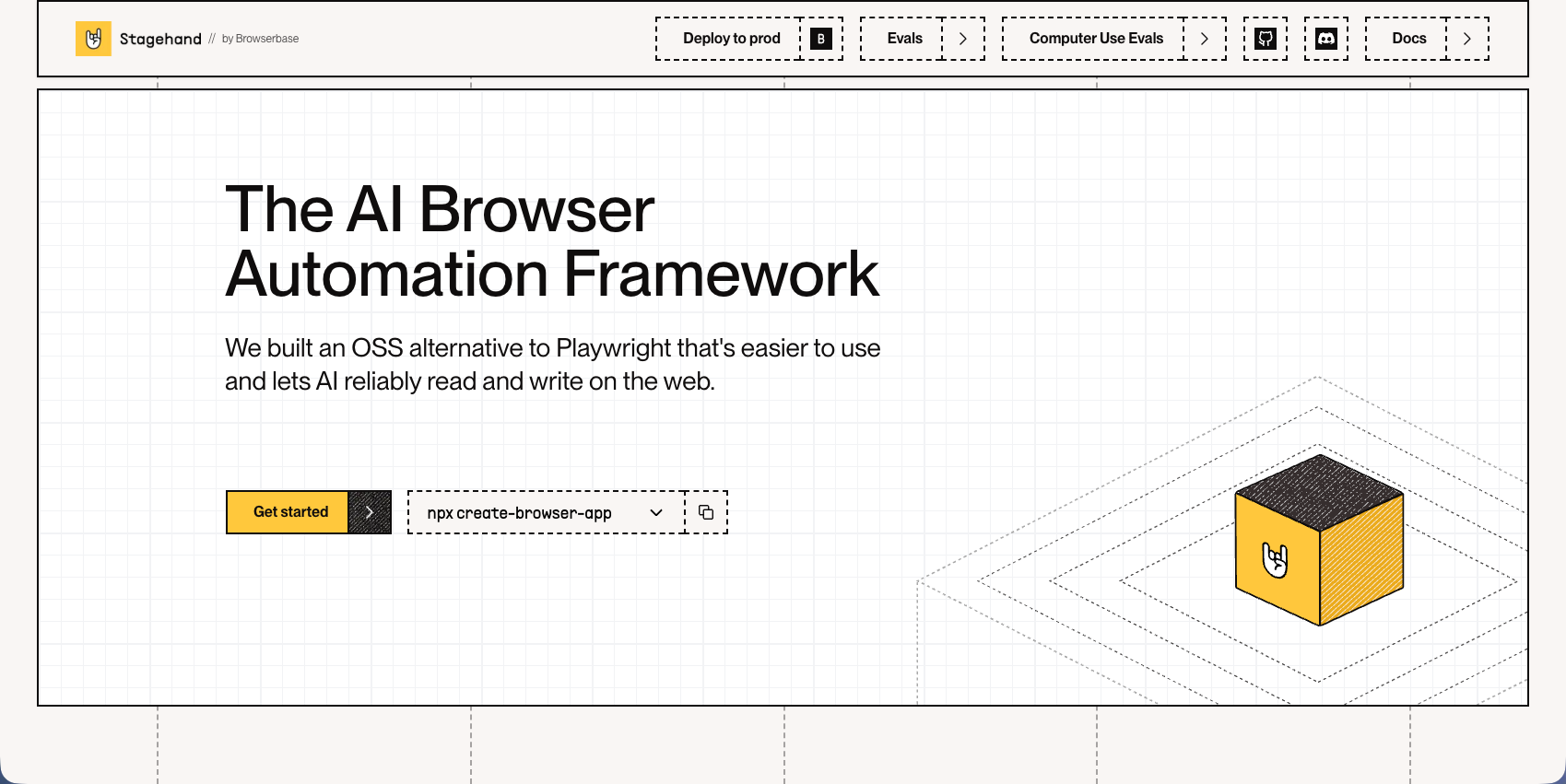
Stagehand is an open-source TypeScript framework that combines traditional automation capabilities with AI-powered natural language control, allowing developers to automate complex web workflows without writing brittle selector-based code. The framework integrates with Browserbase for managed browser infrastructure while providing AI-driven element detection and natural language command interpretation. Unlike pure infrastructure solutions like Hyperbrowser AI, Stagehand adds an intelligent automation layer, though it still requires developers to manage workflow orchestration and infrastructure integration.
The framework operates as a middleware layer between your code and browser automation, translating natural language instructions into browser actions using LLM reasoning. Stagehand handles element identification through AI instead of fixed XPaths, reducing maintenance overhead when websites change. However, it requires Browserbase for production deployments and doesn't provide end-to-end workflow management out of the box.
Key Strengths
Stagehand includes several features that make it a viable alternative for TypeScript-focused teams:
- Natural language automation that translates commands into browser actions without writing detailed selector-based code,
- AI-powered element detection that identifies page elements through intelligent interpretation instead of brittle XPaths,
- Open-source flexibility with no vendor lock-in and transparent codebase for customization,
- TypeScript-native implementation with type safety and integration into existing TypeScript projects,
- Browserbase integration providing managed infrastructure without building your own browser environment, and
- Active development community with regular updates and responsive maintainers.
The Bottom Line
Stagehand bridges traditional automation frameworks and AI-powered solutions, offering intelligent element detection without the complexity of pure infrastructure management. However, it requires Browserbase for production infrastructure, limits you to TypeScript, and still needs custom workflow orchestration for complex multi-step automations. If you're building TypeScript applications and want AI capabilities with framework flexibility, Stagehand delivers. If you need complete end-to-end automation with visual interpretation, multi-language support, and managed infrastructure in one solution, Skyvern provides production-ready capabilities without requiring separate infrastructure services or custom orchestration code.
Feature Comparison: Hyperbrowser AI vs Top Alternatives
Feature | Hyperbrowser AI | Skyvern | Browserbase | Airtop | Browser Use | Stagehand |
|---|---|---|---|---|---|---|
AI-Powered Automation | Partial | ✓ | ✗ | ✓ | ✓ | ✓ |
Visual Page Interpretation | ✗ | ✓ | ✗ | Partial | ✓ | Partial |
Adapts to Layout Changes | ✗ | ✓ | ✗ | Partial | Partial | Partial |
Managed Infrastructure | ✓ | ✓ | ✓ | ✓ | ✗ | Requires Browserbase |
Multi-Site Workflows | Requires coding | ✓ | Requires coding | ✓ | Requires coding | Partial |
CAPTCHA Solving | ✓ | ✓ | ✓ | ✓ | Requires setup | ✓ |
2FA/TOTP Support | ✓ | ✓ + Bitwarden | Partial | ✓ | Requires setup | Partial |
Proxy Network | ✓ | ✓ | ✓ | ✓ | Requires setup | ✓ |
Open Source Option | ✗ | ✓ | ✗ | ✗ | ✓ | ✓ |
Natural Language Control | Partial | Via API | ✗ | ✓ | Requires LLM | ✓ |
Pricing Model | Credit-based | Transparent tiers | Fixed monthly | Credit-based | Free + LLM costs | Free + infra costs |
Why Skyvern is the Best Hyperbrowser AI Alternative
Skyvern tackles the maintenance overhead that Hyperbrowser AI doesn't solve. As an Agentic Process Automation (APA) platform, Skyvern treats browser automation as one execution layer in a broader workflow, more than a collection of scripts to maintain. While Hyperbrowser provides cloud-based browser infrastructure with stealth capabilities, you still write selectors that break when websites change.
Skyvern uses computer vision and LLM interpretation to read web pages visually. Instead of relying on XPaths, it understands content and context. When a site redesigns its checkout flow, Skyvern adapts automatically while traditional scripts fail.
The code-first workflow architecture takes this further. After a successful run, Skyvern compiles the workflow into deterministic Playwright code. Subsequent runs use that code, cutting token consumption by approximately 90% on compiled paths. When a page changes and the compiled code can no longer handle it, the system falls back to AI reasoning automatically and regenerates the code, so no manual fix is required.
Write one Skyvern workflow and apply it across hundreds of vendor portals without modification. The same workflow that runs on one state tax portal runs on all 50 states, with no per-portal configuration and no script rewrites, and the same applies across 3,000+ government and county databases for regulatory monitoring, healthcare credentialing, payroll registration, and utility management. The MCP server ships to all customers by default, so AI assistants and developer tools connect directly to browser automation without extra setup. You get transparent pricing, anti-bot detection, parallel execution, and deployment flexibility through both managed cloud and open source options.
Final thoughts on browser automation alternatives
The best Hyperbrowser AI alternative depends on whether you want to write custom scripts for every site or build workflows that adapt automatically. Skyvern combines visual interpretation with managed infrastructure, so you get both intelligence and reliability. Try the open-source version to see how it handles your specific automation needs.
FAQ
What's the main reason teams switch away from Hyperbrowser AI?
Teams typically switch when they need automation that adapts to website changes automatically instead of breaking when layouts shift. Hyperbrowser AI provides browser infrastructure, but you still write custom scripts for each site that require ongoing developer maintenance.
When should you consider moving from infrastructure-only solutions to AI-powered automation?
Consider switching if you're automating across multiple unfamiliar websites without dedicated developers, or if you're spending a lot of time maintaining scripts that break with site updates. AI-powered solutions like Skyvern eliminate selector maintenance by interpreting pages visually.
What features should you look for when comparing browser automation alternatives?
Look for visual page interpretation that adapts to layout changes, multi-site workflow support without custom coding per site, managed infrastructure with anti-bot detection, and transparent pricing models. The best solutions combine intelligent automation with production-ready reliability.
Can you use Skyvern without managing your own infrastructure?
Yes. Skyvern offers both a managed cloud version with built-in anti-bot detection and parallel execution, plus an open-source option if you prefer self-hosting. The managed version handles all infrastructure concerns while you focus on defining workflows.
How does credit-based pricing compare to transparent tier pricing for automation tools?
Credit-based models make cost forecasting difficult since you need to estimate usage accurately upfront, which gets tricky with variable workloads. Transparent tier pricing gives you predictable monthly costs based on your team size and usage level without surprise charges.
Keep reading
Top 5 UiPath Alternatives Compared in 2026
Compare five UiPath alternatives for browser and desktop workflows, including their strengths, trade-offs, pricing, and migration effort.
Browser Use vs Browserbase: my honest comparison
Browserbase and Browser Use can both automate work in a browser, from collecting product data to filling out forms. Choosing between them comes down to what you want to build: a task you hand to an AI agent, a custom agent inside your application, or browser infrastructure for scripts you already run. I’m Skyvern’s co-founder and CEO by the way. We build a competing product, so I have a stake in this comparison. But I promise I won't promote our product (even though it's a great alternative to
6 Stagehand alternatives for browser automation in 2026
If you're looking for Stagehand alternatives, you probably want an AI browser agent that: * Works natively with Python scripts. * Can navigate and scrape complex websites efficiently. * Stays reliable as your workload grows from a few runs to thousands of browser jobs. That's the kind of workflow I built Skyvern for (Skyvern CEO here). I know, I know, Skyvern CEO's recommending Skyvern as a good alternative. Please just stay with me for a second here. Yes, Skyvern is a good Stagehand alt
Put the browser to work
Use Skyvern for the work that lives in a browser.
Turn repetitive browser tasks into reliable workflows with Skyvern.